

K-WANG


ABB AFS series switches
ABB AFS series switches
Product Overview
Core positioning: A fully managed modular Ethernet switch designed specifically for the power industry (substations, distribution networks, and in plant communication), focusing on core requirements such as high reliability, electromagnetic interference resistance, and wide temperature operation in power scenarios, supporting the expansion of smart grid applications (such as renewable energy integration and distribution automation).
Product series division:
|Model series | Installation method | Core configuration differences | Number of ports | Power consumption range | Special functions|
|AFS650/655 | DIN rail (optional wall mounted) | Compact design, supports multi-mode/single-mode optical ports | Up to 10 (including 3 GbE ports) | 12-21 W | Redundant power supply (18-60VDC/48-320VDC/90-265VAC)|
|AFS670/675 | 19 inch rack | Modular design, 12 slots (2 ports/module) | Up to 28 slots (electrical/optical/SFP cage) | 10-40 W (no PoE) | Supports PoE (power type H/Z), redundant power supply (18-60VDC/77-300VDC/90-265VAC)|
|AFS677/AFR677 | 19 inch rack | Fixed port design | 16 GbE combo ports (RJ45/SFP) | 10-40 W (no PoE) | AFR677 supports L3 routing (RIPv1/v2, OSPFv2, VRRP)|
Key compliance and technical parameters
Certification and anti-interference standards:
|Standard Category | Core Standard Content|
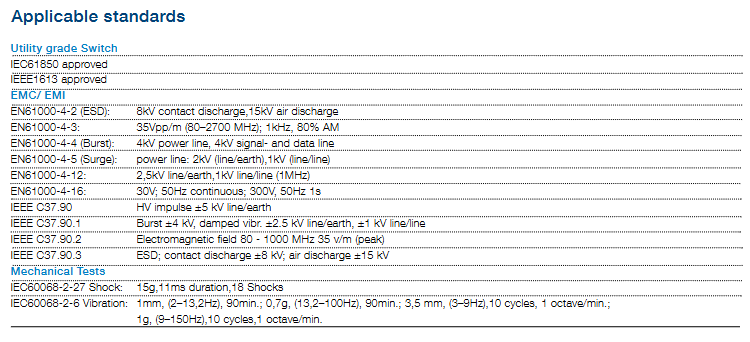
|Industry certification | IEC61850 approval, IEEE1613 approval|
|Electromagnetic compatibility (EMC/EMI) | EN61000-4-2: 8kV contact discharge, 15kV air discharge; EN61000-4-3:35Vpp/m(80-2700MHz); IEEE C37.90.3: ± 8kV contact discharge, ± 15kV air discharge|
|Mechanical testing | IEC60068-2-27: 15g impact (11ms, 18 times); IEC60068-2-6: Vibration Test (2-13.2Hz/1mm/90min, etc.)|
|Network standards | IEEE802.1d/p/Qx/AB, IEEE802.3 series, IEEE1588 (PTP), etc|
Core technical parameters:
Working temperature: Standard 0-60 ℃, optional -40 ℃ to 85 ℃ (continuous operation)
Switching characteristics: Store and forward mode, typical switching delay of 2.7 μ s (100Mbit/s), MAC address table capacity of 8000 entries
Network function: 4042 VLANs (supporting 255 at the same time), 4 priority queues, supporting port rate limitation (kbps step), link aggregation IGMP snooping
Protection mechanism: Supports RSTP (IEEE802.1D), MRP (IEC62439), E-MRP, and fast switching of ring topology
Power specifications: AFS650/655 supports 18-60VDC (low voltage), 48-320VDC/90-265VAC (high voltage); The AFS670 series supports 18-60VDC (low voltage), 77-300VDC/90-265VAC (high voltage), all of which support redundant power supplies
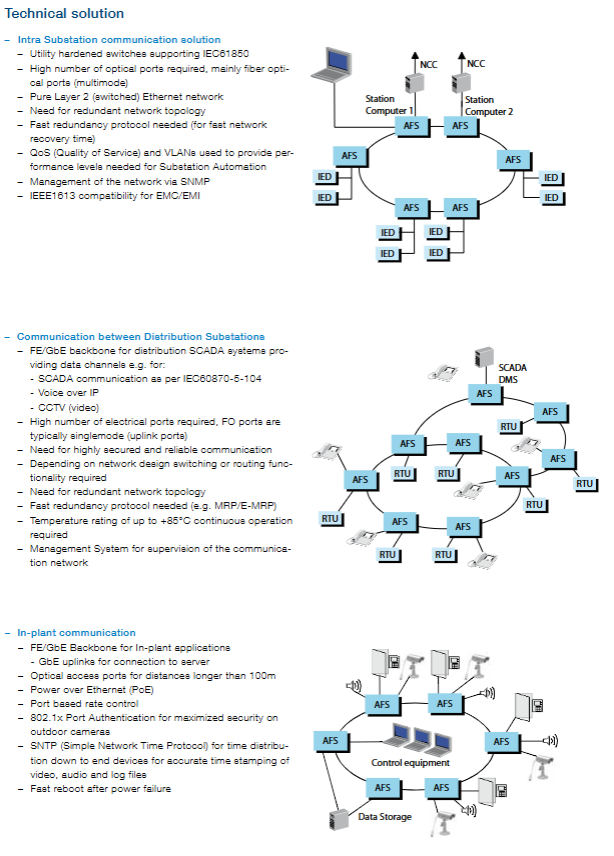
Three core application scenarios and solutions
Application scenario core requirement solution configuration
Substation automation low latency, high availability, IEC61850 compatibility, anti electromagnetic interference pure L2 switching network, redundant topology, multi-mode optical ports as the main, QoS/VLAN enabled, SNMP management supported, GOOSE message and sampling value transmission supported
Long distance transmission of power distribution communication, reliable transmission of SCADA data, multi service carrying FE/GbE backbone network, single-mode optical port (uplink), supporting IEC60870-5-104 protocol, redundant topology+MRP/E-MRP, compatible with VoIP and renewable energy data transmission
In plant communication with high bandwidth (CCTV), equipment power supply, time synchronization, high security GbE upstream connection server, PoE power supply (camera), 802.1x port authentication, SNTP time synchronization, port rate control, supporting CCTV, access control, and public address system communication
Security and management features
Security features: IEEE802.1x port authentication, SSH encryption, Radius centralized password management, multi-level user passwords, port disabling, SNMPv3 encryption authentication, VLAN isolation (IEEE802.1Q)
Management methods: SNMP V1/V2/V3, command-line interface (Telnet), web interface, port mirroring, RMON remote monitoring, LLDP topology auto discovery, SFP diagnosis, configuration recovery adapter (CRA), watchdog and rollback function
Alarm mechanism: Diagnostic LED indicator light, 2 sets of alarm contacts, local logs and Syslog reports
Customer Core Value
Power level adaptation: high EMC/EMI anti-interference ability, wide temperature working range, redundant power supply, suitable for harsh environments in substations
High availability: fanless design, high MTBF, fast switching of link failures, ensuring uninterrupted critical business operations
Flexible Expansion: Port density can be expanded (8-28), supporting FE/GbE, PoE, L3 routing (AFR677), and adapting to different scale requirements
Integrated solution: integrated into ABB's power communication ecosystem, supporting multi business integration such as SCADA, IEC61850, voice, etc
Key issues
Question 1: What are the specific power level characteristics of ABB AFS series switches reflected in? Why can it adapt to the harsh environment of substations?
Answer: The power level characteristics are mainly reflected in three aspects: ① Environmental adaptation: supporting standard working temperature of 0-60 ℃, optional wide temperature range of -40 ℃ to 85 ℃, fanless design+optional normal coating, and can withstand extreme temperatures; ② Anti interference capability: certified by IEEE1613, compliant with EN61000-4 series (ESD 8kV contact/15kV air discharge, surge 2kV line to ground) and IEEE C37.90 series standards, resistant to strong electromagnetic interference; ③ Reliability design: Supports redundant power supply (AC/DC wide voltage input, such as AFS650 supporting 48-320VDC), fast protection mechanism (MRP/E-MRP, ring topology fast switching), high MTBF guarantee, avoiding single point failure. These characteristics enable it to directly adapt to harsh environments such as severe electromagnetic pollution, large temperature fluctuations, and high requirements for continuity in substations.
Question 2: What are the core differences between different models of ABB AFS series? How to choose the appropriate model based on the application scenario?
Answer: The core differences are concentrated in three dimensions: installation method, port configuration, and functional expansion. The selection logic is as follows:
Model Series Core Differences Adaptation Scenarios
AFS650/655 DIN rail installation, up to 10 ports, no L3 routing for small substations, distribution terminals, and distributed equipment communication within the factory (limited space, low port requirements)
AFS670/675 19 inch rack, modular design (up to 28 ports), supporting PoE for large-scale substation automation, requiring high port density distribution communication backbone network (multi device access, requiring PoE power supply for cameras/terminals)
AFS677/AFR677 19 inch rack, 16 GbE combo ports, AFR677 supports L3 routing (RIPv1/v2, OSPFv2) for cross regional power distribution communication and complex networks requiring routing functionality (multi subnet interconnection, backbone network hierarchical architecture)
Question 3: What are the key technical measures for ABB AFS series switches to ensure the reliability of critical business in the power industry, such as IEC61850 data transmission?
Answer: Key technical measures include: ① Fast protection mechanism: supporting MRP (Media Redundancy Protocol), E-MRP, and RSTP, which can achieve fast switching in case of link failure in ring topology, reducing the interruption time of IEC61850 GOOSE message and sampling value transmission; ② Network isolation and priority: Supports 4042 VLANs (255 at the same time) and 4 priority queues, isolates different services through IEEE802.1Q VLANs, ensures QoS guarantees priority transmission of IEC61850 critical data, and avoids bandwidth preemption; ③ Hardware redundancy: supports redundant power input to avoid equipment shutdown caused by power failure; ④ Management and monitoring: Real time monitoring of network status through SNMP V3, RMON, LLDP topology discovery, combined with alarm contacts and Syslog reports, to quickly locate faults; ⑤ Protocol compatibility: Native support for IEC61850 protocol ensures seamless integration with intelligent electronic devices (IEDs), reducing latency and fault risks caused by protocol conversion
- YOKOGAWA
- Reliance
- ADVANCED
- SEW
- ProSoft
- WATLOW
- Kongsberg
- FANUC
- VSD
- DCS
- PLC
- man-machine
- Covid-19
- Energy and Gender
- Energy Access
- Renewable Integration
- Energy Subsidies
- Energy and Water
- Net zero emission
- Energy Security
- Critical Minerals
- A-B
- petroleum
- Mine scale
- Sewage treatment
- cement
- architecture
- Industrial information
- New energy
- Automobile market
- electricity
- Construction site
- HIMA
- ABB
- Rockwell
- Schneider Modicon
- Siemens
- xYCOM
- Yaskawa
- Woodward
- BOSCH Rexroth
- MOOG
- General Electric
- American NI
- Rolls-Royce
- CTI
- Honeywell
- EMERSON
- MAN
- GE
- TRICONEX
- Control Wave
- ALSTOM
- AMAT
- STUDER
- KONGSBERG
- MOTOROLA
- DANAHER MOTION
- Bentley
- Galil
- EATON
- MOLEX
- Triconex
- DEIF
- B&W
- ZYGO
- Aerotech
- DANFOSS
- KOLLMORGEN
- Beijer
- Endress+Hauser
- schneider
- Foxboro
- KB
- REXROTH
- YAMAHA
- Johnson
- Westinghouse
- WAGO
- TOSHIBA
- TEKTRONIX
- BENDER
- BMCM
- SMC
- HITACHI
- HIRSCHMANN
- XP POWER
- Baldor
- Meggitt
- SHINKAWA
- Other Brands
- UniOP
- KUKA
- IBA
- Beckhoff
- ADLINK
-
ABB 3BHE039724R2643 PPD513 AC 800PEC High-Speed Controller for Power Electronic and Excitation Control Systems
-
SHINKAWA FRP 360A - BOARD
-
SHINKAWA IBP-43AM - PCB Board
-
SHINKAWA IBP-42-M - PCB Board
-
SHINKAWA DSP-11C - PCB Board
-
SHINKAWA FRP-341E - BOARD
-
SHINKAWA CPP-111 - PCB Board
-
SHINKAWA FRP-342A - BOARD
-
SHINKAWA FRP-341D - BOARD
-
SHINKAWA MDP-X MDP-135 - PCB Board
-
SHINKAWA MGP-57 - BOARD
-
SHINKAWA FRP-226A - PCB Board
-
SHINKAWA MDP-141 - PCB Board
-
SHINKAWA IOP-188 - BOARD
-
SHINKAWA FRP-341C - BOARD
-
SHINKAWA MDP-90 - PCB Board
-
SHINKAWA CPP-107A - PCB Board
-
SHINKAWA FRP-227A - PCB Board
-
SHINKAWA FRP-249A - PCB Board
-
SHINKAWA MDP-74 - PCB Board
-
SHINKAWA FRP-270 FRP-268 - PCB Board
-
SHINKAWA FRP-386 - PCB Board
-
SHINKAWA ZUP-02C - BOARD
-
SHINKAWA MDP-136A - PCB Board
-
SHINKAWA FRP-259 - PCB Board
-
SHINKAWA JBP-470 - BOARD
-
SHINKAWA MDP-82 - BOARD
-
SHINKAWA FCP-07A - PCB Board
-
SHINKAWA DSP-09A - PCB Board
-
SHINKAWA IOP-178 - PCB Board
-
Nemic-Lambda / Shinkawa VS15C-15 CCB010A UTC-1000 - Power Supply Board
-
SHINKAWA IOP-176A - PCB Board
-
SHINKAWA VM-5C SST-2194-001-P001G - ECCENTRICITY MONITOR
-
SHINKAWA VM-5K SST-2194-001-P001G - VIBRATION MONITOR
-
THK / Shinkawa SRS9M UTC-1000 - Linear Block w/ Rail 26cm
-
Shinkawa JBP-316 P-26-73B-1 P-26-73A-1 UTC-1000 - Board
-
SHINKAWA IOP-215 - BOARD
-
SHINKAWA JBP-268 - PCB Board
-
SHINKAWA ZUP-08 - PCB Board
-
SHINKAWA BCP-05A - BOARD
-
SHINKAWA DSP-15 - PCB Board
-
SHINKAWA FRP-289 - PCB Board
-
SHINKAWA FCP-01 - BOARD
-
SHINKAWA MDP-84 - BOARD
-
SHINKAWA CMU-13A - CAMERA MOTION CONTROLLER
-
SHINKAWA BCP-05D - PCB Board
-
SHINKAWA MDP-FF MDP-87 - Stage Control Board
-
SHINKAWA FRP-342 - BOARD
-
SHINKAWA BCP-05C - BOARD
-
Shinkawa CMU-26A - Camera Control unit
-
SHINKAWA PSP-30 - Welding Machine Control Board
-
SHINKAWA EFU-24 - Spark Generator
-
Shinkawa CMU-27A - Camera Control unit
-
SHINKAWA CMU-44 - Camera Control Unit
-
THK / Shinkawa SRS9M UTC-1000 - Linear Block w/ Rail 21cm
-
TDK-Lambda / Shinkawa VS100B-24 VS100B24 UTC-1000 - Power Supply Board
-
SHINKAWA CMU-34 - Camera Control Unit
-
SHINKAWA FDP-06A - PCB Board
-
SHINKAWA BCP-06A - BOARD
-
SHINKAWA CMU-13A - Camera Control Unit
-
SHINKAWA CMU-31A - Camera Control Unit
-
SHINKAWA VM-5Y1-02/GEM 1594-005-P001G - ECCENTRICITY MONITOR
-
Shinkawa JBP-331 P-26-101B P-26-101A P26101A UTC-1000 - Board
-
SHINKAWA CMU-26 - Camera Control Unit
-
Shinkawa ACB-3000 ACB3000 - Industrial-Grade Automated Friction Bonder
-
Shinkawa SBB-1100 SBB1100 - Stud Bump Bonder Machine
-
Shinkawa ACB-1000 ACB1000 - Super Automated Wire Bonder Machine
-
CKD / Shinkawa FCS500-H6H6 FCS500H6H6 UTC-1000 - Precision Air Source Filter
-
SHINKAWA VM-5H3 1596-001-P002B VM-5Z1 3595-001-P003C - Power Supply Monitor Rack
-
SHINKAWA VM-5H3 2194-001-F004B - Dual Vibration Dual Thrust Monitor Rack
-
Shinkawa EFU-10 - Wire Bonder Spark Generator EFO Box
-
SHINKAWA MP-2S - Overspeed Unit Instruction
-
Shinkawa PK-167B-3 PK-167A-3 10P-10 - PCB Board
-
SHINKAWA VM-3D VM-3E VL VM-3D2 - Vibration Sensor Mit Verlangerungskabel
-
shinkawa FKP-452F2-3 - Sensor
-
shinkawa UTC-1000 ZUP-02B - PCB BOARD
-
SHINKAWA VM-3D VM-3E VL VM-3D2 - VIBRATION SENSOR WITH EXTENSION CABLE
-
Shinkawa E194236-0003 AWM 2464 UTC-1000 - Cable 6&4 Pins Female-Female
-
TDK-Lambda / Shinkawa VS100B-15 VS100B15 UTC-1000 - Power Supply Board
-
Shinkawa FK-202F2-2-1 - Electric Vortex Sensor
-
Marubeni Shinkawa S038493 - Rotary Encoder
-
Shinkawa E194236-0003 AWM 2586 UTC-1000 - Cable 10 & 8 Pins Male-Female
-
National / Shinkawa CAT5E NR3160 UTC-1000 - Ethernet Receptacle Connector Cable
-
Shinkawa LLS2902 E69157 UTC-1000 - Cable 3 Pins Male-Female
-
Shinkawa AWG16 600V UTC-1000 - 5 Pins Cable Female-Female
-
SHINKAWA WK-142K2-2 - Vibration sensors
-
Shinkawa DA-C8-J10 DAC8J10 UTC-1000 - Connector Cable
-
Shinkawa P-27-67B P2767B P-27-67A P2767A UTC-1000 - Circuit Board
-
Taiyo / Shinkawa E67647-WH E67647WH UTC-1000 - Computer Power Cable
-
Shinkawa E66085-H 20276 UTC-1000 - Connector Cable 15 Pins Male-Male
-
Shinkawa P-28-49B JBP-380C P-28-49A BEJ240619A UTC-1000 - Board w/
-
Shinkawa WKN-142K2-2 - 2-Wire vibration transmitter
-
SHINKAWA VM-741 VM-741B - MONITORING SYSTEM
-
Shinkawa FL-202F08R-U2-02-12-10 - Extension probe
-
Shinkawa FK-202F-1-3 FK-202F-2-3 - module
-
Shinkawa CMU-13A CMU13A - Camera Motion Control Unit Cut Cable
-
SHINKAWA VM-5J - DUAL DIFFERENTIAL EXPANSION MONITOR
-
Ebrain / Shinkawa 650-VME08IS-S N6071085 UTC-1000 - Backplane Panel Board
-
Yaskawa Electric / SHINKAWA UGQMEM-06-SW12 MD-11 - Minertia Motor w/ 30 day warranty
-
Shinkawa FL-202F08R-U2-02-12-10 - Extension probe
-
Shinkawa WT-650-16 SP-256A UTC-1000 - Power Source Power Supply AC100V 50/60Hz
-
Yaskawa / Shinkawa UGRMEM-01SSW11 UGRMEM01SSW11 MD-06 - Minertia Motor
-
SHINKAWA FK-452F1 - sensor
-
Shinkawa MS-313 - RPS positioning system
-
Shinkawa Sec M / Rn-ac109-2a - Beschleunigungsmesser
-
Shinkawa PFD80SX UTC-1000 - Power Source Power Supply 80V 1.6A AC100-230V
-
SHINKAWA VL-202A08L-1A72 - Probe extension cable
-
Shinkawa SDP-FA-4.1 - Instruction Manual
-
SHINKAWA VM-5L G0-2 GC6D1377 - Module
-
Shinkawa FRP-184A FRP-111 P-22-17A - Circuit Board
-
Shinkawa CRP-06 PK-189A-3 PK-189B-3 - PCB Board
-
Shinkawa WK-142K2-1 - Vibration Transmitter
-
SHINKAWA VM-5 SST-2194-001-P001G - MAIN BOARD DUAL VIBRATION MONITOR MAIN BOARD
-
Shinkawa SDP-FA-TAPE - Full Automatic Die Bonder Instruction Manual
-
Sanritz Automation / Shinkawa SC2125-0 C12ABP3 SC2125-0-P1 UTC-1000 - Board
-
Shinkawa SDP-FA-4.1 - Die Pickup Unit Instruction Manual
-
Shinkawa E194236-0003 AWM 2464 UTC-1000 - Cable 20 Pins Female-Female
-
IHI / SHINKAWA CQ71SEN004 WK-142K3-3 - 2-wire Transmitter
-
SHINKAWA FK-452F1 - sensor
-
Shinkawa D461256 - Pin Vertical Motion Cam
-
SHINKAWA SE02111-05 STB-FA-IL-7 - Full Automatic Inner Lead Bonder Specifications
-
Shinkawa PSP-25A P-26-58A-3 P2658A3 UTC-1000 - Circuit Controller Board
-
Shinkawa WKN-142K5-2 - Vibration Transmitter
-
Euresys / Shinkawa DAC-422S-A3 DAC422SA3 UTC-1000 - Alpha cPCI Board
-
Shinkawa IL-188-5373-23 IL188537323 - Spare Part
-
Shinkawa FK-202F1-3-1 - Vibration sensor
-
Shinkawa VL-202A08L-1018/BEN - Capteur De Proximite Avec Cable De 9 Metres
-
Shinkawa FK-202F-2-3 - Vibration Transmitter

K-JIANG

Add: Jimei North Road, Jimei District, Xiamen, Fujian, China
Tell:+86-15305925923