

K-WANG


OMRON FQM1 Motion Controller Instruction System
OMRON FQM1 Motion Controller Instruction System
The OMRON FQM1 series flexible motion controller, as a core component in the field of industrial automation, provides a solid foundation for modern FA (factory automation) systems with its powerful instruction set and flexible system architecture. This article is based on the instruction reference manual of the FQM1 series (covering FQM-1-CM002, FQM1-MMP22, and FQM1-MMA22 models), and deeply analyzes its technical specifications, safety guidelines, version evolution, and programming instruction details, aiming to provide a detailed professional technical guide for electrical engineers and system designers.
System Overview and Security Standards
The FQM1 series controller consists of a coordination module and a motion control module, designed to meet complex motion control and logic control requirements. As a professional industrial equipment, its operation and maintenance are strictly limited to professionals with electrical engineering knowledge. The manual clearly defines safety risks through three levels: "DANGER", "Warning", and "Caution".
At the operational level, the manual emphasizes several crucial safety principles:
Electric shock protection: It is strictly prohibited to disassemble modules or touch terminals while powered on, as this may cause serious electric shock injuries.
External safety circuit: Given that the controller may experience output abnormalities (such as output locking in ON or OFF state) due to hardware failures or self diagnostic errors, the system design must include external physical safety circuits (such as emergency stop circuits, interlock circuits) to ensure safe shutdown of the system in the event of controller failure.
Grounding requirements: During installation, a grounding resistor of less than 100 Ω must be connected, especially when the functional grounding of the power unit is short circuited to the grounding terminal of the line. Good grounding must be ensured to prevent electric shock or interference.
In addition, the manual also provides detailed environmental precautions for operation, prohibiting operation in direct sunlight, condensation, corrosive gases, or strong electromagnetic fields. It emphasizes the use of crimping terminals during wiring to avoid direct connection of exposed stranded wires and prevent short circuits or fire risks.
Unit version and functional evolution
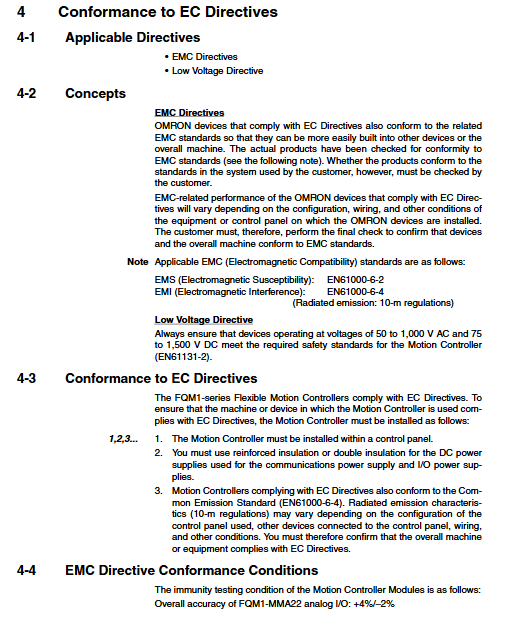
The FQM1 series controllers undergo iteration and hardware upgrades through the "unit version" management function. The version number is usually marked to the right of the batch number on the module nameplate. From version 2.0 to 3.3, the controller has undergone significant feature enhancements:
Version 3.1: The main improvement lies in obtaining UL certification, which requires the configuration of specific relay units and connecting cables to comply with safety standards.
Version 3.2: Introduced multiple key features. In electronic cam mode, PULS (886) command supports pulse output zero crossing (CW/CCW direction) and can automatically calculate the pulse output frequency. In addition, a cyclic refresh zone has been added for data exchange between modules, and support for CJ series units has been expanded, such as analog output units (CJ1W-DA08V, etc.) and position control units. In the system settings, the output range of the 20MHz clock frequency can be extended to 1 Hz to 1 MHz, greatly improving the low-frequency control accuracy.
Version 3.3: The focus has been on enhancing compatibility with servo motors, starting to support OMNUC G-series absolute encoders, and further expanding the mounting capability of CJ series special I/O units, including analog input/output units and hybrid modules.
These version differences require engineers to verify module versions when designing systems to ensure that software instructions match hardware functionality.
Fundamentals of Programming and Data Structures
The program capacity of FQM1 varies depending on the module type, and the coordination module (CM002) has 10K steps. Programming adopts ladder logic, and instruction execution involves bit processing and word processing. Understanding data formats and addressing methods is a prerequisite for efficient programming.
1. Data format
FQM1 supports multiple data formats, including unsigned binary, signed binary, BCD code, and floating-point numbers. Floating point numbers follow the IEEE754 standard, support single precision and double precision operations, and are widely used in high-precision mathematical operation instructions. Binary negative numbers are represented using complement codes, which is crucial for understanding the results of arithmetic operations.
2. operands and addressing
Instructions typically include source operands, target operands, and control operands.
Bit address: Specify the word address and bit number (such as 0001.02).
Indirect addressing: Supports binary mode (@ D) and BCD mode (* D). For example, @ D00300 represents using the content of D00300 as a new address pointer, greatly enhancing the flexibility of the program.
Constant input: Supports decimal (&prefix) and hexadecimal (# prefix), but in timer/counter settings, constant input must conform to the BCD code range.
3. Differential instruction
To capture the edge changes of the signal, FQM1 provides non differential, rising edge differential (@ prefix), and falling edge differential (% prefix) instructions. The rising edge differentiation is only executed once when the execution condition changes from OFF to ON, while the falling edge differentiation is the opposite. This plays a crucial role in handling trigger signals and avoiding duplicate execution.
Detailed Explanation of Core Instruction Set
The instruction set of FQM1 is large and finely classified. The following focuses on analyzing the key instruction categories.
1. Sequential input instructions
This is the cornerstone of ladder diagram programming. LD (load), AND (AND), OR (OR), and their NOT forms form the basis of logical judgment.
Logical block connection: The AND LD and OR LD instructions are used to connect complex logical blocks. The manual states that when using these instructions to connect multiple logical blocks, the number of LOAD instructions must be one more than AND LD/OR LD instructions, otherwise it will cause programming errors.
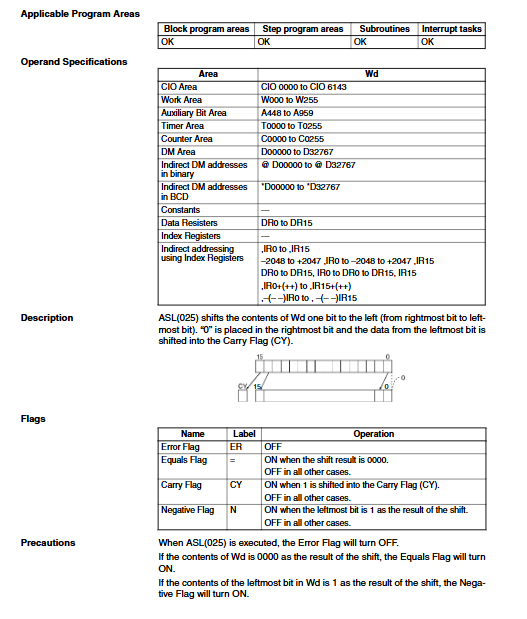
Bit test instructions: TST (350) and TSTN (351) allow testing of specific bit states in specified words like LD/AND/OR, and support DM area operations, solving the limitation of traditional contact instructions that cannot directly read DM areas.
Conditional on-off: The UP (521) and DOWN (522) instructions simplify differential logic and can generate single cycle pulses without occupying working bits, which helps streamline program steps.
2. Sequential output instructions
Output and hold: The OUT instruction directly outputs the state of the execution condition, while the KEEP (011) instruction implements the function of a latch relay. Set when Set input is ON, reset when Reset input is ON. It should be noted that in the interlock program segment, the KEEP instruction can maintain the state, while the ordinary self holding circuit will reset due to the release of the interlock.
Set and Reset: The SET and RSET instructions are independent of execution conditions and only change the bit state when the condition is ON, and remain unchanged when it is OFF. In contrast, the SETB (532), RSTB (533), and OUTB (534) instructions not only operate on the DM location, but also support immediate refreshing of variants (! Prefix), which can directly update physical output terminals and shorten response time.
3. Sequential control instructions
Interlock: IL (002) and ILC (003) must be used in pairs. When the IL condition is OFF, the program segment output between IL and ILC is forcibly reset (OUT becomes OFF, TIM is reset), but the SET/RSET and counter states remain unchanged. This is different from the JMP instruction, as all output states in the program segments skipped by JMP remain unchanged.
Jump: JMP (004)/JME (005) pairs are used to skip program segments. When the JMP condition is OFF, a jump occurs and the skipped instruction is not executed, resulting in a shorter loop time. CJP (510) jumps when the condition is ON, while CJPN (511) is similar to JMP. Note that jump instructions must be paired and within the same task.
Loop: FOR (512)/NEXT (513) forms a loop structure, and the value of N determines the number of loops. The BREAK (514) instruction can be used to forcefully exit a loop. The nested depth of the loop is limited to 15 layers and cannot cross tasks.
4. Timer and counter instructions
FQM1 provides multiple precision timers:
TIM: Standard 100ms countdown timer with an accuracy of -0.01s~0s.
TIMH (015): High speed 10ms countdown timer.
TMHH (540): Ultra high precision 1ms countdown timer, whose current value refreshes every 1ms through interrupts, suitable for microsecond level control requirements.
CNTR (012): Reversible counter with up and down inputs, suitable for scenarios such as position accumulation.
The manual specifically states that in the jump program segment, the timer that is currently counting will continue to count; In the interlock program segment, the timer will be reset. This is because the IL instruction forces a reset of the output state, while JMP only skips execution logic.
5. Data processing and operation instructions
Although the source data in this article does not fully cover all operation instructions, the full picture can be seen from the instruction list.
Comparison instructions: In addition to basic CMP, there are also symbol comparison instructions (such as LD>, AND<=, etc.) as well as table comparison (TCMP) and block comparison (BCMP). The block comparison BCMP (068) can determine whether the source data is within the preset upper and lower limits, greatly simplifying the logic of multi interval judgment.
Data movement: The MOV instruction family supports the transfer of words, bits, and digits. XCHG (073) is used for data exchange, XFER (070) is used for block transfer, and BSET (071) is used for memory filling.
Mathematical operations: Supports BCD code and binary arithmetic operations, including carry processing. Floating point operation instructions (such as+F, * F) comply with the IEEE754 standard, support trigonometric and exponential logarithmic operations, and meet the requirements of complex algorithms.
Logical operations: Instructions such as ANDW, ORW, XORW are used for bitwise logical operations on word data, commonly used for masking or extracting status words.
Advanced features and system maintenance
FQM1 has a comprehensive self diagnostic function. FAL (006) is used for non fatal error alarms, and the system continues to operate; FALS (007) indicates a fatal error and will stop the controller from running. These instructions, in conjunction with the flag bits in the auxiliary area (Area A), provide convenience for troubleshooting.
In terms of data backup mechanism, the user program and some DM areas of the coordination module are backed up through Flash memory, while some DM areas and error logs of the motion control module rely on supercapacitors. At 25 ° C, the capacitor backup time can reach about 100 hours, but as the ambient temperature increases and the lifespan increases, the backup time will be shortened. Therefore, for data recovery after long-term power outages, it is recommended to store key parameters in the DM area address supported by Flash (D20000-D32767).
- YOKOGAWA
- Reliance
- ADVANCED
- SEW
- ProSoft
- WATLOW
- Kongsberg
- FANUC
- VSD
- DCS
- PLC
- man-machine
- Covid-19
- Energy and Gender
- Energy Access
- Renewable Integration
- Energy Subsidies
- Energy and Water
- Net zero emission
- Energy Security
- Critical Minerals
- A-B
- petroleum
- Mine scale
- Sewage treatment
- cement
- architecture
- Industrial information
- New energy
- Automobile market
- electricity
- Construction site
- HIMA
- ABB
- Rockwell
- Schneider Modicon
- Siemens
- xYCOM
- Yaskawa
- Woodward
- BOSCH Rexroth
- MOOG
- General Electric
- American NI
- Rolls-Royce
- CTI
- Honeywell
- EMERSON
- MAN
- GE
- TRICONEX
- Control Wave
- ALSTOM
- AMAT
- STUDER
- KONGSBERG
- MOTOROLA
- DANAHER MOTION
- Bentley
- Galil
- EATON
- MOLEX
- Triconex
- DEIF
- B&W
- ZYGO
- Aerotech
- DANFOSS
- KOLLMORGEN
- Beijer
- Endress+Hauser
- schneider
- Foxboro
- KB
- REXROTH
- YAMAHA
- Johnson
- Westinghouse
- WAGO
- TOSHIBA
- TEKTRONIX
- BENDER
- BMCM
- SMC
- HITACHI
- HIRSCHMANN
- XP POWER
- Baldor
- Meggitt
- SHINKAWA
- Other Brands
- UniOP
- KUKA
- IBA
- Beckhoff
- ADLINK
-
Siemens 6SL3244-0SA01-1AA0 - SINAMICS G120 Control Unit
-
DANFOSS 175Z2688 - COATEDE CONTROLUNIT VLT5000
-
SIEMENS 6FM1721-3AA20 - Positioning Module
-
REXORTH VTS0605 PVAR S21 - Drive Module
-
BECKHOFF 2915-0000 - Control Module
-
COOPER EATON CGLine 400 40071347901 - CEAG CG Controller
-
SIEMENS 3UF5031-3AN00-1 - SIMOCODE DP Basic Unit
-
SIGMATEK DNC305 05-011-305 - Drive Controller
-
Multivac MV1 10249768 - Control Module
-
SCHNEIDER ELECTRIC MES114 59646 & 59645 - Circuit Breaker Accessory
-
CAMILLE BAUER CAPAX 44-580-0012 - Transmitter
-
HENGSTLER VT360P LS1/TOK - Encoder
-
BURKERT 8792 - 24V DC IP65 / IP67 Positioner
-
SENSOPART V10-OB-A1-W6 - Vision Sensor
-
ALLEN-BRADLEY 1762-L40BXB SER.C REV.J - MicroLogix 1200 Controller
-
HITACHI CPU22-02HC 33025801-2 - CPU Module
-
HITACHI AGH-0 33034810-2 - Control Board
-
PHILIPS AIH110 VER 1.0 - Control Module
-
BAUMULLER DO8000 - Drive Controller
-
B&R PS477 3PS477.9 Rev.C0 - Power Supply
-
ABB ALFA LAVAL 200-CISB - Communication Interface 2 x SatBus
-
Moeller MI4-570-TA1 - HMI Operator Panel
-
ABB ACH550-01-06A9-4+B055 - Variable Frequency Drive
-
ABB TPU2 3HNE00313-1 REV 12 - Teach Pendant Unit
-
Schneider Electric BRS368H130ABA - Stepper Motor
-
Foxboro FCM100E P0972ZA - I/A Series Communication Module
-
Siemens 6ES7 450-1AP00-0AE0 6ES7450-1AP00-0AE0 - Simatic S7 Version:04 Counter Module
-
Schneider Electric ATV320U07N4W - Altivar Machine Drive
-
Priva TouchPoint Flush V06:02 5060002 - Control Panel
-
Lenze ESMD402L4TXA - 4kW SMD Inverter Drive
-
Lenze ESMD402L4TXA - 4kW SMD Inverter Drive
-
Schneider Electric PM210 PM210MG - Powerlogic Power Meter
-
ASCOM U982-DB/1C U982 - Power Supply / Communication Module
-
DYADIC SYSTEMS SCN5-010-050-S03-NA - Servo Cylinder
-
Reliance Electric GMI-S04 - AC/AC CONVERTER 380/400V 50/60Hz 3.9/5.2A
-
Pro-Face GLC150-BG41-XY32KF-24V 3080060 PFXGLC150BDBP - Touch Screen HMI
-
ROFIN RSL TERMINAL V2 0185.01/03 - TERMINAL
-
HONEYWELL R7241E1077 - Burner Control / Amplifier
-
SEW MM22C-503-00 8241201 - 2.2kW Movimot Drive
-
Brand Digital III 50mL - Burette
-
Danfoss 195N0039 VLT2811PS2B20STR1DBF00A00C0 - 2.4kVA VLT Drive
-
SONY LG10-2 EK1 - Digital Gauge Indicator
-
EMERSON SKD3400750 - 7.5kW AC Drive
-
SIEMENS 6AV6 542-0AG10-0AX0 - MULTIPANEL HMI
-
TELEMECANIQUE ATV21HU55N4 - ALTIVAR21 5.5KW Variable Speed Drive
-
MITSUBISHI A985GOT-TBA-EU - GOT900 Touch Screen HMI
-
SCHNEIDER LXM32AD30N4 - Lexium 32 Servo Drive
-
SICK PSR01-1501 M20Z-02550A122 - Safety Laser Scanner
-
GECMA CHALLENGER 15-2-FMO - LITE TOUCH Monitor
-
Uniop EK02 6ZA982 - HMI Operator Panel
-
TELEMECANIQUE ATV18U54M2 - SQUARE D ALTIVAR 18 3kW Drive
-
Schneider Electric ATV312HU75S6 - 7.5kW Altivar 312 Drive
-
Siemens 6GK7243-5DX30-0XE0 6GK7 243-5DX30-0XE0 - Communications Processor
-
Schneider Electric LV432455 VIGI630 - 3POLE Earth Leakage Module
-
Rexroth PSI 6100.750 L1 R911170694-107 - frequency inverter / inverter
-
SWEDISH MICROWAVE AB Ku-Band BDC 138010-45-D0 - Block Downconverter
-
METTLER TOLEDO IND429 IND429-BB30 - Weighing Terminal
-
Siemens 6SL3210-5HE10-4UF0 - Sinamics V90 Servo Drive
-
B&R X20CP0482 Rev.D0 - X20 CPU Module
-
Mitsubishi FR-E720S-110SC-EC FRE720S110SCEC - 31A~11A Drive With Filter
-
ABB ACH580-01-026A-4 - Variable Frequency Drive
-
Siemens 6SL3210-1KE13-2AP1 - SINAMIC G120CDP 1.1kw Drive
-
Schneider Electric TM250D 4P3D LV431440 - Compact NSX250 Circuit Breaker
-
RELIANCE ELECTRIC GD.722.81.00-A 802288-74C - MAXITRON Servo Control Card
-
Uniop EK02 6ZA982 - HMI Operator Panel
-
Siemens 6SE9113-7JA13 - MICRO MASTER Junior 1.5kW Inverter
-
Mitsubishi FR-E720S-110SC-EC FRE720S110SCEC - 31A~11A Drive with Filter
-
Johnson Controls FEC2621 MS-FEC2621-0 - Field Equipment Controller
-
BENDER IR475LYT-429 - A-ISOMETER Insulation Monitor
-
Berger lahr D550 RS15 22.550-00-30b - Stepper Drive
-
Rexroth PSI 6100.750 L1 R911170694-107 - Frequency Inverter / INVERTER
-
KOYO 205 D2-06B-1 D2-240 H2-ECOM D2-08ND3 F2-08TRS - DIRECT LOGIC PLC WITH MODULE
-
TELEMECANIQUE ATV18U54M2 ATV18U54M - SQUARE D ALTIVAR 18 3kW Drive
-
Lenze 471-E1.D - Board / Controller Speed
-
Mitsubishi FR-A740-00038-EC - Frequency Inverter
-
Johnson Controls IOM3723 MS-IOM3723-0 - Input/Output Module
-
CURTIS 1238-5602 - AC Motor Controller
-
FOXBORO P0912XX REV.A - 220VAC Power Supply
-
Siemens 6SE9113-7JA13 - MICRO MASTER Junior 1.5kW Inverter
-
Mitsubishi FR-A740-00038-EC - Frequency Inverter
-
KOYO 205 D2-06B-1 D2-240 H2-ECOM D2-08ND3 F2-08TRS - DIRECT LOGIC PLC WITH MODULE
-
AUTZ M406D-00101 - Servo Motor
-
Lauer PCS095 PG095.508.BB - Operator Panel
-
ABB SCOP45SB/DX232 - SattCon OP45 SB Operator Panel
-
SEW Eurodrive MCH42A0030-5A3-4-00 MDX60A0030-5A3-4-00 - 4.8kVA Movidrive Inverter
-
BENDER IR475LYT-429 - A-ISOMETER Insulation Monitor
-
Johnson Controls FEC2621 MS-FEC2621-0 - Field Equipment Controller
-
Johnson Controls IOM3723 MS-IOM3723-0 - Input/Output Module
-
Berger lahr D550 RS15 22550-00-30b - Stepper Drive
-
SIEMENS 6FX1120-4BD03 6FX11204BD03 5702049304.00 E-Stand: A - Sinumerik Module
-
Allen-Bradley 1771-NIV B - HIGH RESOLUTION ISOLATED ANALOG SERIES Module
-
HONEYWELL XFC2D06001 - Flow Computer / Controller
-
Contraves Varidyn Compact ADB 380.90M - DC Drive 380v - 400v 90A 50kVA
-
Red Lion Control GEM52000 - Control Module
-
Siemens 6ES5 955-3NC13 - modular power supply TYPE:DIN41752
-
Danfoss ICV50 G20Mn50T / 027H5200 - Valve zaw
-
Eberle PLS508 P-814 / 2X EA-88 / A-812 / MT-81 / S-11 - PLC with Modules
-
Siemens 6ES7 314-6CF01-0AB0 6ES7314-6CF01-0AB0 - SIMATIC CPU314C-2 DP
-
EBERLE EM-525-87 EM52487 - ICE DETECTOR BASE UNIT
-
Telemecanique / Schneider TSXRKZ02 - TSX Micro automation plus 7module
-
B&R 5DLSDL.1001-00 - Display Link Receiver
-
Siemens 6FX1120-4BD03 6FX11204BD03 5702049304.00 E-Stand: A - Sinumerik Module
-
ALLEN-BRADLEY 1771-NIV A - HIGH RESOLUTION ISOLATED ANALOG SERIES Module
-
ALLEN-BRADLEY 1771-NIV B - HIGH RESOLUTION ISOLATED ANALOG SERIES Module
-
Contraves Varidyn Compact ADB 380.90M - DC Drive 380V - 400V 90A 50kVA
-
Contraves Varidyn Compact ADB 380.90M - DC Drive 380V - 400V 90A 50kVA
-
Ropex RES-202 - Resistron Temperature Controller
-
HONEYWELL XFC2D06001 - Flow Computer / Controller
-
Telemechanics ATV452U40 - DIMMER ALTIVAR5 SERIES 452 4kW 5HP Frequency Inverter
-
VEGA VEGAPLUS61 PS61.XXAGPHAMAX - Radar Level Sensor
-
BRANSON ULTRASONIC TRANSDUCER - Ultrasonic Transducer
-
Danfoss ICV50 G20Mn50T / 027H5200 - Valve Valvola Zaw
-
Schneider Electric 2001549/1 GALAXY PW 5102851200 NT07 - panler card
-
REXROTH VT3006-36 A - Proportional Valve Amplifier
-
Allen-Bradley 1746-OBP16 SERIES:C - SLC 500 OUTPUT MODULE
-
SCHNEIDER LXM32MD12N4 - Lexium 32 Servo Drive
-
Schneider Electric ATV630U22N4 - 2.2KW Altivar Process Drive
-
Allen-Bradley 1746-OBP16 SERIES:C - SLC 500 OUTPUT MODULE
-
Vanderlande 0E2550-00002... - Bagtrax Integrated Power Module 400V 32A
-
B&R X20CP0410 Rev.D0 - X20 CPU Module
-
VANDERLANDE 0E2550-00002 02EDD2B0100 - BAGTRAX Integrated Power Module 400V 32A
-
Rexroth R061205010 - Linear Bushing / Bearing
-
INDRAMAT TVM1.2-50-220/300-W0-220/380 - Power Supply Module
-
Vanderlande 0E2550-00002... - Bagtrax Integrated Power Module 400V 32A
-
HOMAG KEB 07F5S1A-YA00 09E5T60-1001 - Combivert Inverter WITH KEYPAID AND FILTER
-
Siemens 3RW3047-1BB14 - Soft Starter
-
Sumitomo AF-500 AF502-A40 - 0.4kW Transistor Inverter
-
Sumitomo AF-500 AF502-A40 - 0.4kW Transistor Inverter

K-JIANG

Add: Jimei North Road, Jimei District, Xiamen, Fujian, China
Tell:+86-15305925923