

K-WANG


Yokogawa SC200 Intelligent Two Wire Conductivity Transmitter System (IM12D08B01-01E)
Yokogawa SC200 Intelligent Two Wire Conductivity Transmitter System (IM12D08B01-01E)
System positioning and core composition
1. System positioning
The SC200 system is an intelligent conductivity measurement solution based on microprocessors, which achieves continuous online measurement of solution conductivity through a combination of "transmitter+detector+distributor". It can convert the measured value into conductivity at a reference temperature based on temperature compensation, and support fault diagnosis and signal output control, meeting the measurement needs of ordinary industrial environments and hazardous environments (including explosive gases).
2. Core components
The system consists of three core components, each with clear functions and classifications:
Component type, specific model/classification, core functions
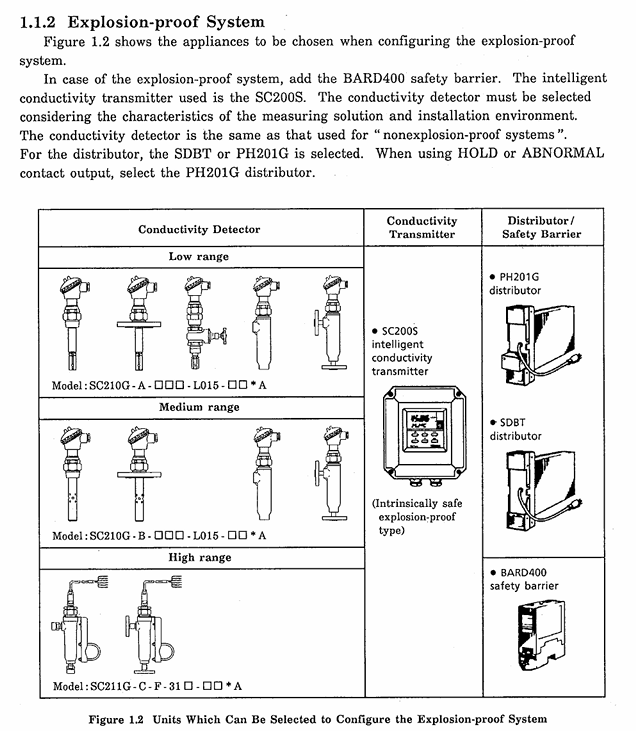
Conductivity detector - SC210G (2-electrode type):
-SC210G-A (low range, electrode constant 0.05 cm ⁻¹)
-SC210G-B (medium range, electrode constant 5 cm ⁻¹)
-SC211G-C (4-electrode type, high range, electrode constant 10 cm ⁻¹) contact measurement solution conductivity, built-in temperature sensor (thermistor for SC210G, Pt1000 for SC211G) for temperature compensation; Supports direct insertion (screw/flange) and flow-through (pipe/flange) installation.
Intelligent Conductivity Transmitter - SC200G (Non Explosion proof Type)
-SC200S (intrinsic safety explosion-proof type) receives the conductivity and temperature signals of the detector, and outputs 4-20 mA DC analog signals after processing; Support digital display, parameter setting, and self diagnosis; Explosion proof type needs to be used in conjunction with safety barriers.
Distributor/Safety Barrier - Distributor: PH201G (supporting HOLD/fault contact output), SDBT/SDBS (universal type)
-Safety Barrier: BARD400 (for intrinsically safe explosion-proof systems) provides power to the transmitter, receives 4-20 mA signals, converts them to 1-5 V DC, and outputs them to the recorder; Safety barriers are used to limit the energy of circuits in hazardous environments and prevent explosions.
Detailed explanation of technical specifications
1. Specification of conductivity detector
(1) Basic parameters
Model measurement range electrode constant contact material (sensor) measurement temperature range measurement pressure range protection level
SC210G-A 0~200 μ S/cm 0.05 cm ⁻¹ SUS316, polytetrafluoroethylene resin, fluororubber 0~105 ℃ (PP bracket 100 ℃) 10 kgf/cm ² (PP bracket 5 kgf/cm ²) IP65 (NEMA 4)
SC210G-B 200 μ S/cm~20 mS/cm 5 cm ⁻¹ Platinum, glass SUS316、 Fluororubber with SC210G-A and SC210G-A IP65 (NEMA 4)
SC211G-C 1 mS/cm~1 S/cm 10 cm ⁻¹ Platinum, glass, polyvinylidene fluoride resin, fluororubber 0~80 ℃ 2 kgf/cm ² Rain proof (JIS C0920)
(2) Installation and Interface
Direct insertion type: supports Rc 1-1/2 (PT thread), 1-1/2 NPT thread, or JIS 10K-50-RF, ANSI CLASS 150-2-RF flange;
Flow type: The bracket material is divided into SCS14 (stainless steel) and PP (polypropylene), and the interface is Rc 1/2, 1/2 NPT thread, or JIS 10K-15-RF/FF, ANSI CLASS 150-1/2-RF/FF flange.
2. Smart transmitter specifications
(1) Basic parameters
Parameter category specification details
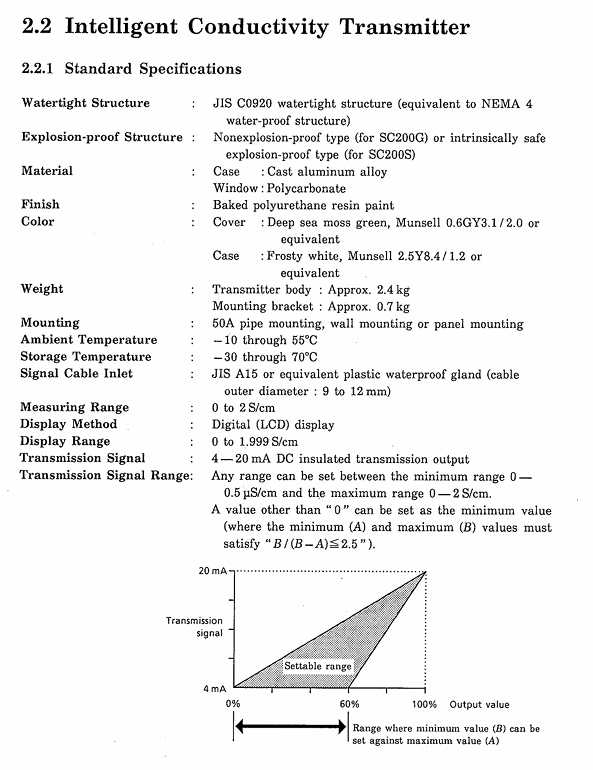
Measurement and output conductivity display range 0~1999 mS/cm, output signal 4~20 mA DC (linear/line approximation/reverse output), maximum cable length 2000m (non explosion proof)/700m (explosion proof);
The temperature compensation reference temperature is adjustable from 0 to 100 ℃, and the compensation coefficient is adjustable from -10% to+10%/℃. It supports NaCl solution characteristic compensation or custom solution characteristic compensation;
Environmental adaptability: working temperature -10~+55 ℃, storage temperature -30~+70 ℃, humidity 10~100% RH (non condensing); The shell material is cast aluminum (polyurethane baked paint) with a protection level of IP65;
Accuracy and repeatability of conductivity measurement accuracy ± 1% range (1 μ S/cm~2 S/cm), ± 0.02 μ S/cm (0~1 μ S/cm), repeatability ± 0.5% range;
The self diagnostic function supports diagnosis of temperature exceeding limits, conductivity exceeding limits, electrode contamination, temperature coefficient errors, circuit faults, etc. When a fault occurs, it outputs 22.0 mA (when the burnout function is turned on);
(2) Explosion proof specification (SC200S)
Explosion proof type: Intrinsic safety type (Ex ia IIC), to be used in conjunction with BARD400 safety barriers;
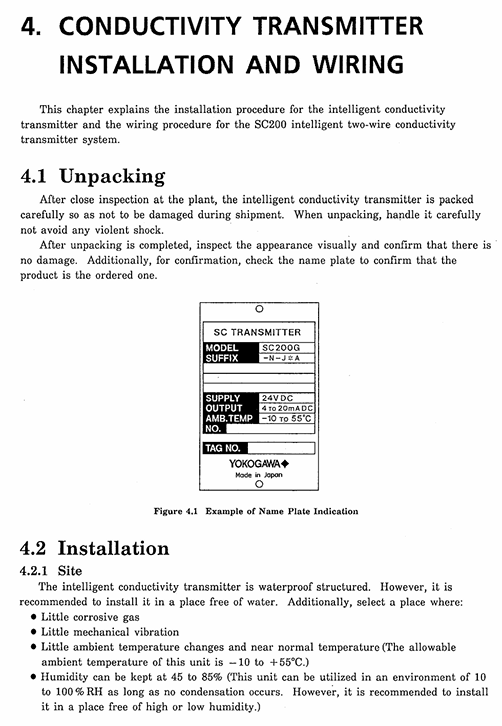
Environmental restrictions: Installation height ≤ 1000m, humidity 45~85% RH, prohibited from installation in Zone 0 hazardous environment;
Circuit parameters: Cable inductance ≤ 2.2 mH, capacitance ≤ 35 nF, ensuring no contact between intrinsic safety circuits and non intrinsic safety circuits.
Installation and wiring process
1. Installation of conductivity detector
(1) Preparation before installation
Site selection requirements: easy to maintain, measuring solution temperature/pressure in accordance with specifications, no bubbles, stable liquid level;
Interface preparation: Direct insertion type requires processing of threaded/flange holes that meet specifications (electrode insertion depth ≥ 60mm); The flow type (PP bracket) requires the installation of a nominal 50A (outer diameter 60.5mm) mounting pipe, which can be installed vertically or horizontally.
(2) Installation steps
Direct insertion type: thread type wrapped with sealing tape and screwed into the interface, flange type needs to add gaskets and evenly tighten 4 bolts;
Flow type: fixed to the installation pipe or wall, adjust the direction of the terminal connection port (can rotate by loosening the union nut);
Pipeline connection: Use rigid vinyl chloride pipes (nominal 16) or PP pipes for PP supports, and SUS304/316 pipes (nominal 15) for SCS14 supports. The recommended flow rate is ≤ 20 L/min to avoid the mixing of bubbles.
2. Installation and wiring of transmitters
(1) Installation method
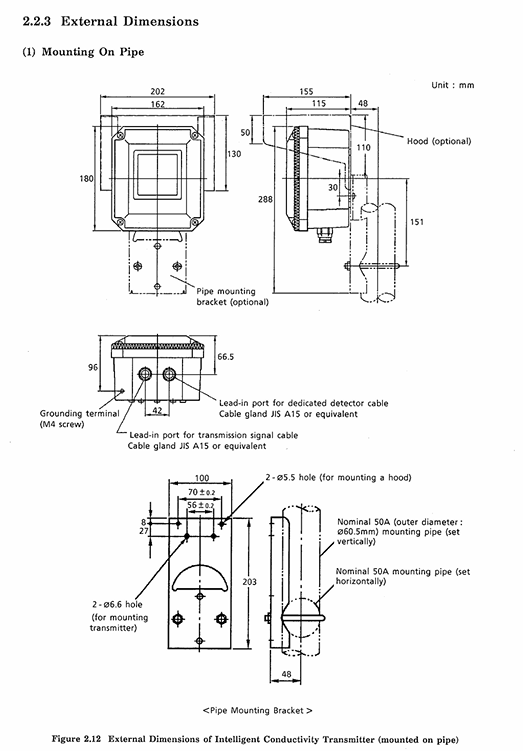
Pipeline installation: fixed to a nominal 50A pipeline (vertical/horizontal) using a dedicated bracket;
Panel installation: The panel opening size is 156 × 121 mm (tolerance+1.1mm), fixed with panel brackets;
Wall installation: Process 3 M8 threaded holes on the wall with a spacing of 70mm, and fix them with wall brackets.
(2) Wiring specifications
Requirements and steps for wiring types
Detector specific cable - SC210G (2 electrodes): 3/5/10m dedicated cable, connecting transmitter terminals 11 (T1), 12 (T2), 13 (C1), 14 (C2);
-SC211G (4 electrodes): 5.5/10m cable with connector, directly inserted into the detector interface, with the other end connected to transmitter terminals 11-16;
2-core shielded cable (outer diameter 6-12mm) is used for transmitting signal cables, with a maximum length of 2000m for non explosion proof systems and 700m for explosion proof systems. The shielding layer is connected to the safety barrier grounding terminal (explosion-proof) or the transmitter grounding terminal (non explosion-proof), with a grounding resistance of ≤ 10 Ω;
Grounding Wiring Non Explosion proof System: The M4 grounding terminal at the bottom of the transmitter is grounded with a wire of ≥ 2 mm ² (JIS Class 1 grounding, resistance ≤ 100 Ω); Explosion proof system: Only grounded through safety barriers, the transmitter is not grounded separately.
Operation and parameter settings
1. Operational hierarchy and mode
The system operation is divided into three levels, with clear functions and permissions at each level:
Operational hierarchy, permission scope, core mode/function
Operational level daily monitoring and basic operations (no need to open the cover) - Measurement mode: display conductivity, temperature, output current;
-Calibration mode: Perform standard solution calibration;
-Display selection: Switch auxiliary data such as temperature, output value, electrode constant, etc;
-Signal Hold: Turn on/off signal hold (requires setting level permission).
Parameter configuration for level adaptation measurement scenarios (requires lid opening operation) - Output range: Set the conductivity range corresponding to 4mA/20mA (4mA value should be less than 60% x 20mA value);
-Maintain parameters: choose to maintain "previous value" or "fixed value" (fixed value 4~20mA adjustable);
-Temperature compensation: Choose NaCl characteristics or custom compensation (input conductivity at reference temperature).
Service level system underlying configuration (password required, only for initial startup or maintenance) - CODE 01: Select temperature sensor type (Pt1000/Ni100/NTC) and temperature unit (℃/℉);
-CODE 02: Set reference temperature (0~100 ℃);
-CODE 03: Select output characteristics (linear/polyline);
-CODE 05: Input electrode constant (including fine adjustment ± 19.99%);
-CODE 07: Select electrode type (2 electrodes/4 electrodes);
-CODE 09: Enable/disable fault burnout function (output 22mA in case of fault).
2. Key operational procedures
(1) Standard solution calibration (operational level)
Enter calibration mode (MEASURE → CAL → YES), immerse the detector electrode in a NaCl standard solution with known conductivity (concentration close to the upper limit of the range, temperature close to the reference temperature);
After the display stabilizes, press the YES key to record the current measurement value;
Enter the actual conductivity of the standard solution at the reference temperature and press the ENT key to complete the calibration;
If the deviation between the calibrated electrode constant and the input value of service level CODE 05 is greater than 20%, Err.3 will be displayed, and the concentration of the standard solution needs to be checked or the electrode needs to be replaced.
(2) Temperature compensation setting (setting level)
Enter temperature compensation mode (Setting → Temperature → YES);
Choose compensation method: NaCl characteristics (default) or custom characteristics (*%);
If customized, adjust the solution temperature to the reference temperature, read the current conductivity and input it, and the system will automatically calculate the compensation coefficient (-10~+10%/℃);
If the compensation coefficient is known, it can be directly input in the service level CODE 14, with priority higher than the calculated value at the setting level.
Maintenance and troubleshooting
1. Regular maintenance
(1) Detector maintenance
Electrode cleaning:
Low/medium range (SC210G): Wipe the electrode surface with a thin rod wrapped in degreasing cotton to avoid scratches;
High range (SC211G): Hot water+detergent is used for ordinary pollution, 5-10% dilute hydrochloric acid is used for lime/hydroxide, and sodium hypochlorite solution is used for algae (mixing hydrochloric acid with sodium hypochlorite is prohibited);
Cleaning cycle: Determine based on the degree of solution contamination. Low range (<200 μ S/cm) may not be cleaned for a long time, while high range (>200 μ S/cm) requires regular inspection.
O-ring replacement: The sealing O-ring (located at the union nut/fixing screw) needs to be checked regularly, and it is recommended to replace it every 6 months in high-temperature solution scenarios to avoid solution leakage.
(2) Transmitter maintenance
Transparent window (polycarbonate material): Clean with a soft cloth or neutral detergent, and do not use organic solvents;
Data backup: After setting the parameters, it is recommended to record key data (electrode constant, reference temperature, compensation coefficient) to avoid power loss.
2. Troubleshooting
The system outputs error codes through self diagnosis. Common faults and their solutions are as follows:
Error code, fault cause, solution measures
Err.1 electrode polarization (pollution, wear, corrosion) cleaning electrode; If the error persists after cleaning, replace the electrode assembly.
Err.2 temperature coefficient calculation abnormality (incorrect reference temperature conductivity input by setting stage). Re measure the solution conductivity at the reference temperature and recalculate after inputting correctly.
Err.3 standard solution calibration deviation>20% (standard solution concentration error or electrode failure). Confirm the standard solution concentration and recalibrate; If there are repeated errors, replace the electrode.
Err.5 conductivity exceeds the limit (the selected detector range does not match). Select a new detector based on the solution conductivity (low range → SC210G-A, medium range → SC210G-B, high range → SC211G-C).
Err.7/8 temperature exceeds the limit (solution temperature is too high/too low) or temperature sensor malfunction. Check the solution temperature and wait for it to recover to the allowable range; If the temperature is normal, check the sensor wiring or replace the sensor.
Err.10 EEPROM malfunction (abnormal internal storage of transmitter), power outage and restart; If it is ineffective, contact after-sales maintenance.
Err.17 output range setting error (4mA corresponds to conductivity ≥ 60% × 20mA value) Reset the range to ensure that 4mA value<60% × 20mA value.
Spare parts and compliance
1. Key spare parts list
Component spare parts model/specification usage
Replace the faulty electrode components of SC210G electrodes K9208EA (SC210G-A) and K9208JA (SC210G-B) to ensure electrode constant matching.
SC211G electrode K9208BD (electrode constant 10 cm ⁻¹) high range detector dedicated electrode replacement.
Seal O-ring K9050AT to prevent detector interface leakage, and replace regularly in high temperature scenarios.
Replace the scratched or contaminated transparent window of transmitter window K9311JN to ensure clear display.
Install brackets K9149SA (pipeline), K9149SB (wall), K9311KA (panel) for transmitter installation and fixation, suitable for different installation scenarios.
2. Compliance Statement
Explosion proof certification: SC200S intrinsic safety type complies with IECEx and ATEX standards and needs to be used in conjunction with designated safety barriers (BARD400);
Grounding requirements: Non explosion proof systems must comply with JIS Class 1 grounding, while explosion proof systems must be separately equipped with intrinsic safety circuit grounding (resistance ≤ 10 Ω);
Cable specifications: Explosion proof system cable inductance ≤ 2.2 mH, capacitance ≤ 35 nF. It is recommended to use CEV-S cable (up to 700m) or CVV-S cable (up to 350m).
- YOKOGAWA
- Reliance
- ADVANCED
- SEW
- ProSoft
- WATLOW
- Kongsberg
- FANUC
- VSD
- DCS
- PLC
- man-machine
- Covid-19
- Energy and Gender
- Energy Access
- Renewable Integration
- Energy Subsidies
- Energy and Water
- Net zero emission
- Energy Security
- Critical Minerals
- A-B
- petroleum
- Mine scale
- Sewage treatment
- cement
- architecture
- Industrial information
- New energy
- Automobile market
- electricity
- Construction site
- HIMA
- ABB
- Rockwell
- Schneider Modicon
- Siemens
- xYCOM
- Yaskawa
- Woodward
- BOSCH Rexroth
- MOOG
- General Electric
- American NI
- Rolls-Royce
- CTI
- Honeywell
- EMERSON
- MAN
- GE
- TRICONEX
- Control Wave
- ALSTOM
- AMAT
- STUDER
- KONGSBERG
- MOTOROLA
- DANAHER MOTION
- Bentley
- Galil
- EATON
- MOLEX
- Triconex
- DEIF
- B&W
- ZYGO
- Aerotech
- DANFOSS
- KOLLMORGEN
- Beijer
- Endress+Hauser
- schneider
- Foxboro
- KB
- REXROTH
- YAMAHA
- Johnson
- Westinghouse
- WAGO
- TOSHIBA
- TEKTRONIX
- BENDER
- BMCM
- SMC
- HITACHI
- HIRSCHMANN
- XP POWER
- Baldor
- Meggitt
- SHINKAWA
- Other Brands
- UniOP
- KUKA
- IBA
- Beckhoff
- ADLINK
-
TRICONEX 3723X 32-Channel TMR Analog Input Module with HART for Tricon CX
-
GE 151X1233DB02SA02 Rev A Pitch Converter 30 Nm DC Pitch Conversion Module
-
GE 151X1207CK02SA02 77MM DE Excitation Module for Mark VI Turbine Control Systems
-
HIMA H6200A Analogue Isolator Power Supply for HIMax Safety Systems
-
ABB SACO 64D4 Digital Annunciator Unit with 64 Alarm Channels
-
Allen-Bradley 5069-L306ER - SER A CompactLogix Controller PLC
-
Omron CJ1W-CORT21 - CANopen Master Unit PLC Module
-
Danfoss 131B9523 / FC-102P5K5T4E20H1 - 5.5kW VLT HVAC Drive Inverter
-
Schneider Electric LXM32MU90M2 - Lexium 32 Servo Drive Controller
-
Danfoss AKD102P15KT4P21H1 - 15kW 131L2413 ADAP-KOOL Drive Inverter
-
Kollmorgen S70602-NANANA - Servo Drive Controller
-
Allen-Bradley 6189-PS2 - Power Supply Industrial Computer PS
-
Beijer E900T / 03010F - Operator Panel IFC ETTP HMI
-
Schneider Electric LMC20 - PacDrive Motion Controller PLC
-
Sartorius CAW2S1-3DC-NCE - COMBICS 2 Industrial Scale Terminal
-
Kollmorgen / Danaher S30301-NA / S300 - SERVOSTAR343 Servo Drive Controller
-
Siemens A5E00159503 - 12 INCH TFT Touch Panel HMI
-
Siemens 3UF5021-3AB00-1 - SIMOCODE DP Basic Unit Control Module
-
Danfoss 131B8872 / FC-202PK37T4E20H1 - 0.37kW VLT AQUA Drive Inverter
-
Atlas Copco ICB421-2003D / VSK001001 - W9139 ICM431-0025C ICM431-0025D Controller
-
Lenze EV82EV751_4C - Version 4A39 Frequency Inverter Drive
-
Atlas Copco / ABB 3HAB8101-19/07B - Robot Cable Assembly Harness
-
Beijer X2 Pro7-B2 - Operator Panel HMI Touch Screen
-
Honeywell CDW45L - Damper Actuator
-
B&R X67DM9331.L12 - Rev. I0 Digital Mixed Module
-
B&R X67DM9331.L12 - Rev. H0 Digital Mixed Module
-
Sanyo Denki PMM-BA-5604-1 - Pentasyn Stepper Motor Driver
-
SICK AWS1-113 / 1008900 - Evaluation Unit
-
Siemens 1TF6064-1AF71-3AH1 - SIMOTICS Synchronous Servo Motor
-
Heidenhain ERN680.P003-4096 / 29416004 - Rotary Encoder
-
Schneider Electric LC1G185EHEA - TeSys Control Contactor
-
Parker SBC HPD5N - High Performance Drive Electronics SPA
-
Advantech UNO-2170-CE11BE - Embedded Automation Computer IPC
-
Siemens 6AG1231-4HF32-4XB0 - SIPLUS S7-1200 SM 1231 Analog Input Module
-
Advantech UNO-2170-BTO - Embedded Automation Computer IPC
-
Jumo SR-96/4-001.0.0.00.111 - Solid State Relay Power Controller
-
Pepperl+Fuchs FC-21-V - FC-20P Safety Barrier Module
-
Emerson SP1404 - Unidrive AC Drive Inverter
-
B&R X67AI1233 - Rev.C0 Analog Input Module
-
Mitsubishi FR-F740-00250-EC - Frequency Inverter AC Drive
-
Allen-Bradley 2711P-T7C21D8S - PANELVIEW PLUS 7 SERIES B Touch Screen HMI
-
Pilz PMCprotego D.03/000/0/0/2/208-480VAC / 8176101 - Servo Amplifier Drive
-
Reliance Electric 57C414 / 57414-1N - Modbus Interface Module
-
Mitsubishi FR-F740-00250-EC - Frequency Inverter AC Drive
-
Siemens 6SN1123-1AA00-0EA2 - Version A 160A SIMODRIVE Power Module
-
Siemens 1TF6064-1AF71-3AH1 - SIMOTICS Synchronous Servo Motor
-
AEG ALU202 / DAP216 / DEP216 / DAU202 - SIM216 SIM203 DNP205 ADU205 PLC Controller KIT
-
Atlas Copco / ABB 3HAB8101-19/07B - Robot Cable Assembly Harness
-
Hitachi CPU22-02HB - Micro-EHV Programmable Controller PLC
-
Parker SBC HPD5N - High Performance Drive Electronics SPA
-
Jetter JX3-THI2-RTD - JX3-BP Temperature Input Module
-
Eaton DC1-34014FB-A20N - 5.5kW Inverter Variable Frequency Drive
-
Eaton DS7-34DSX041N0-D - Soft Starter
-
Reliance Electric 57C422B / 57422-2E - 2-Axis Servo Controller
-
Hitachi CPU22-02HB - Micro-EHV Programmable Controller PLC
-
Eaton DC1-34014FB-A20N - 5.5kW Frequency Inverter Variable Frequency Drive
-
Siemens 6SN1123-1AA00-0EA2 - Version A 160A SIMODRIVE Power Module
-
Reliance Electric 57C414 / 57414-1N - Modbus Interface Module
-
Eaton DS7-34DSX041N0-D - Soft Starter
-
Reliance Electric 57C422B / 57422-2E - 2-Axis Servo Controller
-
Johnson Controls DX-9120-8454 - Digital Controller
-
Jetter JX3-THI2-RTD - JX3-BP Temperature Input Module
-
Siemens 6SL3210-1KE21-7AP1 - SINAMICS G120C DP 7.5kW BOP-2 Inverter Drive
-
Siemens 1FK7042-2AF21-1QG0 - SIMOTICS S Synchronous Servo Motor
-
Mettler Toledo IND570 - Harsh Analog Weighing Terminal Controller
-
Schneider Electric TM238LDA24DR - Modicon M238 Programmable Logic Controller PLC
-
Hitachi EH-CPU548 - EH-150 PLC CPU Module
-
Honeywell Q7750A2003 - Excel 10 Zone Controller
-
Ferag 584.002.V003 - Control Panel HMI
-
Danfoss AK-SM 720 / 080Z8511 - ADAP-KOOL System Manager Controller
-
Ferag 584.002.V003 - Control Panel HMI
-
Kern 3210001.001 / LOP-KS 2903440.001 - PRT.205A.0000.V001.02341 Servo Controller Board
-
Reliance Electric 57C424 - Maxpak III High Speed Link Module
-
Telemecanique XBTA70101PA - Compact Terminal HMI Panel
-
Reliance Electric 57C424 - Maxpak III High Speed Link Module
-
Reliance Electric 57C422B - 2-Axis Servo Controller
-
Honeywell Q7750A2003 - Excel 10 Zone Controller
-
Telemecanique XBTN400 - Magelis Small Panel HMI
-
Schneider Electric TM172PDG42S - Modicon Programmable Logic Controller PLC
-
Fanuc HE693THM884M - Thermocouple Input Module
-
Selectron PMC22BAEZD / 220735 - Selecontrol PMC 22 ABEZD Controller Module
-
Baumuller BUS21-22/45-31-020 - Servo Drive Inverter
-
Schneider Electric TM172PDG42S - Modicon Programmable Logic Controller PLC
-
Schneider Electric ATV32HD11N4 - Altivar Variable Frequency Drive Inverter
-
Lenze 494_E.4B - DC Speed Controller
-
NORD SK300E-111-340-B - SKDA130E-111-340-IBS-AAA Frequency Inverter
-
Reliance Electric GMI-S02 - AC/AC Converter 380/400V 50/60Hz 2.3/2.8A Drive
-
Hakko / Monitouch V710CD - Operator Panel HMI Touch Screen
-
B&R 5PC910.SX01-00 / 5YZCAA00700000-005 - Automation PC Industrial Computer
-
Hitachi EH-CPU548 - EH-150 PLC CPU Module
-
Tecnau / Fortec FORTEC-04/UL / 10117 - PCB Circuit Board
-
Bosch PSS 2037 10B - Power Supply Module
-
Newall B602000 - Digital Readout Scale
-
ELCON PC Controller - Industrial PC Controller
-
Siemens 3UF5100-0AB00 - SIMOCODE-DP Control Module
-
Omron NS8-TV00B-V2 - Touch Screen HMI Panel
-
Siemens 6ES5264-8MA12 / IP264 - CAM Controller Module
-
Allen-Bradley 1756-L72S - SER B GuardLogix Safety Controller
-
Schneider Electric SXWMPC15A10001 - SmartX Controller Automation Server
-
Telemecanique LC1F265F7 - TeSys F Contactor
-
Siemens 6ES7314-6CH04-0AB0 - SIMATIC S7-300 CPU 314C-2 DP PLC
-
Allen-Bradley 1734-EI4S - POINT I/O Safety Module
-
Allen-Bradley 2711P-T7C4D8 / 2711P-RP8D - PanelView Plus HMI Touch Screen Logic Module
-
Ropex UPT-640-V - Resistron Temperature Controller
-
KEB 07.F5.B3A-0A00 - VERSION 1.1 Combivert Frequency Inverter
-
Sensopart V50-OB-A3-IW-M2-L - VISOR Vision Sensor Camera
-
SICK AFM60A-S1NB018X12 / 1059040 - Absolute Rotary Encoder
-
Kern AG KMC600 / 2903436.001 - Servo Drive Controller
-
Lenze E82EV302_4C200 / 13015655 - VERSION 3D35 Frequency Inverter Drive
-
Schneider Electric XBTOT2210 - Magelis Touch Screen HMI Panel
-
Baumuller BM5-O-SAF-000-000-000-001-202 - Parameter Safety Module
-
SICK UE4470-22EE690 - Safety Relay Controller
-
Hitachi EH-CPU448 / EH-150 - PLC CPU Module
-
Rexroth VT5005-13 - R5 00010592 Proportional Valve Amplifier Board
-
Siemens 6ES7510-1DJ00-0AB0 - SIMATIC ET 200SP CPU PLC
-
Beckhoff CX5120-0121 - 2GB Embedded PC Controller
-
Priva BlueiD S10 / 5010002 - SN3t 5020004 5010101 Building Automation Controller
-
Sigmatek DM161 - S-DIAS Digital Mix I/O Module
-
Telemecanique LC3D50P7A64 - Star Delta Starter Contactor
-
Siemens 6SN1123-1AA00-0BA2 - SIMODRIVE 611 Power Module
-
Siemens 6SN1124-1AA00-0CA1 - SIMODRIVE 611 Power Module
-
Dixell XC1015D-1C01F / XC1000D - Compressor Controller
-
Siemens A5E02184619 / 19T 577B - Industrial Touch Screen HMI Panel
-
Siemens 6SE6420-2AD27-5CA1 - Filter 6SE6400-2FS03-8CD0 Micromaster Inverter
-
Schneider Electric LC1G400LSEN - TeSys Control Contactor
-
Baldor BPS10-200-20-P - Servo Drive Motor Controller
-
Ingersoll Rand X4I / Y06IR03.00 - Air Compressor Controller
-
NORD SK 530P-221-340-A - Frequency Inverter

K-JIANG

Add: Jimei North Road, Jimei District, Xiamen, Fujian, China
Tell:+86-15305925923