

K-WANG


Allen Bradley 1753 Series GuardPLC 1800 Controller
Allen Bradley 1753 Series GuardPLC 1800 Controller
Core framework and scope of application of the document
The document follows the logical mainline of "security standards → hardware awareness → installation and practical operation → functional verification", covering the entire process of controller preparation to later testing. The applicable product is GuardPLC 1800 safety controller, which is a programmable electronic system (PES) with safety certification. It integrates 24 digital inputs, 8 digital outputs, 2 high-speed counters, 8 analog inputs, and 4 GuardPLC Ethernet communication interfaces. It complies with SIL 3 (IEC 61508) and PLe (ISO 13849-1 Cat.4) safety levels and is suitable for scenarios with extremely high requirements for fault tolerance and risk control, such as mechanical safety control and process safety monitoring.
Core content sorting
(1) Controller Overview and Safety Standards
Core functions and hardware composition
Function integration: Supports the separation of secure and non secure communication. Secure communication is connected to distributed I/O, other GuardPLC controllers, or OPC servers through 4-channel 10/100BaseT RJ45 interfaces (GuardPLC Ethernet protocol); Non secure communication is achieved through 3-channel 9-pin D-shell interfaces (RS-485, etc.) to realize functions such as Modbus slave and Profibus DP slave (only 1753-L32BBBP-8A).
Hardware structure: including DIN rail installation buckle, 24V DC power interface, I/O plug-in terminal, high-speed counter interface, Ethernet interface (top 2+bottom 2), reset button (received design, anti misoperation), status indicator lights (24V DC, RUN, ERROR, PROMess, etc.). The controller is of open design and needs to be installed in a closed enclosure (protection level ≥ IP20).
Safety and Environmental Regulations
Operation qualification: It must be operated by trained professionals who are familiar with the application requirements of safety related PES (such as EN ISO 13849-1, IEC 61508).
Static electricity protection: The controller is sensitive to static electricity. When operating, it is necessary to touch a grounded object to discharge and wear a grounding wristband. It is forbidden to touch the pins or components of the circuit board. When idle, it should be stored in anti-static packaging.
Environmental requirements:
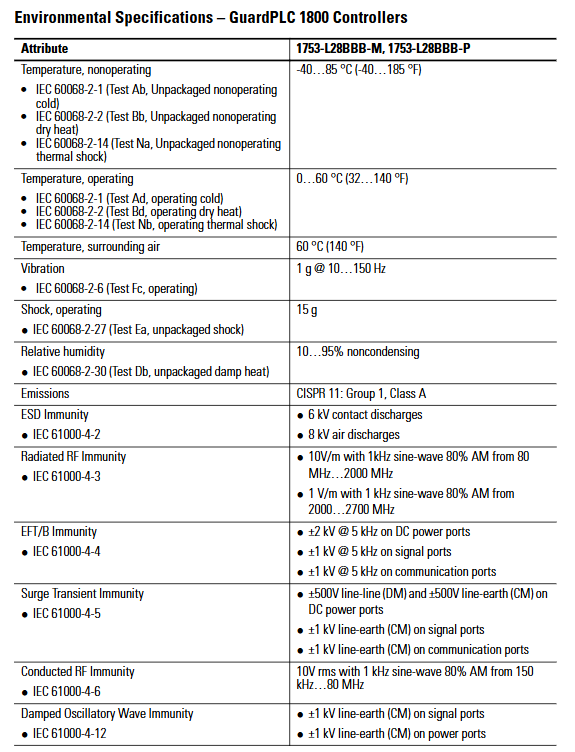
Working temperature: 0 ° C~60 ° C (32 ° F~140 ° F), storage temperature: -40 ° C~85 ° C (-40 ° F~185 ° F);
Relative humidity of 10%~95% (no condensation), pollution level 2 industrial environment, altitude ≤ 2000 meters (no need to downgrade);
It needs to be installed inside a metal casing with flame retardant properties (flame propagation level 5VA/V0, etc.), and the interior can only be accessed through tools to avoid the risk of electric shock.
(2) Installation process: from fixing to grounding
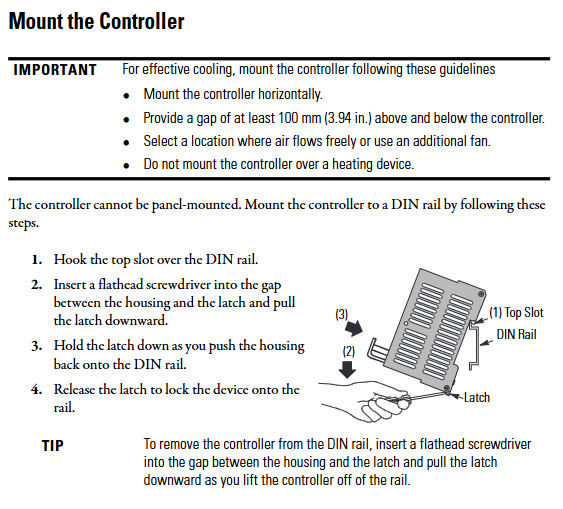
DIN rail installation (only supports DIN rail, not panel installation)
Align the guide rail: Hang the top slot of the controller on the IEC standard DIN rail (such as 199-DR1), and it is recommended to use galvanized yellow chromium steel material for the guide rail (to ensure good grounding). Fix it every 200mm (7.8 inches) and install end anchors.
Locking device: Insert a flathead screwdriver into the gap between the housing and the buckle, pull the buckle downwards, push the controller towards the guide rail, and release the buckle to complete the locking process; Reverse the operation during disassembly.
Heat dissipation requirements: Install horizontally with a minimum gap of 100mm (3.94 inches) above and below, avoiding installation above heating equipment to ensure air circulation. Install a fan if necessary.
Grounding configuration
Double grounding: The controller is functionally grounded through DIN rail, and protective grounding must be connected through a dedicated grounding screw (with grounding symbol) in the upper left corner of the housing. The grounding wire must comply with local electrical regulations (refer to Industrial Automation Wiring and Grounding Guidelines 1770-4.1).
Guide rail requirements: It is prohibited to use guide rails made of aluminum, plastic, or other materials that are prone to corrosion or have poor conductivity, in order to avoid equipment failure or safety risks caused by poor grounding.
(3) Wiring Specification: Power Supply and I/O Circuit
Power wiring (24V DC)
Power requirements: An isolated power supply that complies with EN 60950/UL 1950 must be used, and it must be of the SELV (Safety Extra Low Voltage) or PELV (Protection Extra Low Voltage) level. The SELV voltage should be ≤ 30V rms/42.4V peak/60V DC, and the PELV must be connected to a protective grounding.
Wiring details: Connect the power supply through a 4-pin terminal, and ensure that L+(positive pole) and L - (negative pole) are correctly connected (without reverse polarity protection, as reversing the connection may damage the controller); The terminal supports a maximum of 2.5mm ² (14 AWG) wire and requires external 10A delay fuse protection; The L+and L - terminals are internally connected, and 24V DC Daisy chain power can be supplied to other devices through the remaining terminals.
Current characteristics: The maximum current consumption of the controller is 9A (including I/O load), and it requires 1A for its own operation. The remaining 8A can be used to power input/output devices.
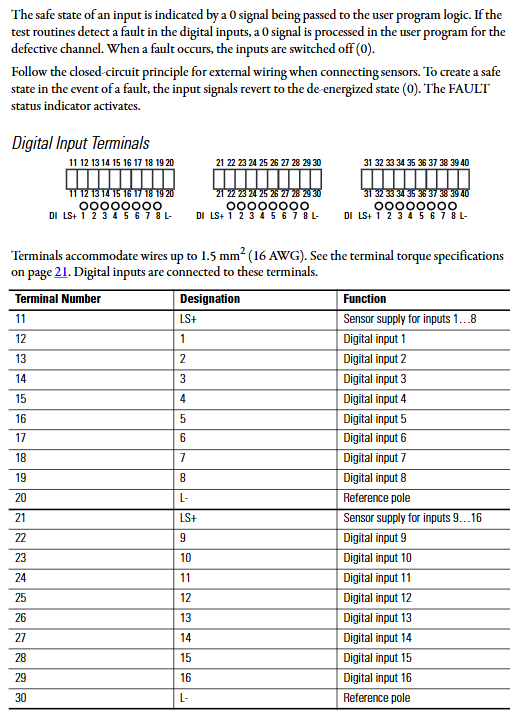
Digital input wiring (24 channels, divided into 3 groups, with 8 channels per group)
Power supply and circuit: Each set of inputs is powered by an independent LS+(24V DC sensor power supply with short-circuit protection), and the input signal is referenced to L - (common terminal); Supports dry contact input or sensors with independent power supply (such as safety light curtains), and the negative pole of the external power supply needs to be connected to the controller L.
Safety design: Following the "closed circuit principle", the input signal is reset to "0" by default in case of a fault (power-off safety state); If an input fault (such as a short circuit) is detected, the input signal of the fault channel is forced to be "0", and the FAILT indicator light is activated.
Terminal specifications: The terminal supports 0.13-1.3mm ² (26-16 AWG) wires, with a tightening torque of 0.51N · m (4.5 lb · in). Terminals 11-20, 21-30, and 31-40 correspond to three sets of input LS+, input channel, and L-。
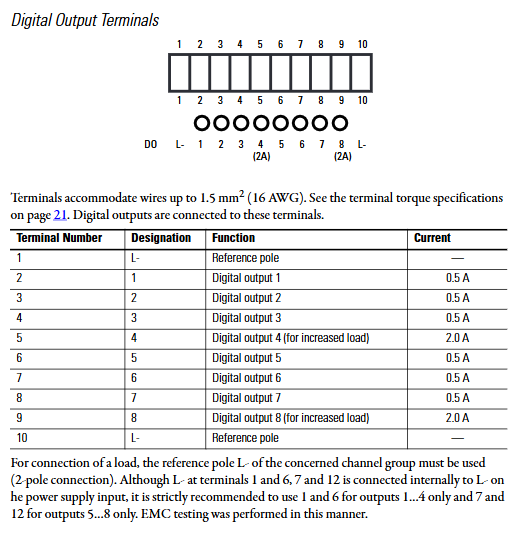
Digital output wiring (8 channels)
Load capacity:
At channels 1-3 and 5-7, the maximum current per channel is 0.5A at 60 ° C;
Channels 4 and 8 (heavy-duty channels): 1A/channel at 60 ° C, 2A/channel at 50 ° C;
The total output current is ≤ 7A, with a minimum load of 2mA per channel. When overcurrent occurs, the output is turned off and automatically restored after troubleshooting.
Wiring requirements: The output circuit should use L - (terminal 1/10) of the corresponding group as the common terminal. Even if L - is internally connected, it is still recommended to use it according to the group (EMC test verification configuration); It is recommended to parallel 1N4004 diodes to suppress interference voltage for inductive loads.
Safety feature: In the event of a fault, all outputs are forced to shut down (in a power-off safety state), and there is no monitoring of the external circuit. However, a short circuit will trigger a fault indication.
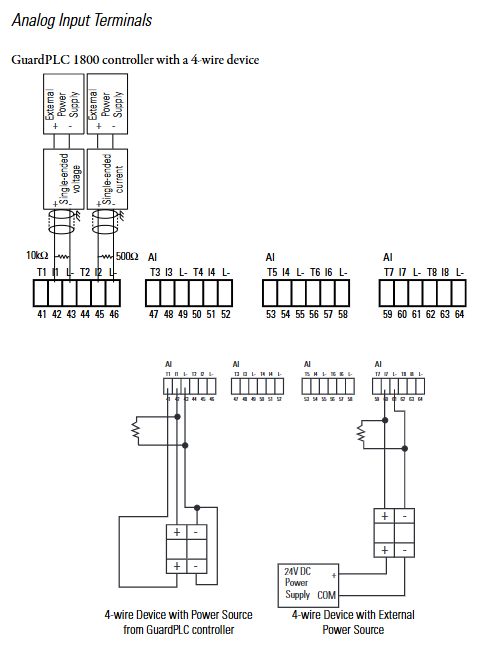
Analog input wiring (8 channels, single polarity)
Signal type:
Voltage signal: 0~10V DC (requires an external 10k Ω shunt resistor);
Current signal: 0~20mA (requires an external 500 Ω shunt resistor);
Unused analog inputs need to be short circuited (connected to I and L -) to avoid interference.
Wiring specifications: Use shielded twisted pair cables, with both ends of the shielding layer grounded, and a maximum wiring length of 300m (984 feet); Terminals 41-64 correspond to transmitter power supply (T1-T8), signal input (I1-I8), and reference terminal (L -) with 8 inputs, supporting 0.13-1.3mm ² (26-16 AWG) wires.
High speed counter wiring (2 channels, 24 bits)
Function configuration: Each counter includes three terminals: A (counting input), B (direction input), and Z (reset input). It supports 5V/24V DC signals and has a maximum input frequency of 100kHz. It can be used as a counter or a 3-digit Gray code decoder.
Wiring requirements: Use shielded twisted pair cables, with both ends of the shielding layer grounded, and a maximum wiring length of 500m (1640 feet); Terminals 65-72 correspond to A1/B1/Z1/L - and A2/B2/Z2/L - of the 2-channel counter, and unused inputs do not need to be terminated.
(4) Communication connection: Separation of secure and non secure
Secure Communication (GuardPLC Ethernet)
Interface configuration: 4 RJ45 interfaces (top 2+bottom 2), connected internally through an Ethernet switch, supporting automatic negotiation (full/half duplex, 10/100Mbps), can use direct or crossover Ethernet cables, supporting star/line topology (network loops are prohibited).
Application scenario: Connect distributed security I/O, other GuardPLC controllers, OPC servers (requiring 1753-OPC modules) and programming software, with MAC address attached to the bottom RJ45 interface.
Non secure communication (3-channel 9-pin D-shell interface)
Interface function:
COMM1:RS-485, Supports Modbus slave (1753-L32BBBM-8A) or Profibus DP slave (1753-L32BBBP-8A);
COMM2: Reserved (TBD);
COMM3:RS-485, Support GuardPLC ASCII protocol;
Pin definitions: Pin 3 (RxD/TxD-A) and Pin 8 (RxD/TxD-B) are for data transmission and reception, Pin 5 (DGND) is for data ground, Pin 6 (VP) is for 5V power supply, and Pin 4/9 are for control signals.
Default parameters: IP address defaults to 192.168.0.99, system ID (SRS) defaults to 60000, and custom parameters can be recorded through transparent labels (note not to obstruct ventilation holes).
(5) Fault diagnosis and status indication
Reset button operation
Trigger scenario: When forgetting the online password for programming software and unable to obtain IP address/SRS, use an insulated needle to press the reset button (top received hole, 4-5cm from the left edge).
Reset process: Press and hold the button for 20 seconds, while restarting the controller (power off and then on). After resetting, only the default account is retained, and the IP address/SRS is restored to its default value; Restore the parameters modified before or after resetting during the next power on (depending on whether they have been modified).
Controller self-test
Power monitoring: Alarm 1 is triggered when the 24V DC voltage is below 19.3V (recording internal variables), alarm 2 is triggered when the voltage is below 15.4V (preparing to shut down), and automatic shutdown is triggered when the voltage is below 13.0V.
Temperature monitoring: A warning is triggered when the temperature is between 60 ° C and 70 ° C, a main alarm is triggered when the temperature is above 70 ° C, and the main alarm is released when the temperature drops to 64 ° C and 54 ° C (the warning is retained). When the temperature drops below 54 ° C, it returns to normal.
Interpretation of status indicator lights
|Indicator light | Status | Meaning|
|24V DC | Always on | 24V DC power supply is normal|
|| Off | No power supply or power failure|
|RUN | Always on | Running normally (executing programs, processing I/O, communication, self-test)|
|| Blinking | STOP mode (no program executed, output reset, triggered by emergency stop)|
|| OFF | VNet STOP mode (see ERROR light)|
|ERROR | Always on | Hardware failure (controller, I/O, counter), system software error, watchdog timeout (out of cycle), software restart required|
|| Off | No errors|
|PROGress | Always on | Uploading new controller configuration|
|| Blinking | Upload new operating system to non-volatile ROM|
|FAULT | Always on | Program logic error, configuration failure, operating system damage|
|| Flashing | ROM write error, I/O failure|
|OSL | Blinking | Emergency Operating System Loader Activation|
|BL | Blinking | Boot loader unable to load operating system|
|Ethernet (green/yellow) | Green constant light | Full duplex; Huang Changliang: Connection establishment|
|| Green flashing | Conflict; Yellow flashing: Interface activity|
(6) Technical specifications and certification
Core parameters
Memory: Maximum 250KB user program memory, 250KB application data memory;
Safety performance: minimum watchdog time of 10ms, minimum safety time of 20ms;
Insulation voltage: 50V DC (basic insulation) between I/O and Ethernet, Ethernet and DC power supply;
Protection level: IP20 (controller body), size 257 × 114 × 66mm (width × height × depth), weight 1.2kg.
Safety certifications: UL Listed (USA&Canada), CE (EMC Directive 2004/108/EC), C-Tick (Australia), T Ü V certification (SIL 3/IEC 61508, PLe/ISO 13849-1).
Key considerations and supplementary resources
Compliance verification: Wiring must comply with local electrical regulations (such as NEC, IEC), and safety circuit design must meet corresponding safety level requirements to avoid reducing safety performance due to improper configuration.
EMC protection: Shielded wires are required for analog inputs, high-speed counters, and Ethernet, with both ends of the shielding layer grounded; Install a filter in the power circuit to reduce the impact of electromagnetic interference on safety functions.
- YOKOGAWA
- Reliance
- ADVANCED
- SEW
- ProSoft
- WATLOW
- Kongsberg
- FANUC
- VSD
- DCS
- PLC
- man-machine
- Covid-19
- Energy and Gender
- Energy Access
- Renewable Integration
- Energy Subsidies
- Energy and Water
- Net zero emission
- Energy Security
- Critical Minerals
- A-B
- petroleum
- Mine scale
- Sewage treatment
- cement
- architecture
- Industrial information
- New energy
- Automobile market
- electricity
- Construction site
- HIMA
- ABB
- Rockwell
- Schneider Modicon
- Siemens
- xYCOM
- Yaskawa
- Woodward
- BOSCH Rexroth
- MOOG
- General Electric
- American NI
- Rolls-Royce
- CTI
- Honeywell
- EMERSON
- MAN
- GE
- TRICONEX
- Control Wave
- ALSTOM
- AMAT
- STUDER
- KONGSBERG
- MOTOROLA
- DANAHER MOTION
- Bentley
- Galil
- EATON
- MOLEX
- Triconex
- DEIF
- B&W
- ZYGO
- Aerotech
- DANFOSS
- KOLLMORGEN
- Beijer
- Endress+Hauser
- schneider
- Foxboro
- KB
- REXROTH
- YAMAHA
- Johnson
- Westinghouse
- WAGO
- TOSHIBA
- TEKTRONIX
- BENDER
- BMCM
- SMC
- HITACHI
- HIRSCHMANN
- XP POWER
- Baldor
- Meggitt
- SHINKAWA
- Other Brands
- UniOP
- KUKA
- IBA
- Beckhoff
- ADLINK
-
Allen-Bradley 5069-L306ER - SER A CompactLogix Controller PLC
-
Omron CJ1W-CORT21 - CANopen Master Unit PLC Module
-
Danfoss 131B9523 / FC-102P5K5T4E20H1 - 5.5kW VLT HVAC Drive Inverter
-
Schneider Electric LXM32MU90M2 - Lexium 32 Servo Drive Controller
-
Danfoss AKD102P15KT4P21H1 - 15kW 131L2413 ADAP-KOOL Drive Inverter
-
Kollmorgen S70602-NANANA - Servo Drive Controller
-
Allen-Bradley 6189-PS2 - Power Supply Industrial Computer PS
-
Beijer E900T / 03010F - Operator Panel IFC ETTP HMI
-
Schneider Electric LMC20 - PacDrive Motion Controller PLC
-
Sartorius CAW2S1-3DC-NCE - COMBICS 2 Industrial Scale Terminal
-
Kollmorgen / Danaher S30301-NA / S300 - SERVOSTAR343 Servo Drive Controller
-
Siemens A5E00159503 - 12 INCH TFT Touch Panel HMI
-
Siemens 3UF5021-3AB00-1 - SIMOCODE DP Basic Unit Control Module
-
Danfoss 131B8872 / FC-202PK37T4E20H1 - 0.37kW VLT AQUA Drive Inverter
-
Atlas Copco ICB421-2003D / VSK001001 - W9139 ICM431-0025C ICM431-0025D Controller
-
Lenze EV82EV751_4C - Version 4A39 Frequency Inverter Drive
-
Atlas Copco / ABB 3HAB8101-19/07B - Robot Cable Assembly Harness
-
Beijer X2 Pro7-B2 - Operator Panel HMI Touch Screen
-
Honeywell CDW45L - Damper Actuator
-
B&R X67DM9331.L12 - Rev. I0 Digital Mixed Module
-
B&R X67DM9331.L12 - Rev. H0 Digital Mixed Module
-
Sanyo Denki PMM-BA-5604-1 - Pentasyn Stepper Motor Driver
-
SICK AWS1-113 / 1008900 - Evaluation Unit
-
Siemens 1TF6064-1AF71-3AH1 - SIMOTICS Synchronous Servo Motor
-
Heidenhain ERN680.P003-4096 / 29416004 - Rotary Encoder
-
Schneider Electric LC1G185EHEA - TeSys Control Contactor
-
Parker SBC HPD5N - High Performance Drive Electronics SPA
-
Advantech UNO-2170-CE11BE - Embedded Automation Computer IPC
-
Siemens 6AG1231-4HF32-4XB0 - SIPLUS S7-1200 SM 1231 Analog Input Module
-
Advantech UNO-2170-BTO - Embedded Automation Computer IPC
-
Jumo SR-96/4-001.0.0.00.111 - Solid State Relay Power Controller
-
Pepperl+Fuchs FC-21-V - FC-20P Safety Barrier Module
-
Emerson SP1404 - Unidrive AC Drive Inverter
-
B&R X67AI1233 - Rev.C0 Analog Input Module
-
Mitsubishi FR-F740-00250-EC - Frequency Inverter AC Drive
-
Allen-Bradley 2711P-T7C21D8S - PANELVIEW PLUS 7 SERIES B Touch Screen HMI
-
Pilz PMCprotego D.03/000/0/0/2/208-480VAC / 8176101 - Servo Amplifier Drive
-
Reliance Electric 57C414 / 57414-1N - Modbus Interface Module
-
Mitsubishi FR-F740-00250-EC - Frequency Inverter AC Drive
-
Siemens 6SN1123-1AA00-0EA2 - Version A 160A SIMODRIVE Power Module
-
Siemens 1TF6064-1AF71-3AH1 - SIMOTICS Synchronous Servo Motor
-
AEG ALU202 / DAP216 / DEP216 / DAU202 - SIM216 SIM203 DNP205 ADU205 PLC Controller KIT
-
Atlas Copco / ABB 3HAB8101-19/07B - Robot Cable Assembly Harness
-
Hitachi CPU22-02HB - Micro-EHV Programmable Controller PLC
-
Parker SBC HPD5N - High Performance Drive Electronics SPA
-
Jetter JX3-THI2-RTD - JX3-BP Temperature Input Module
-
Eaton DC1-34014FB-A20N - 5.5kW Inverter Variable Frequency Drive
-
Eaton DS7-34DSX041N0-D - Soft Starter
-
Reliance Electric 57C422B / 57422-2E - 2-Axis Servo Controller
-
Hitachi CPU22-02HB - Micro-EHV Programmable Controller PLC
-
Eaton DC1-34014FB-A20N - 5.5kW Frequency Inverter Variable Frequency Drive
-
Siemens 6SN1123-1AA00-0EA2 - Version A 160A SIMODRIVE Power Module
-
Reliance Electric 57C414 / 57414-1N - Modbus Interface Module
-
Eaton DS7-34DSX041N0-D - Soft Starter
-
Reliance Electric 57C422B / 57422-2E - 2-Axis Servo Controller
-
Johnson Controls DX-9120-8454 - Digital Controller
-
Jetter JX3-THI2-RTD - JX3-BP Temperature Input Module
-
Siemens 6SL3210-1KE21-7AP1 - SINAMICS G120C DP 7.5kW BOP-2 Inverter Drive
-
Siemens 1FK7042-2AF21-1QG0 - SIMOTICS S Synchronous Servo Motor
-
Mettler Toledo IND570 - Harsh Analog Weighing Terminal Controller
-
Schneider Electric TM238LDA24DR - Modicon M238 Programmable Logic Controller PLC
-
Hitachi EH-CPU548 - EH-150 PLC CPU Module
-
Honeywell Q7750A2003 - Excel 10 Zone Controller
-
Ferag 584.002.V003 - Control Panel HMI
-
Danfoss AK-SM 720 / 080Z8511 - ADAP-KOOL System Manager Controller
-
Ferag 584.002.V003 - Control Panel HMI
-
Kern 3210001.001 / LOP-KS 2903440.001 - PRT.205A.0000.V001.02341 Servo Controller Board
-
Reliance Electric 57C424 - Maxpak III High Speed Link Module
-
Telemecanique XBTA70101PA - Compact Terminal HMI Panel
-
Reliance Electric 57C424 - Maxpak III High Speed Link Module
-
Reliance Electric 57C422B - 2-Axis Servo Controller
-
Honeywell Q7750A2003 - Excel 10 Zone Controller
-
Telemecanique XBTN400 - Magelis Small Panel HMI
-
Schneider Electric TM172PDG42S - Modicon Programmable Logic Controller PLC
-
Fanuc HE693THM884M - Thermocouple Input Module
-
Selectron PMC22BAEZD / 220735 - Selecontrol PMC 22 ABEZD Controller Module
-
Baumuller BUS21-22/45-31-020 - Servo Drive Inverter
-
Schneider Electric TM172PDG42S - Modicon Programmable Logic Controller PLC
-
Schneider Electric ATV32HD11N4 - Altivar Variable Frequency Drive Inverter
-
Lenze 494_E.4B - DC Speed Controller
-
NORD SK300E-111-340-B - SKDA130E-111-340-IBS-AAA Frequency Inverter
-
Reliance Electric GMI-S02 - AC/AC Converter 380/400V 50/60Hz 2.3/2.8A Drive
-
Hakko / Monitouch V710CD - Operator Panel HMI Touch Screen
-
B&R 5PC910.SX01-00 / 5YZCAA00700000-005 - Automation PC Industrial Computer
-
Hitachi EH-CPU548 - EH-150 PLC CPU Module
-
Tecnau / Fortec FORTEC-04/UL / 10117 - PCB Circuit Board
-
Bosch PSS 2037 10B - Power Supply Module
-
Newall B602000 - Digital Readout Scale
-
ELCON PC Controller - Industrial PC Controller
-
Siemens 3UF5100-0AB00 - SIMOCODE-DP Control Module
-
Omron NS8-TV00B-V2 - Touch Screen HMI Panel
-
Siemens 6ES5264-8MA12 / IP264 - CAM Controller Module
-
Allen-Bradley 1756-L72S - SER B GuardLogix Safety Controller
-
Schneider Electric SXWMPC15A10001 - SmartX Controller Automation Server
-
Telemecanique LC1F265F7 - TeSys F Contactor
-
Siemens 6ES7314-6CH04-0AB0 - SIMATIC S7-300 CPU 314C-2 DP PLC
-
Allen-Bradley 1734-EI4S - POINT I/O Safety Module
-
Allen-Bradley 2711P-T7C4D8 / 2711P-RP8D - PanelView Plus HMI Touch Screen Logic Module
-
Ropex UPT-640-V - Resistron Temperature Controller
-
KEB 07.F5.B3A-0A00 - VERSION 1.1 Combivert Frequency Inverter
-
Sensopart V50-OB-A3-IW-M2-L - VISOR Vision Sensor Camera
-
SICK AFM60A-S1NB018X12 / 1059040 - Absolute Rotary Encoder
-
Kern AG KMC600 / 2903436.001 - Servo Drive Controller
-
Lenze E82EV302_4C200 / 13015655 - VERSION 3D35 Frequency Inverter Drive
-
Schneider Electric XBTOT2210 - Magelis Touch Screen HMI Panel
-
Baumuller BM5-O-SAF-000-000-000-001-202 - Parameter Safety Module
-
SICK UE4470-22EE690 - Safety Relay Controller
-
Hitachi EH-CPU448 / EH-150 - PLC CPU Module
-
Rexroth VT5005-13 - R5 00010592 Proportional Valve Amplifier Board
-
Siemens 6ES7510-1DJ00-0AB0 - SIMATIC ET 200SP CPU PLC
-
Beckhoff CX5120-0121 - 2GB Embedded PC Controller
-
Priva BlueiD S10 / 5010002 - SN3t 5020004 5010101 Building Automation Controller
-
Sigmatek DM161 - S-DIAS Digital Mix I/O Module
-
Telemecanique LC3D50P7A64 - Star Delta Starter Contactor
-
Siemens 6SN1123-1AA00-0BA2 - SIMODRIVE 611 Power Module
-
Siemens 6SN1124-1AA00-0CA1 - SIMODRIVE 611 Power Module
-
Dixell XC1015D-1C01F / XC1000D - Compressor Controller
-
Siemens A5E02184619 / 19T 577B - Industrial Touch Screen HMI Panel
-
Siemens 6SE6420-2AD27-5CA1 - Filter 6SE6400-2FS03-8CD0 Micromaster Inverter
-
Schneider Electric LC1G400LSEN - TeSys Control Contactor
-
Baldor BPS10-200-20-P - Servo Drive Motor Controller
-
Ingersoll Rand X4I / Y06IR03.00 - Air Compressor Controller
-
NORD SK 530P-221-340-A - Frequency Inverter
-
Gelma Hennecke MMI-T.1 / MMB - RS485 Interface Panel HMI Touch Screen
-
Siemens 7SJ6025-2BB00-1FA0 - SIPROTEC Overcurrent Protection Relay
-
Lenze EVS9321-EP - Servo Drive Inverter
-
ABB ACS60100253 - AC Drive Frequency Inverter
-
Microwave Laboratory Systems FAM-40/2 - Fiber Optic Temperature Measurement

K-JIANG

Add: Jimei North Road, Jimei District, Xiamen, Fujian, China
Tell:+86-15305925923