

K-WANG


ALSTOM ALSPA P1200NT Tripping and Control Relays
ALSTOM ALSPA P1200NT Tripping and Control Relays
Overall positioning and core values of the product
Product attribute: ALSPA P1200NT is an industrial process monitoring system launched by Alstom, focusing on monitoring and management of small and medium-sized processes. The architecture has high flexibility and can achieve flexible deployment from independent control of a single local workstation to large-scale systems.
Core advantages: It has a high cost performance ratio, adopts standard communication protocols, supports user programming to develop customized solutions, and can easily integrate industry-specific needs.
Scope of adaptation: Suitable for continuous and intermittent industrial process monitoring, covering all industrial fields and service industries such as aviation engineering, food, chemical, energy, metallurgy, water treatment, transportation, glass manufacturing, etc; At the same time, it supports remote long-distance monitoring, and realizes browser access on the intranet/Internet side through ALSPA P1200 Web.
Operating environment: Based on * * Windows 95 ® And Windows NT ®** Developed with a 32-bit multi-threaded architecture, it can run on multiprocessor hardware and provide users with a familiar operating interface and display specifications.
Core Operations and Display Features
User friendliness
No professional training is required to operate, standard functions only require parameter settings, and the entire process is guided by a drop-down menu to quickly complete simulation screen creation, configuration, and application operation.
Support visual attribute management, only displaying relevant operations in the current control stage, improving operational convenience and ensuring the security of monitoring and control.
Graphics and display functions
Using simple and efficient graphical tools, supporting trend windows, predefined alarm message formats, and the ability to create bitmap/vector format application graphics.
Capable of displaying multiple windows, including monitoring screens, data recording windows, and trend windows simultaneously; There is no limit to the number of simulated screens and animations (limited by memory), supporting bitmap components and object libraries, and caching memory for fast loading.
Provide a 16 level tracking function, with tracking content displayed in a graded manner based on operator access permissions, ensuring precise management of operational permissions.
Core monitoring and data management functions
status record
Support GPS clock synchronization and time distribution, achieve event source calibration with 10ms accuracy, and ensure data time accuracy.
Logs can be recorded on hard drives and printers, with unlimited file size and quantity. They support user configuration and archiving, and can be sorted by time and filtered by field/type.
Alarm Management
Supports up to 32000 alarms, with no limit on the number of recorded alarms; Provide 30 alarm levels, 8 alarm states, and support 8 user-defined colors.
Equipped with multiple alarm windows, alarm logs can be recorded and printed on disk, support filtering by domain/type, and can directly access associated simulation screens to improve fault handling efficiency.
trend chart
Support real-time and historical trend display, data can be in ASCII format (for easy export) or binary format (to improve speed), support triggering of state changes or periodic recording.
Provide multi trend windows, with a maximum of 8 curves supported in a single window. It has zoom and panoramic view functions, and can read selected values through the cursor.
Log and screen recording function
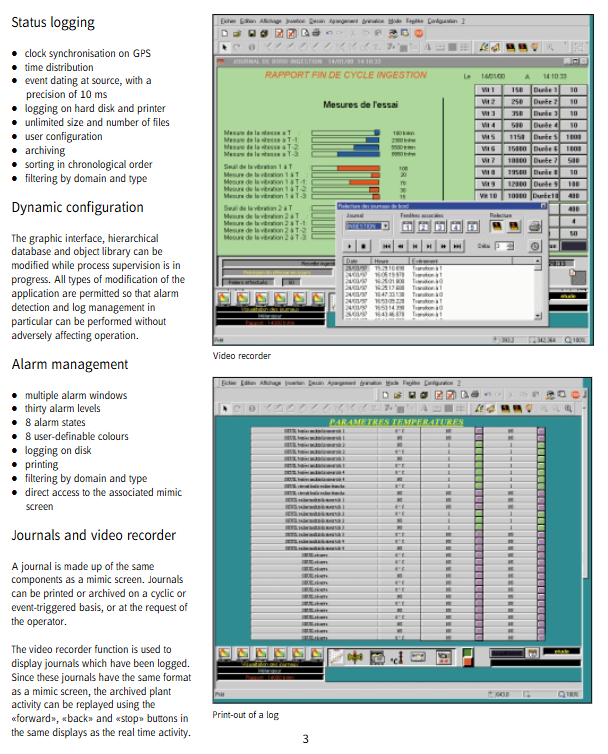
The log is composed of the same components as the simulation screen and can be printed or archived in three ways: loop/event triggered/operator requested.
The screen recording function can display the recorded logs, which are in the same format as the simulated screen. The factory's historical operating status can be replayed through the forward/backward/stop buttons, which is consistent with the real-time monitoring interface.
Formula management: Supports up to 2000 formulas, with a maximum of 5000 variables per formula, to meet the formulation management needs of industrial production.
System Architecture and Redundancy Management
Three deployment architectures
Architecture Type Core Features Adaptation Scenarios
Single workstation independent local control, standard protocol/serial link/Applicom card single independent industrial process monitoring
Multi workstation distributed database system, real-time exchange of variable values, supporting scenarios where multiple semi independent processes are interconnected through alarm confirmation/operator action broadcasting
The client server serves as a data producer, interfaces with the PLC, and broadcasts data to the client as a front-end communication interface; The client can be remotely deployed to access scenarios where multiple operators need to access the integration process through STN/other telecommunications methods
Redundancy management capability
PLC redundancy: Built in ALSPA PLC redundancy management function simplifies workstation configuration and PLC programming, enhancing system hardware reliability.
Server redundancy: dual servers running in parallel, all connected to PLC; Each client is associated with a primary/backup server, which automatically switches to the backup server in case of a primary server failure, ensuring the continuous operation of the system.
Communication and Open Characteristics
Native industrial network support: compatible with Alstom ALSPA series industrial networks, covering different industrial application scenarios:
ALSPA N80: Token Network, balancing cost and performance for manufacturing applications;
ALSPA E80: Ethernet TCP/IP, communication standard for production units;
ALSPA F8000: On site network benchmark for time critical control in high-speed industrial applications;
ALSPA S8000: A client server architecture for Ethernet TCP/IP that combines performance and openness.
Third party device connection: Supports multiple protocol interface cards, can be integrated with any type of controller, and achieve cross brand device integration.
Standard industrial interface
ODBC interface: supports recording trend, log, and archive data to relational databases, and can also read recipes from external databases;
DDE/DLL dynamic linking: calling external functions through DLL, exchanging data through DDE, and achieving linkage with external applications;
OLE 2 interface: can integrate real-time animation windows of Windows applications such as Excel into the running screen;
Active X: As an Active X container, any Active X component can be integrated into the simulation screen and achieve real-time animation.
Remote Web Access: Equipped with ALSPA P1200 Web (built-in web server), it can access simulation screens, alarm views, and trends through browsers such as IE/Netscape; It supports intranet/Internet operation. Security permission management can distinguish display/control permissions. Intranet can control any Ethernet node, and the Internet can realize global remote maintenance.
Custom programming ability
Support SCADA BASIC structured language, capable of logic processing, animation, external DLL program calling, and custom operation station components;
Support Visual BASIC ®, Access all graphical components and optimize the operator interface.
Technical specifications and product models
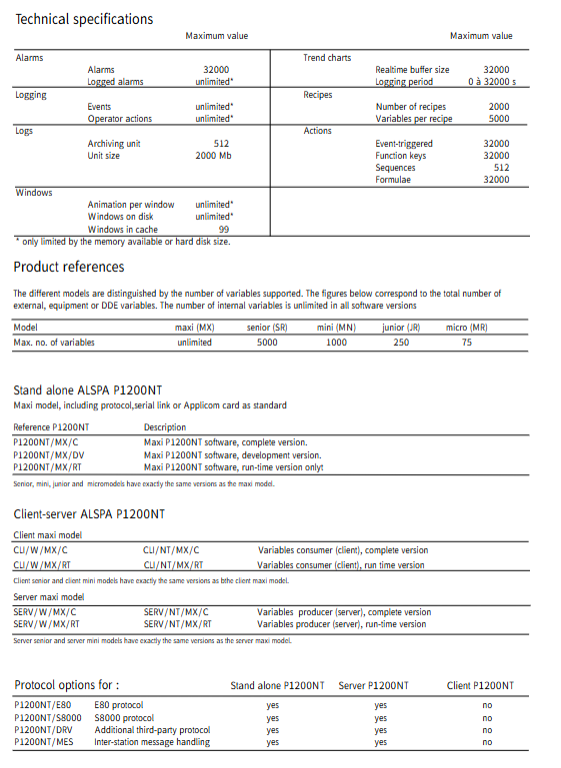
Core technical specifications (maximum value)
Functional module specification parameters Functional module specification parameters
Total number of alarms 32000 Real time trend buffer 32000
Record unlimited number of alarms, trend recording period 0-32000s
Unlimited number of events/operator actions, formula quantity 2000
Archive Unit 512: 5000 variables per recipe
Archive unit size 2000Mb, number of event triggered actions 32000
99 cache windows, 32000 function keys
Number of sequences 512, number of formulas 32000
Single window animation/unlimited disk window * --
Note: Due to memory/hard disk size limitations
Product model classification: Divided into 5 levels based on the maximum number of supported variables, with no limit on the number of internal variables. The number of external/device/DDE variables is as follows:
Model Micro (MR) Junior (JR) Mini (MN) Senior (SR) Maxi (MX)
Maximum number of variables 75 250 1000 5000 Unlimited
Software and deployment versions
Software version: Full version (C), Development version (DV), Run only version (RT), all models support these three types of versions;
Deployment version: Independent version, client version, server version, both client/server versions support Maxi/Senior/Mini models;
Protocol options: E80/S8000/DRV (third-party)/MES (inter station messaging), only supported in the standalone/server version, not in the client version.
- YOKOGAWA
- Reliance
- ADVANCED
- SEW
- ProSoft
- WATLOW
- Kongsberg
- FANUC
- VSD
- DCS
- PLC
- man-machine
- Covid-19
- Energy and Gender
- Energy Access
- Renewable Integration
- Energy Subsidies
- Energy and Water
- Net zero emission
- Energy Security
- Critical Minerals
- A-B
- petroleum
- Mine scale
- Sewage treatment
- cement
- architecture
- Industrial information
- New energy
- Automobile market
- electricity
- Construction site
- HIMA
- ABB
- Rockwell
- Schneider Modicon
- Siemens
- xYCOM
- Yaskawa
- Woodward
- BOSCH Rexroth
- MOOG
- General Electric
- American NI
- Rolls-Royce
- CTI
- Honeywell
- EMERSON
- MAN
- GE
- TRICONEX
- Control Wave
- ALSTOM
- AMAT
- STUDER
- KONGSBERG
- MOTOROLA
- DANAHER MOTION
- Bentley
- Galil
- EATON
- MOLEX
- Triconex
- DEIF
- B&W
- ZYGO
- Aerotech
- DANFOSS
- KOLLMORGEN
- Beijer
- Endress+Hauser
- schneider
- Foxboro
- KB
- REXROTH
- YAMAHA
- Johnson
- Westinghouse
- WAGO
- TOSHIBA
- TEKTRONIX
- BENDER
- BMCM
- SMC
- HITACHI
- HIRSCHMANN
- XP POWER
- Baldor
- Meggitt
- SHINKAWA
- Other Brands
- UniOP
- KUKA
- IBA
- Beckhoff
- ADLINK
-
FANUC A06B-0169-B088 - AC Servo Motor Alpha M40 3000 3 KW
-
ALPHA WIRE 1299C-SLATE-1000 - Multi-Conductor Cable Wire
-
alpha / Wittenstein SK+180S-MF1-10-1M1-1K - Hypoid Gearbox i=10
-
ALPHA WIRE 1181/40C SL005 - Multi-Conductor Cable Wire
-
Generic / DSI Straight Anatomic Plastic Adapter Head + Screw Hex - Dental Implant Fixture
-
Alpha II-650 MV6500526A - Power Supply Unit
-
ALPHA WIRE 7036 WH001 - Hook-Up Wire
-
FANUC RDCGM00000004O / TP 050-MF1-7-061-000 - Gear Reducer / Alpha Gearbox
-
Alpha II-650 MV6500436A - TDK-Lambda Power Supply Unit
-
Alpha S-Alpha600 J60033 - 600W Switching Power Supply Unit
-
Alpha 1500W J00032 - Power Supply Unit
-
Alpha 600W H60638 - Switching Power Supply Unit
-
Alpha 650 MV6500314A - Power Supply Unit
-
Aloka UST-5413 - Linear Probe for Prosound Alpha 6
-
ALPHA WIRE TFT25015 NA002 - High Temperature Heat Shrink Tubing Wire Sleeving
-
JAVAD ALPHA2 / GrAnt-G3 - GPS Receiver
-
Alpha 400W H47318 - Switching Power Supply Unit
-
Alpha SG-ALPHA-202-001 / Q1001-010-001 - Circuit Board Module
-
Antlia Dual ERF H-Alpha & Cak/CaH - Density Astronomical Accessory
-
ALPHA WIRE 5100C SL033 - Multi-Conductor Cable Wire
-
ALPHA WIRE 5098C-SL033 - Multi-Conductor Cable Wire
-
Fanuc A06B-6290-H105 - Alpha Sv 80hv-B Module Servo Amplifier
-
FANUC A06B-6240-H105 - Aux Axis Alpha aiSV 80 Servo Amplifier
-
Endress+Hauser Alpha-Log RSA10-61B1S / 42974737/0130 - Data Logger Measurement Instrument
-
ALPHA WIRE 6363-SL002 - Multi-Conductor Cable Wire
-
Alpha SP100S-MF1-7-1K1-2S - Gear Reducer
-
Alpha SP 100G-MF1-4-0H1-2S-PGG - Planetary Gear Reducer
-
FANUC A06B-0143-B175 #0275 - Alpha 12/3000 AC Servo Motor
-
James Burn Alpha Doc P33 / GBC PDI - Automatic Punch DocuPunch
-
Titus HVAC 105383-01 - ALPHA BAC Controller and Actuator
-
Wittenstein Alpha SP 100S-MF2-20-0E0-2S - Planetary Gearbox i=20
-
Kashiyama Alpha-85-ZV / SP-8026G - Pump Controller
-
Christ Alpha 2-4 LDplus - Freeze Drier Part N/ 101542
-
Lambda / Alpha H40896 - 400W Power Supply Unit
-
Wittenstein Alpha LP-070S-MF1-3-1E1-38 - Planetary Gearbox
-
Matrox / EXO-2480 133-D06-3 / 398-17962-1 - Alpha Numeric PCB Board
-
Fanuc A06B-6096-H204 - Dual Axis Alpha Servo Amplifier Module
-
Alpha Wire 5002C-SL001 - Multi-Conductor Cable 2 Conductors 22AWG 300VAC
-
Alpha 600W H60638 - Switching Power Supply Unit
-
Alpha Scientific Spin Precession Dual Electro Magnet Beam Line Chamber - Electro Magnet Beam Line Chamber
-
ALPHA WIRE 6017C SL005 - Multi-Conductor Cable Wire
-
ALPHA WIRE 65804 SL002 - Multi-Conductor Cable Wire
-
Fanuc A06B-0152-B010 - AC Servo Motor Alpha A30/2000 with Brake
-
ALPHA WIRE 5856-VI001 - Hook-Up Wire
-
ALPHA WIRE M13142-SL001 - Multi-Conductor Cable Wire
-
Alpha & Omega AOZ1017 - 8-Pin SOIC SMD Buck Switching Regulator IC
-
Alpha 600W H67027 CA600 - 600W Switching Power Supply Unit
-
ALPHA WIRE 2845/7-RD001 - Hook-Up Wire
-
Wittenstein Alpha VH+063S-MF1-10-6H1-1K-0C2 - Worm Gear Reducer i=10
-
ALPHA WIRE 2414C SL022 - Multi-Conductor Cable Wire
-
ALPHA WIRE 5672-SL005 - Multi-Conductor Cable Wire
-
BECKHOFF / Alpha AM8021-0B10-0000 + CP 040-MO1-10 - Servo Motor with Planetary Gearbox
-
ALPHA Systems Lab Inc MBA-WV1-F / PCB-WV1-F - PCB Board
-
FANUC A06B-0826-B201 - Alpha P12 AC Spindle Motor
-
WF & HC / Alpha-E 10045 - Tiller Bar Flat Flange Inlet 3150LB 3X 2.5 Inch
-
Seiler Alpha Air 3 - Dental Microscope
-
Alpha 400W H47223 - Switching Power Supply Unit
-
Wittenstein Alpha SP 180S-MC1-5-1M0-2K - Planetary Gearbox
-
FANUC A06B-6117-H211 - Servo Amplifier Module Alpha iSV 160/160 Amp
-
Alpha S-Alpha600 J60033 - 600W Switching Power Supply Unit
-
Adaptive Alpha Eclipse StreetSmart Model 17X - Master Slave LED Sign 44 x 44 Inch
-
ALPHA WIRE 391697-WH005 / 391697WH005 - Hook-Up Wire
-
Generic 22W Laser Engraver Cutter - Smart Air Pump APP Control CNC Dual-core CPU DIY Tools
-
FANUC A06B-6102-H226 / A06B6102H226 - Spindle Amplifier Module
-
FANUC A06B-6090-H006 / A06B6090H006 - Servo Power Supply Module
-
Alpha Wire Apr-19 - High Low Temperature Cable 75 FT
-
Wittenstein Alpha HG+ 075S-MF2-28-6E1-1S10 - Hypoid Gearbox Reducer i=28
-
Alpha J00032 - 1500W Power Supply Unit
-
Alpha H47038 - 400W Power Supply Unit
-
FANUC A06B-6096-H204 - Dual Axis Alpha Servo Amplifier Module
-
Wittenstein Alpha LPB090-MO1-10-111-00 - Alpha Planetary Gearbox
-
ALPHA WIRE 2842/19-YL001 - Hook-Up Wire
-
WITTENSTEIN ALPHA HG+060S-MF1-56C1-1K00 - Planetary Gearbox
-
Basler A102K Alpha VIS - Black and White CCD Industrial Camera
-
Alpha H40935 - 400W Power Supply Unit
-
FANUC A06B-6114-H207 - 2-Axis Servo Amplifier Module SVM20/40i Alpha i Series
-
TDK-Lambda / Alpha H47318 - 400W Switching Power Supply Unit
-
HITACHI Aloka Prosound Alpha 7 Premier - Diagnostic Ultrasound System
-
Alpha SP100S-MF1-4-1E1-2S - Precision Gear Reducer
-
FANUC A20B-2001-0950 - Control Circuit Board PCB
-
ALPHA WIRE 2855/1-GR001 - Hook-Up Wire
-
FANUC A06B-6096-H204 - Dual Axis Alpha Servo Amplifier Module
-
Wittenstein Alpha LPB090-MO1-10-111-00 - Alpha Planetary Gearbox
-
ALPHA WIRE 2842/19-YL001 - Hook-Up Wire
-
Basler A102K Alpha VIS - Black and White CCD Industrial Camera
-
Wittenstein Alpha LP 090-M01-7-111-000 / Schneider - Gear Box i:7 Schneider Electric Servo Motor
-
LAMBDA ALPHA 600W H60554 - Switching Power Supply Unit
-
Fanuc A06B-0238-B100 / A860-2000-T301 - AC Servo Motor with Encoder
-
FANUC A06B-6290-H322 - ALPHA iSV 10/10/10HV-B 3-Axis Servo Drive
-
Polymotor Italiana 9919 121 90332 / Alpha SP75-M1-3 - D.C. Permanent Magnet Motor with Gearbox
-
MJ Research PTC-200 - PCR DNA Engine Thermal Cycler with Dual 48-Well Alpha Block
-
ALPHA WIRE 5002C-SL002 - Multi-Conductor Cable Wire
-
Fluke / Victoreen ASM 990 / 489-110D - Biomedical Radiation Detector Probe with Pelican Case
-
ALPHA WIRE 5855-BK001 - Hook-Up Wire 22AWG Silver Plated Copper
-
Tetra / Alpha 600W H60552 - Switching Power Supply Unit
-
Bruker Alpha FTIR Spectrometer / Alpha-P ATR - Infrared Spectrometer FTIR Instrument
-
Simagic AlphaM-FX-C 290mm FX-C - Formula Steering Wheel with Alpha Mini Wheel Base
-
Alpha Wire 5152C 20/2C - XtraGuard High Performance Instrumentation/Control Cable
-
ALPHA WIRE 1219/40C SL005 - Multi-Conductor Cable Wire
-
ALPHA WIRE 3131441 TN005 - Multi-Conductor Cable Wire
-
ALPHA WIRE 2172-SV005 - Multi-Conductor Cable Wire
-
FANUC A20B-2100-0742 - ALPHA ia Servo Control Board
-
Olympus Endo Alpha Cart TI-A1 - Medical Equipment Cart with Accessories
-
ALPHA WIRE 74010-BK002 - Multi-Conductor Cable Wire
-
Fanuc A06B-6110-H026#N - ALPHA i Power Supply Module PSM-26i
-
Alpha Laval SX2/013 - Rotary Lobe Pump
-
Alpha II-450P MV4500007B - Switching Power Supply Unit
-
TDK-Lambda / Alpha 400W - Switching Power Supply Unit
-
ALPHA ALPHA6000E-3015GB/3018PB - Frequency Inverter Drive Power Converter
-
ALPHA WIRE 391245-WH005 - Hook-Up Wire
-
Alpha H60562 CA600 - 600W Switching Power Supply Unit
-
Fanuc A06B-0147-B675 - Alpha 22/2000 3.8kW 2000rpm AC Servo Motor
-
ALPHA WIRE 9821 - Twinaxial Cable 1PR 25AWG Poly Insulation
-
Fanuc / Alpha A16B-2203-0820 - ALPHA i Spindle Wiring PCB
-
FANUC A20B-2100-0742 - ALPHA ia Servo Control Board
-
Fanuc A06B-6096-H104 - Alpha Servo Module
-
Fuji Electric RYT202D5-VV2 / Faldic Alpha5 - Servo Amplifier
-
ALPHA WIRE 2817/6 20 AWG - PTFE High Temperature Cable
-
Aloka Prosound Alpha 10 / EU-6031C / JB-274D - High Voltage Power Supply for Ultrasound
-
Wittenstein Alpha SP 140S-MF1-5-01F-2S - Planetary Gearbox
-
FANUC A06B-6124-H205 - Alpha iSV Servo Amplifier Module
-
TDK-Lambda / Alpha MV6500314A - 650W Power Supply Unit
-
TDK-Lambda / Alpha H47318 - 400W Switching Power Supply Unit
-
Alpha H47318 - 400W Switching Power Supply Unit
-
CNC Bearing / Alpha AR090-S1-300-20-N - Robotics Bearing Component
-
Alpha CA400 5A,3.3Q,5B,12/12E / DXH47037 - 400W Power Supply Unit
-
FANUC A20B-2100-0742 - ALPHA ia Servo Control Board
-
Fanuc / Amada A04B-0810-C403 / LC1212 alpha II - Pressure Regulator

K-JIANG

Add: Jimei North Road, Jimei District, Xiamen, Fujian, China
Tell:+86-15305925923