

K-WANG


YOKOGAWA FFCS COMPACT CONTROL STATION IN CENTUM CS3000 R3
YOKOGAWA FFCS COMPACT CONTROL STATION IN CENTUM CS3000 R3
Overview
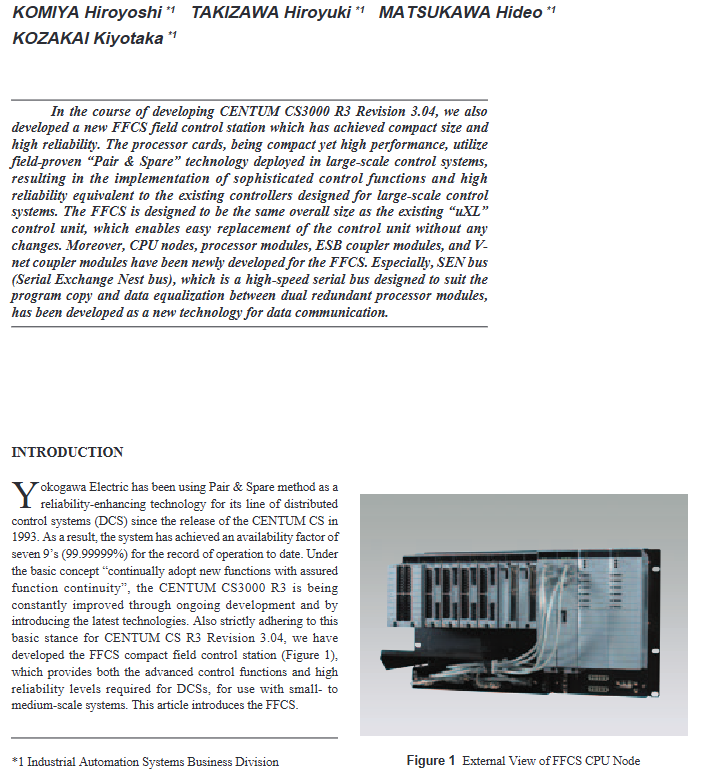
Yokogawa Electric released a technical report (No. 38) in 2004, focusing on the newly added FFCS compact field control station in the CENTUM CS3000 R3 V3.04 version. As a field control station (FCS) designed specifically for small and medium-sized systems, FFCS inherits the high reliability and advanced functions of large DCS, achieves compactness through a new hardware design, and is compatible with existing uXL systems, supporting low-cost upgrades, enriching the FCS product line of CENTUM CS3000 R3 (including standard, extended, renewable, and highly distributed types).
FFCS Core Features
Specific description of characteristic category
Compact and compatible volume is 1/5 of traditional control units; The external dimensions are consistent with the uXL control system control unit and can be directly replaced, maximizing the reuse of existing assets
High reliability adopts Pair&Spare dual redundancy technology, with no instantaneous switching control in case of failure; System availability reaches 7 9s (99.99999%)
Advanced features with complex control functions equivalent to large controllers, supporting system software reuse (common for small and medium-sized/large factories)
Scalable CPU nodes can install up to 8 I/O modules; Can connect up to 3 extension nodes (directly coupled nodes+remote nodes)
Hardware compatibility is compatible with the I/O module (IOM) and field network I/O module (FIO) of CENTUM CS3000 R3
Hardware configuration details
(1) Overall redundant architecture
FFCS supports full hardware dual redundancy configuration, with core redundant components including processor modules, power units (PW481/PW482/PW484), communication buses (SEN/ESB/ER/V-net), and I/O modules, ensuring that a single point of failure does not affect system operation.
(2) Core hardware components
CPU node
The smallest system core can run independently and can install up to 8 IOM modules;
Scalability: Supports connecting 3 expansion nodes (directly coupled nodes+remote nodes);
Interface module: EC401 (ESB bus coupler) is required to connect directly coupled nodes, and EB401 (ER bus main interface module) is required to connect remote nodes.
CP401 processor module
Redundant design: dual MPU architecture, synchronous computing+cross checking, detecting instantaneous errors;
Hardware Reuse: Integrated with CENTUM CS3000 mature CP345 processor card and SB301 interface card, software compatible;
Packaging form: Modular packaging (replacing traditional card design), built-in nickel hydrogen battery (environmentally friendly alternative to nickel cadmium battery), backup main memory;
Core function: Achieve fault free instantaneous switching and ensure control continuity.
The SEN bus (Serial Exchange Nest bus) is specifically developed for program copying and data synchronization of dual redundant processor modules, with the following key parameters:
Specific specifications of parameter items
Transmission method: synchronous serial transmission
Transmission rate 384 Mbps
Data access size 1-256 bytes (depending on frame structure)
Address space of 32 bits per module (4 GB)
Signal level LVDS (EIA/TIA-644 standard)
Topology point-to-point structure
Redundancy feature standard configuration
Error detection CRC-CCITT (16 bits), idle frame self diagnosis
Live operation support module for live plugging and unplugging
Advantages: Compared to traditional parallel transmission, the signal line and installation area are reduced to 1/10, reducing radiation noise and power consumption.
Other key modules
EC401: ESB bus coupler module, 1 ESB bus port, dual module configuration supports ESB bus redundancy;
V-net coupling unit: integrates V-net data link control and physical layer interface to achieve signal isolation and level conversion;
EB401/EB501: ER bus master/slave interface module, used to connect remote nodes;
SB401: The ESB bus is an interface module used to expand communication between nodes and CPU nodes.
System configuration and connection
Minimum system: Only CPU nodes (including 8 IOM modules) meet basic control requirements;
Expansion system: CPU nodes+up to 3 expansion nodes (directly coupled nodes/remote nodes) to expand I/O capacity;
Connection logic:
CPU node ↔ Directly coupled nodes: EC401 (CPU end)+SB401 (expansion end)+ESB bus;
CPU/Directly Coupled Node ↔ Remote nodes: EB401 (master)+EB501 (slave)+ER bus.
Adaptation scenarios and value
Adaptation scenario: Distributed control requirements for small and medium-sized factories, especially suitable for space constrained and high reliability scenarios;
Upgrade value: uXL system users can directly replace control units, minimize equipment investment, and reuse existing assets;
Technical value: The SEN bus lays the foundation for subsequent FCS functional upgrades (such as greater data synchronization), and the dual redundancy design ensures production continuity.
Key issues
Question 1: How can the FFCS compact on-site control station achieve compact design while ensuring reliability and control functions comparable to large DCS?
Answer: ① Reliability guarantee: Adopting Yokogawa's mature Pair&Spare dual redundancy technology, the processor module dual MPU synchronous calculation+cross validation, no instantaneous switching control in case of failure, system availability reaches 7 9s (99.99999%), consistent with large DCS; ② Functional reuse: Integrate the validated CP345 processor card and SB301 interface card core assets of CENTUM CS3000 on hardware, and universal system software at the software level to ensure consistent complex control functions; ③ Compact implementation: Adopting high-density installation technologies such as BGA packaging programmable devices, 1005 size components, and multilayer boards, multiple traditional card components are integrated into a single modular package, compressing the volume to 1/5 of traditional control units.
Question 2: What are the core technical advantages of FFCS's SEN bus compared to traditional parallel transmission buses? What practical value do these advantages bring to the operation of the system?
Answer: The core advantages and practical value are as follows: ① Transmission performance: With a speed of 384 Mbps, it meets the large data synchronization requirements of dual redundant processors and solves the problem of insufficient transmission capacity of traditional buses; ② Hardware optimization: point-to-point serial transmission, reducing signal lines and installation area to 1/10, reducing hardware costs and space occupation; ③ Stability improvement: Adopting LVDS level standard, with low radiation noise and low power consumption, combined with CRC-CCITT error detection and idle frame self diagnosis function, to improve transmission reliability; ④ Convenient operation and maintenance: supports module live plugging and unplugging, maintenance can be carried out without stopping the machine, reducing the risk of production interruption; ⑤ Compatibility: Inheriting the existing backplane bus software interface, users can use it without additional adaptation.
Question 3: What are the core advantages of upgrading to FFCS for existing uXL control system users? What hardware compatibility issues should be noted during the upgrade process?
Answer: Core upgrade advantages: ① Seamless replacement: FFCS has the same external dimensions as the uXL control unit and can be directly replaced without changing the installation structure, maximizing the reuse of existing assets; ② Performance improvement: Achieve high reliability (dual redundancy) and advanced control functions equivalent to large DCS, meeting higher production requirements; ③ Flexible Expansion: Supports up to 3 expansion nodes and 8 I/O modules, and can be flexibly expanded according to production scale. Compatibility issues to be noted: ① Power supply unit: Use the PW481/PW482/PW484 models specified in the document to ensure power supply matching; ② I/O module: Only compatible with the IOM (I/O module) and FIO (Field Network I/O module) of the CENTUM CS3000 R3 series. It is necessary to confirm whether the existing module belongs to this series; ③ Expansion interface: When connecting expansion nodes, dedicated interface modules such as EC401 and EB401 must be used in conjunction, and other types of interface cards cannot be mixed.
- YOKOGAWA
- Reliance
- ADVANCED
- SEW
- ProSoft
- WATLOW
- Kongsberg
- FANUC
- VSD
- DCS
- PLC
- man-machine
- Covid-19
- Energy and Gender
- Energy Access
- Renewable Integration
- Energy Subsidies
- Energy and Water
- Net zero emission
- Energy Security
- Critical Minerals
- A-B
- petroleum
- Mine scale
- Sewage treatment
- cement
- architecture
- Industrial information
- New energy
- Automobile market
- electricity
- Construction site
- HIMA
- ABB
- Rockwell
- Schneider Modicon
- Siemens
- xYCOM
- Yaskawa
- Woodward
- BOSCH Rexroth
- MOOG
- General Electric
- American NI
- Rolls-Royce
- CTI
- Honeywell
- EMERSON
- MAN
- GE
- TRICONEX
- Control Wave
- ALSTOM
- AMAT
- STUDER
- KONGSBERG
- MOTOROLA
- DANAHER MOTION
- Bentley
- Galil
- EATON
- MOLEX
- Triconex
- DEIF
- B&W
- ZYGO
- Aerotech
- DANFOSS
- KOLLMORGEN
- Beijer
- Endress+Hauser
- schneider
- Foxboro
- KB
- REXROTH
- YAMAHA
- Johnson
- Westinghouse
- WAGO
- TOSHIBA
- TEKTRONIX
- BENDER
- BMCM
- SMC
- HITACHI
- HIRSCHMANN
- XP POWER
- Baldor
- Meggitt
- SHINKAWA
- Other Brands
- UniOP
- KUKA
- IBA
- Beckhoff
- ADLINK
-
ENOTEC OXITEC 5000 SME-53310000 InSitu O2 Gas Analyzer System
-
TRICONEX 3723X 32-Channel TMR Analog Input Module with HART for Tricon CX
-
GE 151X1233DB02SA02 Rev A Pitch Converter 30 Nm DC Pitch Conversion Module
-
GE 151X1207CK02SA02 77MM DE Excitation Module for Mark VI Turbine Control Systems
-
HIMA H6200A Analogue Isolator Power Supply for HIMax Safety Systems
-
ABB SACO 64D4 Digital Annunciator Unit with 64 Alarm Channels
-
Allen-Bradley 5069-L306ER - SER A CompactLogix Controller PLC
-
Omron CJ1W-CORT21 - CANopen Master Unit PLC Module
-
Danfoss 131B9523 / FC-102P5K5T4E20H1 - 5.5kW VLT HVAC Drive Inverter
-
Schneider Electric LXM32MU90M2 - Lexium 32 Servo Drive Controller
-
Danfoss AKD102P15KT4P21H1 - 15kW 131L2413 ADAP-KOOL Drive Inverter
-
Kollmorgen S70602-NANANA - Servo Drive Controller
-
Allen-Bradley 6189-PS2 - Power Supply Industrial Computer PS
-
Beijer E900T / 03010F - Operator Panel IFC ETTP HMI
-
Schneider Electric LMC20 - PacDrive Motion Controller PLC
-
Sartorius CAW2S1-3DC-NCE - COMBICS 2 Industrial Scale Terminal
-
Kollmorgen / Danaher S30301-NA / S300 - SERVOSTAR343 Servo Drive Controller
-
Siemens A5E00159503 - 12 INCH TFT Touch Panel HMI
-
Siemens 3UF5021-3AB00-1 - SIMOCODE DP Basic Unit Control Module
-
Danfoss 131B8872 / FC-202PK37T4E20H1 - 0.37kW VLT AQUA Drive Inverter
-
Atlas Copco ICB421-2003D / VSK001001 - W9139 ICM431-0025C ICM431-0025D Controller
-
Lenze EV82EV751_4C - Version 4A39 Frequency Inverter Drive
-
Atlas Copco / ABB 3HAB8101-19/07B - Robot Cable Assembly Harness
-
Beijer X2 Pro7-B2 - Operator Panel HMI Touch Screen
-
Honeywell CDW45L - Damper Actuator
-
B&R X67DM9331.L12 - Rev. I0 Digital Mixed Module
-
B&R X67DM9331.L12 - Rev. H0 Digital Mixed Module
-
Sanyo Denki PMM-BA-5604-1 - Pentasyn Stepper Motor Driver
-
SICK AWS1-113 / 1008900 - Evaluation Unit
-
Siemens 1TF6064-1AF71-3AH1 - SIMOTICS Synchronous Servo Motor
-
Heidenhain ERN680.P003-4096 / 29416004 - Rotary Encoder
-
Schneider Electric LC1G185EHEA - TeSys Control Contactor
-
Parker SBC HPD5N - High Performance Drive Electronics SPA
-
Advantech UNO-2170-CE11BE - Embedded Automation Computer IPC
-
Siemens 6AG1231-4HF32-4XB0 - SIPLUS S7-1200 SM 1231 Analog Input Module
-
Advantech UNO-2170-BTO - Embedded Automation Computer IPC
-
Jumo SR-96/4-001.0.0.00.111 - Solid State Relay Power Controller
-
Pepperl+Fuchs FC-21-V - FC-20P Safety Barrier Module
-
Emerson SP1404 - Unidrive AC Drive Inverter
-
B&R X67AI1233 - Rev.C0 Analog Input Module
-
Mitsubishi FR-F740-00250-EC - Frequency Inverter AC Drive
-
Allen-Bradley 2711P-T7C21D8S - PANELVIEW PLUS 7 SERIES B Touch Screen HMI
-
Pilz PMCprotego D.03/000/0/0/2/208-480VAC / 8176101 - Servo Amplifier Drive
-
Reliance Electric 57C414 / 57414-1N - Modbus Interface Module
-
Mitsubishi FR-F740-00250-EC - Frequency Inverter AC Drive
-
Siemens 6SN1123-1AA00-0EA2 - Version A 160A SIMODRIVE Power Module
-
Siemens 1TF6064-1AF71-3AH1 - SIMOTICS Synchronous Servo Motor
-
AEG ALU202 / DAP216 / DEP216 / DAU202 - SIM216 SIM203 DNP205 ADU205 PLC Controller KIT
-
Atlas Copco / ABB 3HAB8101-19/07B - Robot Cable Assembly Harness
-
Hitachi CPU22-02HB - Micro-EHV Programmable Controller PLC
-
Parker SBC HPD5N - High Performance Drive Electronics SPA
-
Jetter JX3-THI2-RTD - JX3-BP Temperature Input Module
-
Eaton DC1-34014FB-A20N - 5.5kW Inverter Variable Frequency Drive
-
Eaton DS7-34DSX041N0-D - Soft Starter
-
Reliance Electric 57C422B / 57422-2E - 2-Axis Servo Controller
-
Hitachi CPU22-02HB - Micro-EHV Programmable Controller PLC
-
Eaton DC1-34014FB-A20N - 5.5kW Frequency Inverter Variable Frequency Drive
-
Siemens 6SN1123-1AA00-0EA2 - Version A 160A SIMODRIVE Power Module
-
Reliance Electric 57C414 / 57414-1N - Modbus Interface Module
-
Eaton DS7-34DSX041N0-D - Soft Starter
-
Reliance Electric 57C422B / 57422-2E - 2-Axis Servo Controller
-
Johnson Controls DX-9120-8454 - Digital Controller
-
Jetter JX3-THI2-RTD - JX3-BP Temperature Input Module
-
Siemens 6SL3210-1KE21-7AP1 - SINAMICS G120C DP 7.5kW BOP-2 Inverter Drive
-
Siemens 1FK7042-2AF21-1QG0 - SIMOTICS S Synchronous Servo Motor
-
Mettler Toledo IND570 - Harsh Analog Weighing Terminal Controller
-
Schneider Electric TM238LDA24DR - Modicon M238 Programmable Logic Controller PLC
-
Hitachi EH-CPU548 - EH-150 PLC CPU Module
-
Honeywell Q7750A2003 - Excel 10 Zone Controller
-
Ferag 584.002.V003 - Control Panel HMI
-
Danfoss AK-SM 720 / 080Z8511 - ADAP-KOOL System Manager Controller
-
Ferag 584.002.V003 - Control Panel HMI
-
Kern 3210001.001 / LOP-KS 2903440.001 - PRT.205A.0000.V001.02341 Servo Controller Board
-
Reliance Electric 57C424 - Maxpak III High Speed Link Module
-
Telemecanique XBTA70101PA - Compact Terminal HMI Panel
-
Reliance Electric 57C424 - Maxpak III High Speed Link Module
-
Reliance Electric 57C422B - 2-Axis Servo Controller
-
Honeywell Q7750A2003 - Excel 10 Zone Controller
-
Telemecanique XBTN400 - Magelis Small Panel HMI
-
Schneider Electric TM172PDG42S - Modicon Programmable Logic Controller PLC
-
Fanuc HE693THM884M - Thermocouple Input Module
-
Selectron PMC22BAEZD / 220735 - Selecontrol PMC 22 ABEZD Controller Module
-
Baumuller BUS21-22/45-31-020 - Servo Drive Inverter
-
Schneider Electric TM172PDG42S - Modicon Programmable Logic Controller PLC
-
Schneider Electric ATV32HD11N4 - Altivar Variable Frequency Drive Inverter
-
Lenze 494_E.4B - DC Speed Controller
-
NORD SK300E-111-340-B - SKDA130E-111-340-IBS-AAA Frequency Inverter
-
Reliance Electric GMI-S02 - AC/AC Converter 380/400V 50/60Hz 2.3/2.8A Drive
-
Hakko / Monitouch V710CD - Operator Panel HMI Touch Screen
-
B&R 5PC910.SX01-00 / 5YZCAA00700000-005 - Automation PC Industrial Computer
-
Hitachi EH-CPU548 - EH-150 PLC CPU Module
-
Tecnau / Fortec FORTEC-04/UL / 10117 - PCB Circuit Board
-
Bosch PSS 2037 10B - Power Supply Module
-
Newall B602000 - Digital Readout Scale
-
ELCON PC Controller - Industrial PC Controller
-
Siemens 3UF5100-0AB00 - SIMOCODE-DP Control Module
-
Omron NS8-TV00B-V2 - Touch Screen HMI Panel
-
Siemens 6ES5264-8MA12 / IP264 - CAM Controller Module
-
Allen-Bradley 1756-L72S - SER B GuardLogix Safety Controller
-
Schneider Electric SXWMPC15A10001 - SmartX Controller Automation Server
-
Telemecanique LC1F265F7 - TeSys F Contactor
-
Siemens 6ES7314-6CH04-0AB0 - SIMATIC S7-300 CPU 314C-2 DP PLC
-
Allen-Bradley 1734-EI4S - POINT I/O Safety Module
-
Allen-Bradley 2711P-T7C4D8 / 2711P-RP8D - PanelView Plus HMI Touch Screen Logic Module
-
Ropex UPT-640-V - Resistron Temperature Controller
-
KEB 07.F5.B3A-0A00 - VERSION 1.1 Combivert Frequency Inverter
-
Sensopart V50-OB-A3-IW-M2-L - VISOR Vision Sensor Camera
-
SICK AFM60A-S1NB018X12 / 1059040 - Absolute Rotary Encoder
-
Kern AG KMC600 / 2903436.001 - Servo Drive Controller
-
Lenze E82EV302_4C200 / 13015655 - VERSION 3D35 Frequency Inverter Drive
-
Schneider Electric XBTOT2210 - Magelis Touch Screen HMI Panel
-
Baumuller BM5-O-SAF-000-000-000-001-202 - Parameter Safety Module
-
SICK UE4470-22EE690 - Safety Relay Controller
-
Hitachi EH-CPU448 / EH-150 - PLC CPU Module
-
Rexroth VT5005-13 - R5 00010592 Proportional Valve Amplifier Board
-
Siemens 6ES7510-1DJ00-0AB0 - SIMATIC ET 200SP CPU PLC
-
Beckhoff CX5120-0121 - 2GB Embedded PC Controller
-
Priva BlueiD S10 / 5010002 - SN3t 5020004 5010101 Building Automation Controller
-
Sigmatek DM161 - S-DIAS Digital Mix I/O Module
-
Telemecanique LC3D50P7A64 - Star Delta Starter Contactor
-
Siemens 6SN1123-1AA00-0BA2 - SIMODRIVE 611 Power Module
-
Siemens 6SN1124-1AA00-0CA1 - SIMODRIVE 611 Power Module
-
Dixell XC1015D-1C01F / XC1000D - Compressor Controller
-
Siemens A5E02184619 / 19T 577B - Industrial Touch Screen HMI Panel
-
Siemens 6SE6420-2AD27-5CA1 - Filter 6SE6400-2FS03-8CD0 Micromaster Inverter
-
Schneider Electric LC1G400LSEN - TeSys Control Contactor
-
Baldor BPS10-200-20-P - Servo Drive Motor Controller
-
Ingersoll Rand X4I / Y06IR03.00 - Air Compressor Controller

K-JIANG

Add: Jimei North Road, Jimei District, Xiamen, Fujian, China
Tell:+86-15305925923