

K-WANG


FANUC Series 0i MODEL F Plus Standard CNC System
FANUC Series 0i MODEL F Plus Standard CNC System
Product series and system composition
(1) Core product series
The system is divided into two series according to the type of machine tool, and the core specifications are as follows:
Product Model Applicable Scenarios Control Axis Count (1 Path/2 Paths) Simultaneously Control Axis Count Core Features
0i MF Plus machining center 12 axis/14 axis 4-axis compatible with complex machining centers, supporting multi-path collaboration
0i TF Plus lathe 15 axis/18 axis 4-axis with workpiece loading and unloading control path, suitable for lathe specific requirements
Note: Total number of control axes=number of feed axes+number of main axes (including workpiece loading and unloading control path).
(2) System hardware composition
Control unit: Provides integrated/detachable design, suitable for different cabinet spaces;
Display equipment: covering 10.4 "LCD/MDI units, PANEL+H/+H Pro (10.4"/15 "), FANUC+PC (15"/21.5 "/24"), meeting the operational needs of small to large machine tools;
Operating equipment: handheld operating unit (including emergency stop switch, manual pulse generator), portable manual pulse generator, etc;
I/O unit: divided into MODEL A/B series, supporting multi-point input/output, analog/temperature input, high-speed counter, some models comply with IP67 protection level, and can be configured separately;
Drive system: Equipped with α i-B/β i-B series servo motors, spindle motors, and servo amplifiers, supporting FSSB bus connection.
Core processing functions
(1) Efficient processing technology (reducing cycle time)
Core objective: By optimizing the machining program and dynamically adjusting parameters, the machining cycle time can be shortened. After the application of the example workpiece, the cycle time can be reduced by about 15% (4 minutes and 47 seconds → 4 minutes and 4 seconds);
Key functions:
Intelligent acceleration and deceleration: dynamically adjusting the time constant based on the inertia of the spindle/feed axis, improving the positioning efficiency of large inertial workpieces;
Spindle load control: Real time adaptation of cutting load, optimization of spindle speed and feed rate, and improvement of heavy cutting efficiency;
Sequential processing optimization: Shorten external signal response time and maximize spindle capability;
Efficient processing settings: Compare the current parameters with FANUC default values and configure the optimal parameters with just one click.
(2) Surface fine treatment technology (improving processing quality)
Core objective: To achieve high-quality processing, reduce surface defects, and adapt to precision scenarios such as mold processing;
Key functions:
Smooth tolerance+control: Smooth the path of small line segments within the specified tolerance range, reduce mechanical impact, and ensure that there are no program segment connection marks on the machined surface;
Servo learning control: For repetitive cutting workpieces such as non spherical surfaces and gears, achieve high-speed and high-precision machining with an error of ≤ 2 μ m;
Servo learning type shaking processing: tracks high-frequency shaking commands to finely crush chips without prolonging processing time;
Smooth TCP: When machining with 4-axis linkage, the tool endpoint trajectory is consistent with the instructions, adapting to complex shapes such as impellers and improving CAD/CAM compatibility;
High precision foundation: minimum setting unit of 0.1 μ m, maximum pre reading of 1500 program segments, supporting AI contour control and servo HRV+control.
Usability Design
(1) +HMI interactive system
Core advantage: Covering the entire process of "planning processing improvement", providing integrated operation screens, supporting dedicated keys to return to the HOME screen with one click;
Key functions:
Programming support: G-code wizard (menu based input of complex commands), machining program preview (pre run error detection), command color coded display;
Data management: Centralized management of tool data, with access to tool manufacturer catalog data; Integrate mechanical and CNC/amplifier/motor maintenance parts information;
Auxiliary tools: SERVO VIEWER (displaying operating waveforms, PMC signals), Operator Manual Browser (supporting CNC/machine tool/process manual registration).
(2) User defined functions
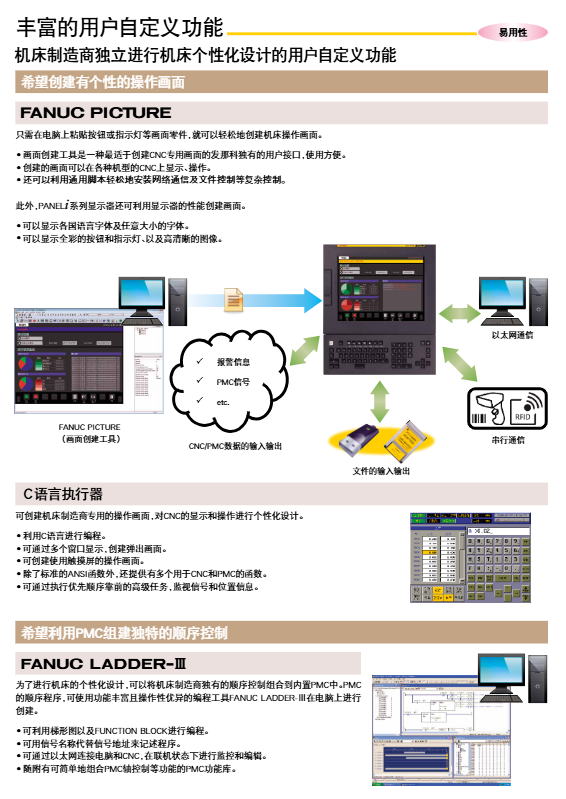
Screen customization: Using the FANUC PICURE tool, drag and drop buttons/indicator lights to create a dedicated operation screen that supports multiple languages and full-color display. Network communication and file control can be achieved through scripts;
Program customization: C language executor supports personalized programming, can create pop-up screens, touch screen operation interfaces, and provide CNC/PMC specific functions;
Sequential control customization: FANUC LADDER-III tool supports ladder diagram/Function BLOCK programming, can replace addresses with signal names, supports Ethernet online monitoring and editing, and comes with PMC function library.
(3) Program storage and operation optimization
Storage Expansion: The program memory supports CF cards (up to 2GB, 1000 programs/folders) or PC hard drives (up to 40GB), and supports high-speed GOTO jump;
USB convenient operation: USB programs can be run with one click, and copying and selecting the main program can be completed in one step;
Homework preparation support: Manually control the tool to contact the workpiece for measurement, supporting 8 measurement modes such as end face/outer diameter/inner diameter/width/corner, automatically setting the workpiece coordinate system, and reducing preparation time.
Expansion and connection functions
(1) Robot Easy Connection (CNC-QSSR)
Realize rapid integration of machine tools and robots through four major functions without the need for significant equipment modifications:
Function name, core function, operation advantages
QSSR CONNECT machine connected to robot with 1 Ethernet cable, guided initial setup
QSSR G-CODE CNC Control Robot G Code Instruction Control, Handwheel Positioning Teaching
QSSR AUTO PATH automatically generates motion trajectories with specified starting and ending points, automatically avoids collisions, and simulates confirmation
QSSR ON-SITE is compatible with existing machine tools without the need to modify the ladder diagram/software, with macro variable collaboration
(2) Rich network support
Basic network: Built in embedded Ethernet and Fast Ethernet (100Mbps), supporting program transmission and remote maintenance;
On site network: supports 8 types of industrial networks including FL net, EtherNet/IP (master/slave), PROFINET (master/slave), PROFIBUS-DP, etc., and can connect waterproof I/O devices and sensors (vibration/temperature);
IoT support: Through FANUC MT-LINK * operation management software, centralized collection of equipment information such as machine tools, robots, PLCs, etc., providing standard screens for overall monitoring, operation results, etc., supporting OPC UA/MTConnect protocol.
Security and Maintenance Assurance
(1) Security function
Double check safety function: compliant with ISO13849-1 PL d standard, dual processors monitor motor position/speed and safety I/O, and double block power path;
Network security function: supports FL net/EtherNet/IP/PROFINET security functions to ensure the safety of production lines;
STO function: The servo amplifier has a built-in safety torque cutoff function, which complies with the IEC61800-5-2 standard and double cuts off the circuit.
(2) High operational efficiency guarantee
Preventive maintenance function:
Insulation degradation detection: The amplifier automatically measures the insulation resistance of the motor, providing early warning of insulation problems caused by cutting fluid;
Fan speed detection: monitoring CNC/servo amplifier fan speed, boxed design for easy replacement;
Power outage protection: Through the power outage backup module (PFB-24/PFB-R/PFB-C), gravity axis anti fall, deceleration shutdown, tool retraction are achieved to avoid equipment and workpiece damage;
Fault diagnosis function:
Fault location: I/O Link+and FSSB support DO short circuit, disconnection, and power transient detection. The detector communication inspection circuit quickly distinguishes detector/cable/amplifier faults;
Diagnostic Screen: Provides fault diagnosis guidance, monitoring, and graphical screens, directly obtaining alarm related system status information on the CNC screen.
Digital twins and supporting tools
(1) Development and simulation tools
Tool Name Core Function Application Value
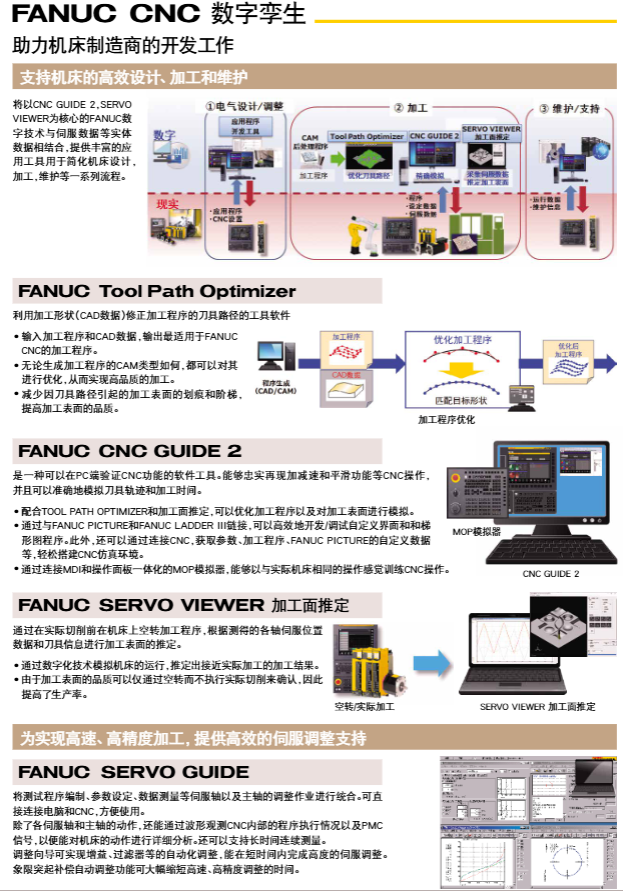
TOOL PATH OPTIONER: Input machining programs and CAD data, optimize tool paths to reduce surface scratches, improve quality, and adapt to any CAM generated program
CNC GUIDE 2 PC CNC Function Verification and Simulation Reproduction Acceleration/Deceleration/Smoothing Function, Simulating Tool Trajectory and Processing Time, Supporting Custom Interface/Ladder Diagram Debugging
When the SERVO VIEWER idle program is running, it is estimated that the machined surface does not require actual cutting to confirm the machining quality and improve productivity
(2) Debugging and adjustment tools
SERVO GUIDE: integrates the full process operation of servo/spindle adjustment, supports test program programming, parameter setting, data measurement, adjustment wizard automatically optimizes gain and filter, quadrant protrusion compensation automatically adjusts to shorten high-speed and high-precision adjustment time;
MOP simulator: linked with CNC GUIDE 2, providing integrated operation of MDI and operation panel, simulating the actual machine operation feeling, used for personnel training.
- YOKOGAWA
- Reliance
- ADVANCED
- SEW
- ProSoft
- WATLOW
- Kongsberg
- FANUC
- VSD
- DCS
- PLC
- man-machine
- Covid-19
- Energy and Gender
- Energy Access
- Renewable Integration
- Energy Subsidies
- Energy and Water
- Net zero emission
- Energy Security
- Critical Minerals
- A-B
- petroleum
- Mine scale
- Sewage treatment
- cement
- architecture
- Industrial information
- New energy
- Automobile market
- electricity
- Construction site
- HIMA
- ABB
- Rockwell
- Schneider Modicon
- Siemens
- xYCOM
- Yaskawa
- Woodward
- BOSCH Rexroth
- MOOG
- General Electric
- American NI
- Rolls-Royce
- CTI
- Honeywell
- EMERSON
- MAN
- GE
- TRICONEX
- Control Wave
- ALSTOM
- AMAT
- STUDER
- KONGSBERG
- MOTOROLA
- DANAHER MOTION
- Bentley
- Galil
- EATON
- MOLEX
- Triconex
- DEIF
- B&W
- ZYGO
- Aerotech
- DANFOSS
- KOLLMORGEN
- Beijer
- Endress+Hauser
- schneider
- Foxboro
- KB
- REXROTH
- YAMAHA
- Johnson
- Westinghouse
- WAGO
- TOSHIBA
- TEKTRONIX
- BENDER
- BMCM
- SMC
- HITACHI
- HIRSCHMANN
- XP POWER
- Baldor
- Meggitt
- SHINKAWA
- Other Brands
- UniOP
- KUKA
- IBA
- Beckhoff
- ADLINK
-
TRICONEX 3723X 32-Channel TMR Analog Input Module with HART for Tricon CX
-
GE 151X1233DB02SA02 Rev A Pitch Converter 30 Nm DC Pitch Conversion Module
-
GE 151X1207CK02SA02 77MM DE Excitation Module for Mark VI Turbine Control Systems
-
HIMA H6200A Analogue Isolator Power Supply for HIMax Safety Systems
-
ABB SACO 64D4 Digital Annunciator Unit with 64 Alarm Channels
-
Allen-Bradley 5069-L306ER - SER A CompactLogix Controller PLC
-
Omron CJ1W-CORT21 - CANopen Master Unit PLC Module
-
Danfoss 131B9523 / FC-102P5K5T4E20H1 - 5.5kW VLT HVAC Drive Inverter
-
Schneider Electric LXM32MU90M2 - Lexium 32 Servo Drive Controller
-
Danfoss AKD102P15KT4P21H1 - 15kW 131L2413 ADAP-KOOL Drive Inverter
-
Kollmorgen S70602-NANANA - Servo Drive Controller
-
Allen-Bradley 6189-PS2 - Power Supply Industrial Computer PS
-
Beijer E900T / 03010F - Operator Panel IFC ETTP HMI
-
Schneider Electric LMC20 - PacDrive Motion Controller PLC
-
Sartorius CAW2S1-3DC-NCE - COMBICS 2 Industrial Scale Terminal
-
Kollmorgen / Danaher S30301-NA / S300 - SERVOSTAR343 Servo Drive Controller
-
Siemens A5E00159503 - 12 INCH TFT Touch Panel HMI
-
Siemens 3UF5021-3AB00-1 - SIMOCODE DP Basic Unit Control Module
-
Danfoss 131B8872 / FC-202PK37T4E20H1 - 0.37kW VLT AQUA Drive Inverter
-
Atlas Copco ICB421-2003D / VSK001001 - W9139 ICM431-0025C ICM431-0025D Controller
-
Lenze EV82EV751_4C - Version 4A39 Frequency Inverter Drive
-
Atlas Copco / ABB 3HAB8101-19/07B - Robot Cable Assembly Harness
-
Beijer X2 Pro7-B2 - Operator Panel HMI Touch Screen
-
Honeywell CDW45L - Damper Actuator
-
B&R X67DM9331.L12 - Rev. I0 Digital Mixed Module
-
B&R X67DM9331.L12 - Rev. H0 Digital Mixed Module
-
Sanyo Denki PMM-BA-5604-1 - Pentasyn Stepper Motor Driver
-
SICK AWS1-113 / 1008900 - Evaluation Unit
-
Siemens 1TF6064-1AF71-3AH1 - SIMOTICS Synchronous Servo Motor
-
Heidenhain ERN680.P003-4096 / 29416004 - Rotary Encoder
-
Schneider Electric LC1G185EHEA - TeSys Control Contactor
-
Parker SBC HPD5N - High Performance Drive Electronics SPA
-
Advantech UNO-2170-CE11BE - Embedded Automation Computer IPC
-
Siemens 6AG1231-4HF32-4XB0 - SIPLUS S7-1200 SM 1231 Analog Input Module
-
Advantech UNO-2170-BTO - Embedded Automation Computer IPC
-
Jumo SR-96/4-001.0.0.00.111 - Solid State Relay Power Controller
-
Pepperl+Fuchs FC-21-V - FC-20P Safety Barrier Module
-
Emerson SP1404 - Unidrive AC Drive Inverter
-
B&R X67AI1233 - Rev.C0 Analog Input Module
-
Mitsubishi FR-F740-00250-EC - Frequency Inverter AC Drive
-
Allen-Bradley 2711P-T7C21D8S - PANELVIEW PLUS 7 SERIES B Touch Screen HMI
-
Pilz PMCprotego D.03/000/0/0/2/208-480VAC / 8176101 - Servo Amplifier Drive
-
Reliance Electric 57C414 / 57414-1N - Modbus Interface Module
-
Mitsubishi FR-F740-00250-EC - Frequency Inverter AC Drive
-
Siemens 6SN1123-1AA00-0EA2 - Version A 160A SIMODRIVE Power Module
-
Siemens 1TF6064-1AF71-3AH1 - SIMOTICS Synchronous Servo Motor
-
AEG ALU202 / DAP216 / DEP216 / DAU202 - SIM216 SIM203 DNP205 ADU205 PLC Controller KIT
-
Atlas Copco / ABB 3HAB8101-19/07B - Robot Cable Assembly Harness
-
Hitachi CPU22-02HB - Micro-EHV Programmable Controller PLC
-
Parker SBC HPD5N - High Performance Drive Electronics SPA
-
Jetter JX3-THI2-RTD - JX3-BP Temperature Input Module
-
Eaton DC1-34014FB-A20N - 5.5kW Inverter Variable Frequency Drive
-
Eaton DS7-34DSX041N0-D - Soft Starter
-
Reliance Electric 57C422B / 57422-2E - 2-Axis Servo Controller
-
Hitachi CPU22-02HB - Micro-EHV Programmable Controller PLC
-
Eaton DC1-34014FB-A20N - 5.5kW Frequency Inverter Variable Frequency Drive
-
Siemens 6SN1123-1AA00-0EA2 - Version A 160A SIMODRIVE Power Module
-
Reliance Electric 57C414 / 57414-1N - Modbus Interface Module
-
Eaton DS7-34DSX041N0-D - Soft Starter
-
Reliance Electric 57C422B / 57422-2E - 2-Axis Servo Controller
-
Johnson Controls DX-9120-8454 - Digital Controller
-
Jetter JX3-THI2-RTD - JX3-BP Temperature Input Module
-
Siemens 6SL3210-1KE21-7AP1 - SINAMICS G120C DP 7.5kW BOP-2 Inverter Drive
-
Siemens 1FK7042-2AF21-1QG0 - SIMOTICS S Synchronous Servo Motor
-
Mettler Toledo IND570 - Harsh Analog Weighing Terminal Controller
-
Schneider Electric TM238LDA24DR - Modicon M238 Programmable Logic Controller PLC
-
Hitachi EH-CPU548 - EH-150 PLC CPU Module
-
Honeywell Q7750A2003 - Excel 10 Zone Controller
-
Ferag 584.002.V003 - Control Panel HMI
-
Danfoss AK-SM 720 / 080Z8511 - ADAP-KOOL System Manager Controller
-
Ferag 584.002.V003 - Control Panel HMI
-
Kern 3210001.001 / LOP-KS 2903440.001 - PRT.205A.0000.V001.02341 Servo Controller Board
-
Reliance Electric 57C424 - Maxpak III High Speed Link Module
-
Telemecanique XBTA70101PA - Compact Terminal HMI Panel
-
Reliance Electric 57C424 - Maxpak III High Speed Link Module
-
Reliance Electric 57C422B - 2-Axis Servo Controller
-
Honeywell Q7750A2003 - Excel 10 Zone Controller
-
Telemecanique XBTN400 - Magelis Small Panel HMI
-
Schneider Electric TM172PDG42S - Modicon Programmable Logic Controller PLC
-
Fanuc HE693THM884M - Thermocouple Input Module
-
Selectron PMC22BAEZD / 220735 - Selecontrol PMC 22 ABEZD Controller Module
-
Baumuller BUS21-22/45-31-020 - Servo Drive Inverter
-
Schneider Electric TM172PDG42S - Modicon Programmable Logic Controller PLC
-
Schneider Electric ATV32HD11N4 - Altivar Variable Frequency Drive Inverter
-
Lenze 494_E.4B - DC Speed Controller
-
NORD SK300E-111-340-B - SKDA130E-111-340-IBS-AAA Frequency Inverter
-
Reliance Electric GMI-S02 - AC/AC Converter 380/400V 50/60Hz 2.3/2.8A Drive
-
Hakko / Monitouch V710CD - Operator Panel HMI Touch Screen
-
B&R 5PC910.SX01-00 / 5YZCAA00700000-005 - Automation PC Industrial Computer
-
Hitachi EH-CPU548 - EH-150 PLC CPU Module
-
Tecnau / Fortec FORTEC-04/UL / 10117 - PCB Circuit Board
-
Bosch PSS 2037 10B - Power Supply Module
-
Newall B602000 - Digital Readout Scale
-
ELCON PC Controller - Industrial PC Controller
-
Siemens 3UF5100-0AB00 - SIMOCODE-DP Control Module
-
Omron NS8-TV00B-V2 - Touch Screen HMI Panel
-
Siemens 6ES5264-8MA12 / IP264 - CAM Controller Module
-
Allen-Bradley 1756-L72S - SER B GuardLogix Safety Controller
-
Schneider Electric SXWMPC15A10001 - SmartX Controller Automation Server
-
Telemecanique LC1F265F7 - TeSys F Contactor
-
Siemens 6ES7314-6CH04-0AB0 - SIMATIC S7-300 CPU 314C-2 DP PLC
-
Allen-Bradley 1734-EI4S - POINT I/O Safety Module
-
Allen-Bradley 2711P-T7C4D8 / 2711P-RP8D - PanelView Plus HMI Touch Screen Logic Module
-
Ropex UPT-640-V - Resistron Temperature Controller
-
KEB 07.F5.B3A-0A00 - VERSION 1.1 Combivert Frequency Inverter
-
Sensopart V50-OB-A3-IW-M2-L - VISOR Vision Sensor Camera
-
SICK AFM60A-S1NB018X12 / 1059040 - Absolute Rotary Encoder
-
Kern AG KMC600 / 2903436.001 - Servo Drive Controller
-
Lenze E82EV302_4C200 / 13015655 - VERSION 3D35 Frequency Inverter Drive
-
Schneider Electric XBTOT2210 - Magelis Touch Screen HMI Panel
-
Baumuller BM5-O-SAF-000-000-000-001-202 - Parameter Safety Module
-
SICK UE4470-22EE690 - Safety Relay Controller
-
Hitachi EH-CPU448 / EH-150 - PLC CPU Module
-
Rexroth VT5005-13 - R5 00010592 Proportional Valve Amplifier Board
-
Siemens 6ES7510-1DJ00-0AB0 - SIMATIC ET 200SP CPU PLC
-
Beckhoff CX5120-0121 - 2GB Embedded PC Controller
-
Priva BlueiD S10 / 5010002 - SN3t 5020004 5010101 Building Automation Controller
-
Sigmatek DM161 - S-DIAS Digital Mix I/O Module
-
Telemecanique LC3D50P7A64 - Star Delta Starter Contactor
-
Siemens 6SN1123-1AA00-0BA2 - SIMODRIVE 611 Power Module
-
Siemens 6SN1124-1AA00-0CA1 - SIMODRIVE 611 Power Module
-
Dixell XC1015D-1C01F / XC1000D - Compressor Controller
-
Siemens A5E02184619 / 19T 577B - Industrial Touch Screen HMI Panel
-
Siemens 6SE6420-2AD27-5CA1 - Filter 6SE6400-2FS03-8CD0 Micromaster Inverter
-
Schneider Electric LC1G400LSEN - TeSys Control Contactor
-
Baldor BPS10-200-20-P - Servo Drive Motor Controller
-
Ingersoll Rand X4I / Y06IR03.00 - Air Compressor Controller
-
NORD SK 530P-221-340-A - Frequency Inverter

K-JIANG

Add: Jimei North Road, Jimei District, Xiamen, Fujian, China
Tell:+86-15305925923