

K-WANG


BENDER IRDH575 Insulation Monitoring Equipment (IT System)
BENDER IRDH575 Insulation Monitoring Equipment (IT System)
Product Overview
(1) Product positioning and core applications
IRDH575 is an industrial grade insulation monitoring and fault location control integrated equipment launched by BENDER in Germany. It is designed specifically for ungrounded (IT) systems and is used to monitor the ground insulation resistance of 3 (N) AC, AC/DC hybrid, and pure DC systems in real time, identify the risk of grounding faults in advance, and can be expanded into an accurate fault location system. It is suitable for industrial scenarios with sensitive loads such as frequency converters, thyristor controlled DC drives, PLCs, etc., such as factory power distribution systems, automated production lines, new energy equipment, etc. Through the dual functions of "monitoring and warning+precise positioning", it ensures the electrical safety and continuous operation of IT systems, avoiding equipment damage or production interruption caused by grounding faults.
(2) Core Features and Compliance Standards
1. Core Features
Strong universality: It has a wide voltage range of adaptation (AC/DC 20... 575V low voltage type, 340... 760V high voltage type) and is compatible with multiple types of IT systems.
Accurate monitoring: The insulation resistance measurement range is 1k Ω... 10M Ω, supporting two-level alarm thresholds to distinguish between "potential risks" and "serious faults" in advance.
Positioning Expansion: Paired with EDS4 series positioning devices, it can cover up to 1080 circuits and accurately locate fault branches and sources.
Comprehensive functionality: It has multiple functions such as data storage, bidirectional communication, self-monitoring, and external device expansion, and is suitable for industrial centralized monitoring needs.
2. Compliance and Certification
Following standards: DIN EN 61557-8/9(VDE 0413-8/9)、IEC 61557-8/9、IEC 61326-2-4、ASTM F1669M-96(2007)、ASTM F1207M-96(2007)、DIN EN 60664-1/3(VDE 0110-1) Wait.
Certification qualifications: CE, UL/US LISTED certification, the shell adopts halogen-free design, and the flame retardant level reaches UL94 V-0, which meets environmental and safety requirements.
Core functions and operational features
(1) Insulation monitoring function
Core measurement mechanism
Measurement principle: Using the AMP measurement method, a weak test signal (measured voltage ≤ 40V, measured current ≤ 220 µ A) is injected into the system through a built-in measurement circuit to monitor the insulation resistance between the system conductor and ground. The measurement results are not affected by the system load current and rated voltage, and have strong stability.
Measurement range: 1k Ω... 10M Ω, covering the entire scene from low resistance faults (close to short circuits) to high resistance faults (slight insulation damage), and can identify faults in advance before leakage current occurs.
Measurement accuracy: The range error of 10k Ω... 10M Ω is 0%...+20%, and the range error of 1k Ω... 10k Ω is+2k Ω. The measurement data is reliable and provides accurate basis for fault diagnosis.
Hierarchical alarm mechanism
Alarm output: 3 switch contacts (SPDT), corresponding to first level alarm (K1, warning), second level alarm (K2, main alarm), equipment failure/EDS alarm (K3), supporting N/O (normally open) or N/C (normally closed) operation mode switching, factory default K1/K2 is N/O, K3 is N/C.
Alarm mode: Supports self-locking mode (manual reset after fault clearance) and non self-locking mode (automatic reset after fault clearance), which can be switched through menu settings and adapted to different fault handling processes.
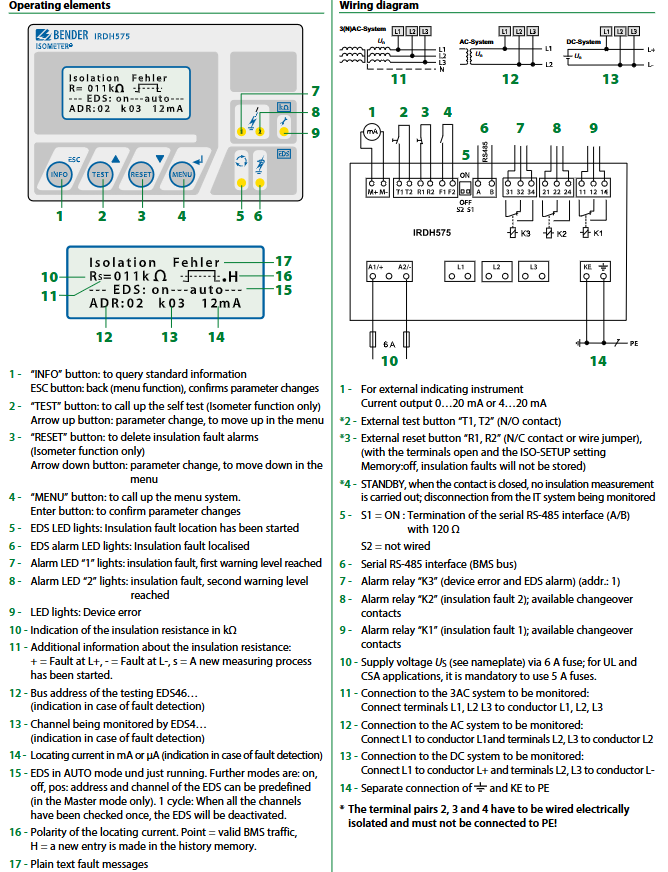
Status indication: Alarm LED1 (first level alarm), Alarm LED2 (second level alarm), and equipment fault LED correspond to different alarm levels, providing intuitive feedback on the severity of the fault for quick on-site identification.
Self monitoring and testing
Self monitoring: Continuously monitor the grounding connection, line connection, and internal circuit status of the equipment itself. In case of abnormalities, trigger the K3 relay action and light up the equipment fault LED to avoid missed reports due to equipment failure.
Testing function: Supports internal/external testing buttons (N/O contacts), long press the TEST button to activate self-test, verify whether the alarm circuit, display system, and connection to the system/ground are normal, and ensure reliable device functionality.
Reset function: Internal/external reset button (N/C contact or jumper), short press the RESET button to clear the alarm memory. When the terminal is open and ISO-SETUP is set to Memory: off, insulation faults are not stored.
(2) Ground fault location function
System expansion configuration
Core components: IRDH575 host+EDS460 (main circuit positioning device)/EDS461 (control circuit positioning device)+dedicated current transformer (W series adapted to main circuit, 8000 series adapted to control circuit), optional EDS3090/EDS3091 portable positioning system.
Scalability: Supports up to 90 EDS4 series devices for interconnection, with each EDS device capable of monitoring 12 circuits, covering a total of 1080 circuits, and adapting to the fault location needs of large industrial distribution systems.
Positioning workflow
Trigger method: After IRDH575 detects an insulation fault, it automatically starts the positioning process, or can be manually started through the menu, flexibly adapting to different on-site requirements.
Signal generation: IRDH575 generates pulse positioning current, the amplitude of which depends on the system voltage and the degree of insulation fault. In case of low resistance fault, the positioning current is automatically limited, and the current limit value can be set through the menu (maximum 50mA). The pulse period is 2s and the interval is 4s to avoid affecting the normal operation of the system.
Fault identification: The positioning current pulse starts from the host through live parts, travels along the shortest path to the fault point, and then returns to the host through the insulation fault point and PE line. The current transformer on the fault path collects the pulse signal, which is evaluated by EDS equipment.
The results show that when the positioning current exceeds the response value of the EDS device, the EDS local alarm LED lights up, indicating the faulty sub circuit. At the same time, the IRDH575 LCD synchronously displays the bus address, monitoring channel, and positioning current intensity (mA/µ A) of the faulty EDS device, achieving accurate fault positioning.
Portable troubleshooting: Optional EDS3090/EDS3091 portable positioning system can track pulse signals to the source of faults, suitable for complex wiring and concealed fault troubleshooting scenarios.
PLC control circuit adaptation
Due to the sensitivity of PLC input signals, EDS461 equipment is required for control circuit positioning, and the positioning current of IRDH575 should be set to a maximum of 2.5mA or 1mA to avoid interfering with the normal operation of the PLC.
(3) Data storage and communication functions
Data recording and querying
Storage capacity: Non volatile memory can store 99 alarm messages with date and timestamp, including fault type, insulation resistance value, occurrence time, EDS device address, etc. Data will not be lost after power failure, making it easy to trace and analyze faults.
Information query: Pressing the INFO key can quickly query system leakage capacitance, device parameter settings, alarm history, and other information without entering deep menus, making operation convenient.
communication interface
RS-485 interface (BMS protocol): Supports bidirectional data communication between devices, with a maximum cable length of 1200m. It is recommended to use shielded cable J-Y (ST) Y 2 × 0.6mm ² (single ended PE for shielding layer), equipped with a 120 Ω terminal resistor (controlled by micro switch S1 to enable/disable), to reduce signal attenuation and electromagnetic interference.
Protocol extension: Can connect to Bendel protocol converters, adapt to industrial protocols such as Ethernet, MODBUS, PROFIBUS, etc., and achieve interconnection with upper control systems such as PLC and DCS.
Analog output: 0/4... 20mA optional, load ≤ 500 Ω, can convert insulation resistance signal into standard analog quantity, connect to external instruments or centralized monitoring system, achieve remote real-time monitoring of insulation status.
(4) Operation and display functions
display system
Backlit LCD screen: 4 × 16 character pure text display, character height 5mm, clear display, supports multilingual switching, real-time display of insulation resistance value (k Ω), system status, alarm information, EDS equipment status, etc.
Auxiliary display: "s" indicates that a new measurement is in progress, "+" indicates a fault on the L+side, and "-" indicates a fault on the L - side; EDS mode display (AUTO/ON/OFF/pos/1 cycle), POS mode can preset EDS address and channel (host mode only), EDS will automatically stop after detecting all channels in 1 cycle mode; Position current polarity indication (Point=active BMS communication, H=new historical record).
Operation buttons
Function keys: INFO (information query), MENU (menu call), ESC (return/confirm parameter modification), TEST (self-test), RESET (alarm reset).
Navigation keys: up/down arrow keys (menu scrolling, parameter adjustment), Enter key (confirm parameter modification).
Operation logic: Clear menu hierarchy, intuitive parameter settings, password protection support to prevent unauthorized personnel from tampering with settings.
Detailed technical parameters
(1) Electrical parameters
Category specific specifications
Monitoring system voltage low voltage type (B1 series): AC 20... 575V (3 (N) AC/single-phase, 50... 460Hz), DC 20... 575V
High voltage type (B2 series): AC 340... 760V (3 (N) AC/single-phase, 50... 460Hz), DC 340... 575V
Supply voltage AC 88... 264V (50... 460Hz), DC 77... 286V; UL/CSA applications mandate the use of 5A fuses, while 6A fuses are recommended for other scenarios; Two fuses are required for IT system power supply
Allow external DC voltage B1 series ≤ 810V, B2 series ≤ 1060V
Allow system leakage capacitance ≤ 150 (500) µ F
Relay parameters: rated contact voltage AC 250V/DC 300V, connection capacity AC/DC 5A, breaking capacity 2 A(AC 230V,cosφ=0.4)、0.2A(DC 220V,L/R=0.04s), Electrical lifespan of 12000 cycles, contact current (DC 24V) ≥ 2mA (50mW), contact level IIB (DIN IEC 60255-23)
Analog output 0/4... 20mA, load ≤ 500 Ω
Power consumption ≤ 14 VA
(2) Environmental and mechanical parameters
Category specific specifications
Working environment temperature -10 ℃...+55 ℃ (cannot operate continuously in 50mA positioning mode); The short-term working temperature can reach -25 ℃...+70 ℃
Storage environment temperature -40 ℃...+85 ℃
Climate grade DIN IEC 60721-3-3 (3K5)
Impact resistance performance during operation: 15g/11ms (IEC 60068-2-27); During transportation: 40g/6ms (IEC 60068-2-29); Option-W model: 30g/11ms
Vibration resistance performance during operation: 1g/10... 150Hz (IEC 60068-2-6); During transportation: 2g/10... 150Hz (IEC 60068-2-6); Option-W model: 1.6mm/10... 25Hz, 4g/25... 150Hz
Protection level: Internal components IP30, terminals IP20, door mounted IP40, optional IP42 (equipped with panel seals)
Installation method: Panel installation, hole size 138 × 90mm, installation direction is display facing outward, installation distance ≥ 30mm; optional DIN rail adapter (Art. No. B98060010)
Wire terminal screw terminal, supporting rigid conductors 0.2... 4mm ², flexible conductors 0.2... 2.5mm ², flexible conductors with/without plastic collars 0.25... 2.5mm ², compatible with AWG 24... 12 specification conductors
Shell and weight halogen-free flame-retardant shell, weight ≤ 900g
System installation and typical configuration
(1) Installation points
Power supply configuration: The power supply circuit is connected in series with corresponding specifications of fuses (5A for UL/CSA, 6A for others). The IT system power supply must be equipped with two fuses to ensure equipment overcurrent protection.
Grounding requirements: The equipment grounding terminal (KE) should be reliably grounded, and the RS-485 cable shielding layer should be single ended with PE to reduce electromagnetic interference; Terminal pairs 2, 3, and 4 require electrical isolation wiring and must not be connected to PE.
Wiring specifications: Measurement circuits and power cables should be laid separately to avoid cross interference; The wiring between EDS equipment and current transformers must follow polarity requirements to ensure accurate signal acquisition.
Environmental requirements: The installation location should be well ventilated, away from heat sources and strong electromagnetic interference sources, and meet the working temperature (-10...+55 ℃) and protection level requirements; The Option-W model has stronger shock and vibration resistance and is suitable for harsh environments.
(2) Typical application configuration
1. Main circuit monitoring and positioning system (AC/DC 20... 575V)
Configuration components: IRDH575B1-435+EDS460+W series current transformer+6A fuse.
Applicable scenarios: Factory three-phase main distribution circuit, motor control circuit, etc. Each EDS460 monitors 12 main circuit branches and supports cascading expansion of multiple EDS460.
Wiring method: The L1/L2/L3 terminals of the 3AC system are respectively connected to the L1/L2/L3 terminals of the equipment, the N line is connected as needed, and the KE terminal of the equipment is connected to PE; EDS460 communicates with IRDH575 through the AB terminal, and the current transformer is installed on the main circuit branch line.
2. Control circuit monitoring and positioning system (AC 20... 265V/DC 20... 308V)
Configuration components: IRDH575B1-435+EDS461+8000 series current transformer+6A fuse+PLC.
Applicable scenarios: PLC control circuits, DC instrument circuits, and other sensitive load circuits. EDS461 is designed to meet the high sensitivity requirements of control circuits and avoid interference from positioning currents on loads.
Wiring method: The L+terminal of the DC system is connected to the L1 terminal of the device, the L - terminal is connected to the L2/L3 terminal, and the KE terminal of the device is connected to the PE terminal. EDS461 communicates with IRDH575, and the current transformer is installed on the PLC input and output circuit line, with a positioning current set to 1... 2.5mA.
- YOKOGAWA
- Reliance
- ADVANCED
- SEW
- ProSoft
- WATLOW
- Kongsberg
- FANUC
- VSD
- DCS
- PLC
- man-machine
- Covid-19
- Energy and Gender
- Energy Access
- Renewable Integration
- Energy Subsidies
- Energy and Water
- Net zero emission
- Energy Security
- Critical Minerals
- A-B
- petroleum
- Mine scale
- Sewage treatment
- cement
- architecture
- Industrial information
- New energy
- Automobile market
- electricity
- Construction site
- HIMA
- ABB
- Rockwell
- Schneider Modicon
- Siemens
- xYCOM
- Yaskawa
- Woodward
- BOSCH Rexroth
- MOOG
- General Electric
- American NI
- Rolls-Royce
- CTI
- Honeywell
- EMERSON
- MAN
- GE
- TRICONEX
- Control Wave
- ALSTOM
- AMAT
- STUDER
- KONGSBERG
- MOTOROLA
- DANAHER MOTION
- Bentley
- Galil
- EATON
- MOLEX
- Triconex
- DEIF
- B&W
- ZYGO
- Aerotech
- DANFOSS
- KOLLMORGEN
- Beijer
- Endress+Hauser
- schneider
- Foxboro
- KB
- REXROTH
- YAMAHA
- Johnson
- Westinghouse
- WAGO
- TOSHIBA
- TEKTRONIX
- BENDER
- BMCM
- SMC
- HITACHI
- HIRSCHMANN
- XP POWER
- Baldor
- Meggitt
- SHINKAWA
- Other Brands
- UniOP
- KUKA
- IBA
- Beckhoff
- ADLINK
-
ENOTEC OXITEC 5000 SME-53310000 InSitu O2 Gas Analyzer System
-
TRICONEX 3723X 32-Channel TMR Analog Input Module with HART for Tricon CX
-
GE 151X1233DB02SA02 Rev A Pitch Converter 30 Nm DC Pitch Conversion Module
-
GE 151X1207CK02SA02 77MM DE Excitation Module for Mark VI Turbine Control Systems
-
HIMA H6200A Analogue Isolator Power Supply for HIMax Safety Systems
-
ABB SACO 64D4 Digital Annunciator Unit with 64 Alarm Channels
-
Allen-Bradley 5069-L306ER - SER A CompactLogix Controller PLC
-
Omron CJ1W-CORT21 - CANopen Master Unit PLC Module
-
Danfoss 131B9523 / FC-102P5K5T4E20H1 - 5.5kW VLT HVAC Drive Inverter
-
Schneider Electric LXM32MU90M2 - Lexium 32 Servo Drive Controller
-
Danfoss AKD102P15KT4P21H1 - 15kW 131L2413 ADAP-KOOL Drive Inverter
-
Kollmorgen S70602-NANANA - Servo Drive Controller
-
Allen-Bradley 6189-PS2 - Power Supply Industrial Computer PS
-
Beijer E900T / 03010F - Operator Panel IFC ETTP HMI
-
Schneider Electric LMC20 - PacDrive Motion Controller PLC
-
Sartorius CAW2S1-3DC-NCE - COMBICS 2 Industrial Scale Terminal
-
Kollmorgen / Danaher S30301-NA / S300 - SERVOSTAR343 Servo Drive Controller
-
Siemens A5E00159503 - 12 INCH TFT Touch Panel HMI
-
Siemens 3UF5021-3AB00-1 - SIMOCODE DP Basic Unit Control Module
-
Danfoss 131B8872 / FC-202PK37T4E20H1 - 0.37kW VLT AQUA Drive Inverter
-
Atlas Copco ICB421-2003D / VSK001001 - W9139 ICM431-0025C ICM431-0025D Controller
-
Lenze EV82EV751_4C - Version 4A39 Frequency Inverter Drive
-
Atlas Copco / ABB 3HAB8101-19/07B - Robot Cable Assembly Harness
-
Beijer X2 Pro7-B2 - Operator Panel HMI Touch Screen
-
Honeywell CDW45L - Damper Actuator
-
B&R X67DM9331.L12 - Rev. I0 Digital Mixed Module
-
B&R X67DM9331.L12 - Rev. H0 Digital Mixed Module
-
Sanyo Denki PMM-BA-5604-1 - Pentasyn Stepper Motor Driver
-
SICK AWS1-113 / 1008900 - Evaluation Unit
-
Siemens 1TF6064-1AF71-3AH1 - SIMOTICS Synchronous Servo Motor
-
Heidenhain ERN680.P003-4096 / 29416004 - Rotary Encoder
-
Schneider Electric LC1G185EHEA - TeSys Control Contactor
-
Parker SBC HPD5N - High Performance Drive Electronics SPA
-
Advantech UNO-2170-CE11BE - Embedded Automation Computer IPC
-
Siemens 6AG1231-4HF32-4XB0 - SIPLUS S7-1200 SM 1231 Analog Input Module
-
Advantech UNO-2170-BTO - Embedded Automation Computer IPC
-
Jumo SR-96/4-001.0.0.00.111 - Solid State Relay Power Controller
-
Pepperl+Fuchs FC-21-V - FC-20P Safety Barrier Module
-
Emerson SP1404 - Unidrive AC Drive Inverter
-
B&R X67AI1233 - Rev.C0 Analog Input Module
-
Mitsubishi FR-F740-00250-EC - Frequency Inverter AC Drive
-
Allen-Bradley 2711P-T7C21D8S - PANELVIEW PLUS 7 SERIES B Touch Screen HMI
-
Pilz PMCprotego D.03/000/0/0/2/208-480VAC / 8176101 - Servo Amplifier Drive
-
Reliance Electric 57C414 / 57414-1N - Modbus Interface Module
-
Mitsubishi FR-F740-00250-EC - Frequency Inverter AC Drive
-
Siemens 6SN1123-1AA00-0EA2 - Version A 160A SIMODRIVE Power Module
-
Siemens 1TF6064-1AF71-3AH1 - SIMOTICS Synchronous Servo Motor
-
AEG ALU202 / DAP216 / DEP216 / DAU202 - SIM216 SIM203 DNP205 ADU205 PLC Controller KIT
-
Atlas Copco / ABB 3HAB8101-19/07B - Robot Cable Assembly Harness
-
Hitachi CPU22-02HB - Micro-EHV Programmable Controller PLC
-
Parker SBC HPD5N - High Performance Drive Electronics SPA
-
Jetter JX3-THI2-RTD - JX3-BP Temperature Input Module
-
Eaton DC1-34014FB-A20N - 5.5kW Inverter Variable Frequency Drive
-
Eaton DS7-34DSX041N0-D - Soft Starter
-
Reliance Electric 57C422B / 57422-2E - 2-Axis Servo Controller
-
Hitachi CPU22-02HB - Micro-EHV Programmable Controller PLC
-
Eaton DC1-34014FB-A20N - 5.5kW Frequency Inverter Variable Frequency Drive
-
Siemens 6SN1123-1AA00-0EA2 - Version A 160A SIMODRIVE Power Module
-
Reliance Electric 57C414 / 57414-1N - Modbus Interface Module
-
Eaton DS7-34DSX041N0-D - Soft Starter
-
Reliance Electric 57C422B / 57422-2E - 2-Axis Servo Controller
-
Johnson Controls DX-9120-8454 - Digital Controller
-
Jetter JX3-THI2-RTD - JX3-BP Temperature Input Module
-
Siemens 6SL3210-1KE21-7AP1 - SINAMICS G120C DP 7.5kW BOP-2 Inverter Drive
-
Siemens 1FK7042-2AF21-1QG0 - SIMOTICS S Synchronous Servo Motor
-
Mettler Toledo IND570 - Harsh Analog Weighing Terminal Controller
-
Schneider Electric TM238LDA24DR - Modicon M238 Programmable Logic Controller PLC
-
Hitachi EH-CPU548 - EH-150 PLC CPU Module
-
Honeywell Q7750A2003 - Excel 10 Zone Controller
-
Ferag 584.002.V003 - Control Panel HMI
-
Danfoss AK-SM 720 / 080Z8511 - ADAP-KOOL System Manager Controller
-
Ferag 584.002.V003 - Control Panel HMI
-
Kern 3210001.001 / LOP-KS 2903440.001 - PRT.205A.0000.V001.02341 Servo Controller Board
-
Reliance Electric 57C424 - Maxpak III High Speed Link Module
-
Telemecanique XBTA70101PA - Compact Terminal HMI Panel
-
Reliance Electric 57C424 - Maxpak III High Speed Link Module
-
Reliance Electric 57C422B - 2-Axis Servo Controller
-
Honeywell Q7750A2003 - Excel 10 Zone Controller
-
Telemecanique XBTN400 - Magelis Small Panel HMI
-
Schneider Electric TM172PDG42S - Modicon Programmable Logic Controller PLC
-
Fanuc HE693THM884M - Thermocouple Input Module
-
Selectron PMC22BAEZD / 220735 - Selecontrol PMC 22 ABEZD Controller Module
-
Baumuller BUS21-22/45-31-020 - Servo Drive Inverter
-
Schneider Electric TM172PDG42S - Modicon Programmable Logic Controller PLC
-
Schneider Electric ATV32HD11N4 - Altivar Variable Frequency Drive Inverter
-
Lenze 494_E.4B - DC Speed Controller
-
NORD SK300E-111-340-B - SKDA130E-111-340-IBS-AAA Frequency Inverter
-
Reliance Electric GMI-S02 - AC/AC Converter 380/400V 50/60Hz 2.3/2.8A Drive
-
Hakko / Monitouch V710CD - Operator Panel HMI Touch Screen
-
B&R 5PC910.SX01-00 / 5YZCAA00700000-005 - Automation PC Industrial Computer
-
Hitachi EH-CPU548 - EH-150 PLC CPU Module
-
Tecnau / Fortec FORTEC-04/UL / 10117 - PCB Circuit Board
-
Bosch PSS 2037 10B - Power Supply Module
-
Newall B602000 - Digital Readout Scale
-
ELCON PC Controller - Industrial PC Controller
-
Siemens 3UF5100-0AB00 - SIMOCODE-DP Control Module
-
Omron NS8-TV00B-V2 - Touch Screen HMI Panel
-
Siemens 6ES5264-8MA12 / IP264 - CAM Controller Module
-
Allen-Bradley 1756-L72S - SER B GuardLogix Safety Controller
-
Schneider Electric SXWMPC15A10001 - SmartX Controller Automation Server
-
Telemecanique LC1F265F7 - TeSys F Contactor
-
Siemens 6ES7314-6CH04-0AB0 - SIMATIC S7-300 CPU 314C-2 DP PLC
-
Allen-Bradley 1734-EI4S - POINT I/O Safety Module
-
Allen-Bradley 2711P-T7C4D8 / 2711P-RP8D - PanelView Plus HMI Touch Screen Logic Module
-
Ropex UPT-640-V - Resistron Temperature Controller
-
KEB 07.F5.B3A-0A00 - VERSION 1.1 Combivert Frequency Inverter
-
Sensopart V50-OB-A3-IW-M2-L - VISOR Vision Sensor Camera
-
SICK AFM60A-S1NB018X12 / 1059040 - Absolute Rotary Encoder
-
Kern AG KMC600 / 2903436.001 - Servo Drive Controller
-
Lenze E82EV302_4C200 / 13015655 - VERSION 3D35 Frequency Inverter Drive
-
Schneider Electric XBTOT2210 - Magelis Touch Screen HMI Panel
-
Baumuller BM5-O-SAF-000-000-000-001-202 - Parameter Safety Module
-
SICK UE4470-22EE690 - Safety Relay Controller
-
Hitachi EH-CPU448 / EH-150 - PLC CPU Module
-
Rexroth VT5005-13 - R5 00010592 Proportional Valve Amplifier Board
-
Siemens 6ES7510-1DJ00-0AB0 - SIMATIC ET 200SP CPU PLC
-
Beckhoff CX5120-0121 - 2GB Embedded PC Controller
-
Priva BlueiD S10 / 5010002 - SN3t 5020004 5010101 Building Automation Controller
-
Sigmatek DM161 - S-DIAS Digital Mix I/O Module
-
Telemecanique LC3D50P7A64 - Star Delta Starter Contactor
-
Siemens 6SN1123-1AA00-0BA2 - SIMODRIVE 611 Power Module
-
Siemens 6SN1124-1AA00-0CA1 - SIMODRIVE 611 Power Module
-
Dixell XC1015D-1C01F / XC1000D - Compressor Controller
-
Siemens A5E02184619 / 19T 577B - Industrial Touch Screen HMI Panel
-
Siemens 6SE6420-2AD27-5CA1 - Filter 6SE6400-2FS03-8CD0 Micromaster Inverter
-
Schneider Electric LC1G400LSEN - TeSys Control Contactor
-
Baldor BPS10-200-20-P - Servo Drive Motor Controller
-
Ingersoll Rand X4I / Y06IR03.00 - Air Compressor Controller

K-JIANG

Add: Jimei North Road, Jimei District, Xiamen, Fujian, China
Tell:+86-15305925923