

K-WANG


KONGSBERG RMP420 Remote Multi functional I/O Module
Industrial application and technical advantages of KONGSBERG GT300 pressure transmitter
Chapter 1: Product Overview and Application Positioning
1.1 Precise positioning of universal design
The GT300 pressure transmitter is defined as a general purpose transmitter, primarily designed for engine rooms, hydraulic stations, and similar industrial applications. It offers two forms of gauge pressure and sealed gauge pressure, covering a wide range of needs from micro pressure to high pressure.
1.2 Range and Output
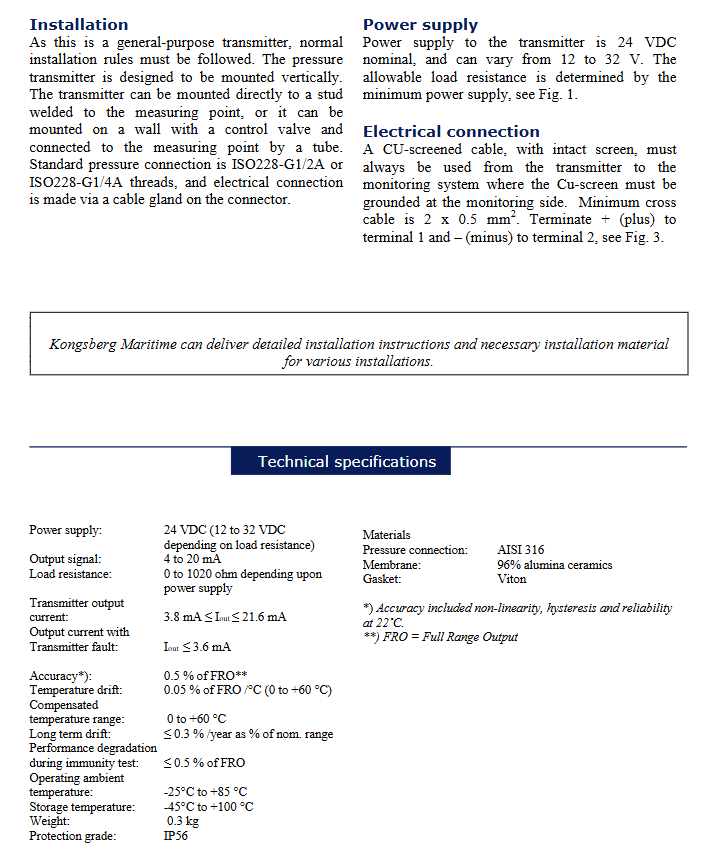
This series supports a pressure range of up to 100 bar and adopts the industry standard 2-wire connection method, with output signals ranging from 4 to 20mA analog. This signal system has strong anti-interference ability and is suitable for long-distance transmission, making it a classic choice for industrial sites. Its nominal power supply value is 24 VDC, allowing for fluctuations within a wide voltage range of 12 to 32 VDC, greatly facilitating compatibility with different ship or factory power supply systems.
Chapter 2: Core Technology Innovation: Dry Ceramic Sensors
The most significant technical feature of the GT300 is its pressure sensitive element - a dry measurement unit made of 96% alumina (Al ₂ O3) ceramic.
2.1 Material advantage: 96% alumina ceramic
Alumina ceramics are widely recognized as highly elastic, corrosion-resistant, and wear-resistant materials. The GT300 uses 96% pure ceramic film, which has extremely high chemical inertness and can withstand the corrosion of most chemical media. This means that the measured process medium can directly contact the measuring diaphragm, without the need to transmit pressure through stainless steel isolation diaphragm and intermediate filling liquid (such as silicone oil) like traditional sensors.
2.2 Technical differentiation between wet and dry methods
In traditional "wet" sensors, the filling fluid is both a pressure transmission medium and a potential source of error. When the ambient temperature changes, the thermal expansion and contraction of the filling liquid will cause a volume change, thereby introducing temperature drift errors. In addition, if the isolation membrane is damaged and the filling liquid leaks, it will cause the sensor to completely fail. The "dry" design of GT300 fundamentally eliminates these issues, which explains why it can surpass traditional analog sensors in temperature stability indicators.
2.3 Signal Conversion and Digital Compensation
The internal core of GT300 is a rigid structure composed of ceramic membrane and insulating substrate. Strain gauges connected in the form of Wheatstone bridges are integrated on the membrane. When pressure is applied, the small deformation of the diaphragm causes a change in the resistance value of the strain gauge, which is converted into an electrical signal.
The revolutionary breakthrough of GT300 lies in its digital compensation process:
Individualized calibration: Each sensor undergoes dual scanning of pressure and temperature during the manufacturing process.
Table lookup compensation: The collected data is digitized and stored in the built-in memory of the sensor, forming a unique 'Tabular'.
Real time calibration: During operation, the microprocessor combines real-time temperature and pressure signals to perform linearization and temperature compensation calculations based on this table.
This digital compensation technology based on the unique characteristics of each component enables the GT300 to achieve accuracy and stability far ahead of analog sensors in the compensation temperature range of 0 to 60 ° C, ultimately ensuring a full-scale output accuracy (FRO) of 0.5%.
Chapter 3: Mechanical Structure and Material Technology
3.1 Shell and Protection
The main structure of GT300 is made of AISI 316L stainless steel. 316L is a low-carbon, molybdenum containing austenitic stainless steel with excellent resistance to intergranular corrosion, especially chloride ion corrosion, making it very suitable for ships and offshore environments. Its protection level reaches IP56, which means it can prevent dust (dust level 5, no harmful deposits) and strong water spray, sufficient to cope with the flushing and humid environment inside the cabin.
3.2 Pressure and Electrical Interface
Pressure interface: The pressure connection located at the lower end of the transmitter complies with the ISO228 standard and mainly provides two specifications of cylindrical threads, G1/2A and G1/4A. These threads are usually sealed with sealing gaskets (such as Viton seals provided with the goods).
Electrical interface: The upper end adopts a connector that complies with DIN 175301-803 standard. This type of connector is commonly known as the "Hirschman connector" or "square plug" in the industrial field, with convenient and reliable wiring. Users can choose the appropriate cable gland based on the outer diameter of the cable, such as M16 or M20 specifications.
Chapter 4: Electrical Characteristics and Installation Specifications
4.1 Power Supply and Load Capacity
The electrical design of GT300 follows the principle of two-wire circuit power supply. The load resistance capability depends on the magnitude of the supply voltage. As shown in Figure 1 (original Fig.1 in the manual), the allowable load resistance is proportional to the power supply voltage. For example, when powered by 24V, it can drive loads up to about 600 Ω (excluding the minimum operating voltage of the transmitter itself), making it easy to work with PLC analog input modules or digital display instruments.
4.2 Wiring Details
When wiring, attention must be paid to polarity and shielding layer handling:
Terminal definition: Terminal 1 is connected to the positive pole (+) of the power supply, and terminal 2 is connected to the negative pole (-) of the signal output.
Cable requirements: Copper screened cable with shielding layer must be used, and the cable cross-sectional area is recommended to be no less than 2 x 0.5 mm ².
Grounding principle: In order to prevent electromagnetic interference (EMI) from affecting the measurement signal, the shielding layer must be single ended grounded on the monitoring system side (i.e. PLC or control cabinet side).
4.3 Fault safety logic
GT300 has a fault self diagnosis function. When there is a malfunction inside the sensor (such as component damage or disconnection), the output current will drop below 3.6mA or rise above 22mA. This "transmitter fault current" mechanism helps the control system identify sensor abnormalities and avoid misoperations caused by incorrect readings.
Chapter 5: Installation Practice and Precautions
Although the GT300 is designed to be sturdy and durable, proper installation is a prerequisite for unleashing its performance.
5.1 Installation direction
The manufacturer recommends installing vertically. This is not only beneficial for mechanical stability, but also reduces zero offset caused by the self weight of the membrane or the deposition of small particles in the medium.
5.2 Installation method
Direct installation: It can be welded directly onto the base of the measuring point through bolts.
Remote installation: Introduce pressure into the transmitter through a pressure conduit. For steam or high-temperature media, the pressure pipe can also play a role in heat dissipation and buffering, preventing high temperatures from directly impacting the sensor electronic unit.
5.3 Environmental Requirements
Despite having IP56 protection, the electronic part of the sensor should be avoided from being exposed to severe thermal radiation or strong electromagnetic interference sources during long-term use. If the temperature of the measured medium changes dramatically, damping or buffering devices can be added within the allowable range of the process.
Chapter 6: Selection Guide and Order Code Interpretation
Understanding the ordering code of GT300 is crucial for proper procurement. According to the "Ordering key" on page four of the manual, we can deconstruct it as follows:
Model example: GT300 C 0 0 C G 1 0 G 0 E05 XXX
GT300: Basic series number.
Pressure Connection:
V=G1/2A, AISI 316L material, Viton seal.
B=G1/4A, AISI 316L material, Viton seal.
OUTPUT SIGNAL:
0 = 4-20mA, Second line system.
Application:
0=General/engine compartment.
Accuracy:
C=0.5% accuracy, temperature compensation range 0-60 ° C.
ZERO POINT:
G=4mA corresponds to atmospheric pressure (zero point of gauge pressure).
K=4mA corresponds to -1 bar gauge (for vacuum or negative pressure measurement).
RANGE AND OVERLOAD PRESSURE:
This is a combination code, for example, 10 corresponds to a range of 0-10 bar and overload of 20 bar; 60 corresponds to a range of 0-60bar, overload of 100bar, etc.
CABLE GLAND:
1=M16 (applicable for cable diameters of 3.5-8mm)
2=M16 * (applicable cable diameter 6-10mm)
3=M20 (applicable cable diameter 7-13mm)
CABLE (cable option):
E05=with 5-meter cable (EFTE oil resistant material)
E10=with 10 meter cable
XXX=Special Customization
Chapter 7: Performance Comparison and Industry Development Trends
7.1 Ceramic Sensor vs. Diffuse Silicon Sensor
In the field of industrial pressure measurement, diffusion silicon sensors and ceramic sensors are the two mainstream technologies. The diffusion silicon sensor has extremely high sensitivity and is suitable for micro pressure measurement, but its PN junction is easily affected in high temperature environments and must rely on a filling liquid isolation medium. Although ceramic sensors (such as those used in GT300) have slightly lower sensitivity than silicon, their characteristics of no hysteresis, overload resistance, and corrosion resistance make them have a longer service life and stability under harsh working conditions. The 0.5% accuracy of GT300 is considered excellent in the general industrial field, while its long-term drift is controlled at an extremely low level through digital compensation.
7.2 Overload resistance capability
Overload is the main cause of sensor damage. The elastic limit of ceramic materials is extremely high. When the pressure instantly exceeds the range or even reaches several times the overload, the ceramic diaphragm will adhere tightly to the substrate (bottom) instead of undergoing plastic deformation like metal diaphragms. Once the pressure returns to normal, the sensor immediately resumes operation with unchanged performance. The GT300 provides clear overload pressure indicators for different ranges, such as a 0.6bar range that can withstand an overload of 2bar, and a 10bar range that can withstand an overload of 20bar.
Chapter 8: Maintenance and Troubleshooting
In practical applications, GT300 may experience output abnormalities, which can usually be attributed to the following reasons:
Blockage of the pressure system: Sediments or crystals at the process connection block the pressure channel.
Wiring and grounding: The shielding layer is not properly grounded or the cable is laid in parallel with the power cable, which introduces interference.
Sealing failure: The aging or improper installation of Viton sealing rings leads to medium leakage.
Exceeding compensation temperature: Although the storage temperature range is wide, if electronic components work at 85 ° C or above for a long time, it will accelerate component aging.
It is recommended that users perform regular zero calibration (adjust under no pressure) and check whether the cable joints are loose or have water ingress.
- YOKOGAWA
- Reliance
- ADVANCED
- SEW
- ProSoft
- WATLOW
- Kongsberg
- FANUC
- VSD
- DCS
- PLC
- man-machine
- Covid-19
- Energy and Gender
- Energy Access
- Renewable Integration
- Energy Subsidies
- Energy and Water
- Net zero emission
- Energy Security
- Critical Minerals
- A-B
- petroleum
- Mine scale
- Sewage treatment
- cement
- architecture
- Industrial information
- New energy
- Automobile market
- electricity
- Construction site
- HIMA
- ABB
- Rockwell
- Schneider Modicon
- Siemens
- xYCOM
- Yaskawa
- Woodward
- BOSCH Rexroth
- MOOG
- General Electric
- American NI
- Rolls-Royce
- CTI
- Honeywell
- EMERSON
- MAN
- GE
- TRICONEX
- Control Wave
- ALSTOM
- AMAT
- STUDER
- KONGSBERG
- MOTOROLA
- DANAHER MOTION
- Bentley
- Galil
- EATON
- MOLEX
- Triconex
- DEIF
- B&W
- ZYGO
- Aerotech
- DANFOSS
- KOLLMORGEN
- Beijer
- Endress+Hauser
- schneider
- Foxboro
- KB
- REXROTH
- YAMAHA
- Johnson
- Westinghouse
- WAGO
- TOSHIBA
- TEKTRONIX
- BENDER
- BMCM
- SMC
- HITACHI
- HIRSCHMANN
- XP POWER
- Baldor
- Meggitt
- SHINKAWA
- Other Brands
- UniOP
- KUKA
- IBA
- Beckhoff
- ADLINK
-
Siemens 6SL3244-0SA01-1AA0 - SINAMICS G120 Control Unit
-
DANFOSS 175Z2688 - COATEDE CONTROLUNIT VLT5000
-
SIEMENS 6FM1721-3AA20 - Positioning Module
-
REXORTH VTS0605 PVAR S21 - Drive Module
-
BECKHOFF 2915-0000 - Control Module
-
COOPER EATON CGLine 400 40071347901 - CEAG CG Controller
-
SIEMENS 3UF5031-3AN00-1 - SIMOCODE DP Basic Unit
-
SIGMATEK DNC305 05-011-305 - Drive Controller
-
Multivac MV1 10249768 - Control Module
-
SCHNEIDER ELECTRIC MES114 59646 & 59645 - Circuit Breaker Accessory
-
CAMILLE BAUER CAPAX 44-580-0012 - Transmitter
-
HENGSTLER VT360P LS1/TOK - Encoder
-
BURKERT 8792 - 24V DC IP65 / IP67 Positioner
-
SENSOPART V10-OB-A1-W6 - Vision Sensor
-
ALLEN-BRADLEY 1762-L40BXB SER.C REV.J - MicroLogix 1200 Controller
-
HITACHI CPU22-02HC 33025801-2 - CPU Module
-
HITACHI AGH-0 33034810-2 - Control Board
-
PHILIPS AIH110 VER 1.0 - Control Module
-
BAUMULLER DO8000 - Drive Controller
-
B&R PS477 3PS477.9 Rev.C0 - Power Supply
-
ABB ALFA LAVAL 200-CISB - Communication Interface 2 x SatBus
-
Moeller MI4-570-TA1 - HMI Operator Panel
-
ABB ACH550-01-06A9-4+B055 - Variable Frequency Drive
-
ABB TPU2 3HNE00313-1 REV 12 - Teach Pendant Unit
-
Schneider Electric BRS368H130ABA - Stepper Motor
-
Foxboro FCM100E P0972ZA - I/A Series Communication Module
-
Siemens 6ES7 450-1AP00-0AE0 6ES7450-1AP00-0AE0 - Simatic S7 Version:04 Counter Module
-
Schneider Electric ATV320U07N4W - Altivar Machine Drive
-
Priva TouchPoint Flush V06:02 5060002 - Control Panel
-
Lenze ESMD402L4TXA - 4kW SMD Inverter Drive
-
Lenze ESMD402L4TXA - 4kW SMD Inverter Drive
-
Schneider Electric PM210 PM210MG - Powerlogic Power Meter
-
ASCOM U982-DB/1C U982 - Power Supply / Communication Module
-
DYADIC SYSTEMS SCN5-010-050-S03-NA - Servo Cylinder
-
Reliance Electric GMI-S04 - AC/AC CONVERTER 380/400V 50/60Hz 3.9/5.2A
-
Pro-Face GLC150-BG41-XY32KF-24V 3080060 PFXGLC150BDBP - Touch Screen HMI
-
ROFIN RSL TERMINAL V2 0185.01/03 - TERMINAL
-
HONEYWELL R7241E1077 - Burner Control / Amplifier
-
SEW MM22C-503-00 8241201 - 2.2kW Movimot Drive
-
Brand Digital III 50mL - Burette
-
Danfoss 195N0039 VLT2811PS2B20STR1DBF00A00C0 - 2.4kVA VLT Drive
-
SONY LG10-2 EK1 - Digital Gauge Indicator
-
EMERSON SKD3400750 - 7.5kW AC Drive
-
SIEMENS 6AV6 542-0AG10-0AX0 - MULTIPANEL HMI
-
TELEMECANIQUE ATV21HU55N4 - ALTIVAR21 5.5KW Variable Speed Drive
-
MITSUBISHI A985GOT-TBA-EU - GOT900 Touch Screen HMI
-
SCHNEIDER LXM32AD30N4 - Lexium 32 Servo Drive
-
SICK PSR01-1501 M20Z-02550A122 - Safety Laser Scanner
-
GECMA CHALLENGER 15-2-FMO - LITE TOUCH Monitor
-
Uniop EK02 6ZA982 - HMI Operator Panel
-
TELEMECANIQUE ATV18U54M2 - SQUARE D ALTIVAR 18 3kW Drive
-
Schneider Electric ATV312HU75S6 - 7.5kW Altivar 312 Drive
-
Siemens 6GK7243-5DX30-0XE0 6GK7 243-5DX30-0XE0 - Communications Processor
-
Schneider Electric LV432455 VIGI630 - 3POLE Earth Leakage Module
-
Rexroth PSI 6100.750 L1 R911170694-107 - frequency inverter / inverter
-
SWEDISH MICROWAVE AB Ku-Band BDC 138010-45-D0 - Block Downconverter
-
METTLER TOLEDO IND429 IND429-BB30 - Weighing Terminal
-
Siemens 6SL3210-5HE10-4UF0 - Sinamics V90 Servo Drive
-
B&R X20CP0482 Rev.D0 - X20 CPU Module
-
Mitsubishi FR-E720S-110SC-EC FRE720S110SCEC - 31A~11A Drive With Filter
-
ABB ACH580-01-026A-4 - Variable Frequency Drive
-
Siemens 6SL3210-1KE13-2AP1 - SINAMIC G120CDP 1.1kw Drive
-
Schneider Electric TM250D 4P3D LV431440 - Compact NSX250 Circuit Breaker
-
RELIANCE ELECTRIC GD.722.81.00-A 802288-74C - MAXITRON Servo Control Card
-
Uniop EK02 6ZA982 - HMI Operator Panel
-
Siemens 6SE9113-7JA13 - MICRO MASTER Junior 1.5kW Inverter
-
Mitsubishi FR-E720S-110SC-EC FRE720S110SCEC - 31A~11A Drive with Filter
-
Johnson Controls FEC2621 MS-FEC2621-0 - Field Equipment Controller
-
BENDER IR475LYT-429 - A-ISOMETER Insulation Monitor
-
Berger lahr D550 RS15 22.550-00-30b - Stepper Drive
-
Rexroth PSI 6100.750 L1 R911170694-107 - Frequency Inverter / INVERTER
-
KOYO 205 D2-06B-1 D2-240 H2-ECOM D2-08ND3 F2-08TRS - DIRECT LOGIC PLC WITH MODULE
-
TELEMECANIQUE ATV18U54M2 ATV18U54M - SQUARE D ALTIVAR 18 3kW Drive
-
Lenze 471-E1.D - Board / Controller Speed
-
Mitsubishi FR-A740-00038-EC - Frequency Inverter
-
Johnson Controls IOM3723 MS-IOM3723-0 - Input/Output Module
-
CURTIS 1238-5602 - AC Motor Controller
-
FOXBORO P0912XX REV.A - 220VAC Power Supply
-
Siemens 6SE9113-7JA13 - MICRO MASTER Junior 1.5kW Inverter
-
Mitsubishi FR-A740-00038-EC - Frequency Inverter
-
KOYO 205 D2-06B-1 D2-240 H2-ECOM D2-08ND3 F2-08TRS - DIRECT LOGIC PLC WITH MODULE
-
AUTZ M406D-00101 - Servo Motor
-
Lauer PCS095 PG095.508.BB - Operator Panel
-
ABB SCOP45SB/DX232 - SattCon OP45 SB Operator Panel
-
SEW Eurodrive MCH42A0030-5A3-4-00 MDX60A0030-5A3-4-00 - 4.8kVA Movidrive Inverter
-
BENDER IR475LYT-429 - A-ISOMETER Insulation Monitor
-
Johnson Controls FEC2621 MS-FEC2621-0 - Field Equipment Controller
-
Johnson Controls IOM3723 MS-IOM3723-0 - Input/Output Module
-
Berger lahr D550 RS15 22550-00-30b - Stepper Drive
-
SIEMENS 6FX1120-4BD03 6FX11204BD03 5702049304.00 E-Stand: A - Sinumerik Module
-
Allen-Bradley 1771-NIV B - HIGH RESOLUTION ISOLATED ANALOG SERIES Module
-
HONEYWELL XFC2D06001 - Flow Computer / Controller
-
Contraves Varidyn Compact ADB 380.90M - DC Drive 380v - 400v 90A 50kVA
-
Red Lion Control GEM52000 - Control Module
-
Siemens 6ES5 955-3NC13 - modular power supply TYPE:DIN41752
-
Danfoss ICV50 G20Mn50T / 027H5200 - Valve zaw
-
Eberle PLS508 P-814 / 2X EA-88 / A-812 / MT-81 / S-11 - PLC with Modules
-
Siemens 6ES7 314-6CF01-0AB0 6ES7314-6CF01-0AB0 - SIMATIC CPU314C-2 DP
-
EBERLE EM-525-87 EM52487 - ICE DETECTOR BASE UNIT
-
Telemecanique / Schneider TSXRKZ02 - TSX Micro automation plus 7module
-
B&R 5DLSDL.1001-00 - Display Link Receiver
-
Siemens 6FX1120-4BD03 6FX11204BD03 5702049304.00 E-Stand: A - Sinumerik Module
-
ALLEN-BRADLEY 1771-NIV A - HIGH RESOLUTION ISOLATED ANALOG SERIES Module
-
ALLEN-BRADLEY 1771-NIV B - HIGH RESOLUTION ISOLATED ANALOG SERIES Module
-
Contraves Varidyn Compact ADB 380.90M - DC Drive 380V - 400V 90A 50kVA
-
Contraves Varidyn Compact ADB 380.90M - DC Drive 380V - 400V 90A 50kVA
-
Ropex RES-202 - Resistron Temperature Controller
-
HONEYWELL XFC2D06001 - Flow Computer / Controller
-
Telemechanics ATV452U40 - DIMMER ALTIVAR5 SERIES 452 4kW 5HP Frequency Inverter
-
VEGA VEGAPLUS61 PS61.XXAGPHAMAX - Radar Level Sensor
-
BRANSON ULTRASONIC TRANSDUCER - Ultrasonic Transducer
-
Danfoss ICV50 G20Mn50T / 027H5200 - Valve Valvola Zaw
-
Schneider Electric 2001549/1 GALAXY PW 5102851200 NT07 - panler card
-
REXROTH VT3006-36 A - Proportional Valve Amplifier
-
Allen-Bradley 1746-OBP16 SERIES:C - SLC 500 OUTPUT MODULE
-
SCHNEIDER LXM32MD12N4 - Lexium 32 Servo Drive
-
Schneider Electric ATV630U22N4 - 2.2KW Altivar Process Drive
-
Allen-Bradley 1746-OBP16 SERIES:C - SLC 500 OUTPUT MODULE
-
Vanderlande 0E2550-00002... - Bagtrax Integrated Power Module 400V 32A
-
B&R X20CP0410 Rev.D0 - X20 CPU Module
-
VANDERLANDE 0E2550-00002 02EDD2B0100 - BAGTRAX Integrated Power Module 400V 32A
-
Rexroth R061205010 - Linear Bushing / Bearing
-
INDRAMAT TVM1.2-50-220/300-W0-220/380 - Power Supply Module
-
Vanderlande 0E2550-00002... - Bagtrax Integrated Power Module 400V 32A
-
HOMAG KEB 07F5S1A-YA00 09E5T60-1001 - Combivert Inverter WITH KEYPAID AND FILTER
-
Siemens 3RW3047-1BB14 - Soft Starter
-
Sumitomo AF-500 AF502-A40 - 0.4kW Transistor Inverter
-
Sumitomo AF-500 AF502-A40 - 0.4kW Transistor Inverter

K-JIANG

Add: Jimei North Road, Jimei District, Xiamen, Fujian, China
Tell:+86-15305925923