

K-WANG


Maintenance Manual Kongsberg Steering Gear type SR and SV
Maintenance Guide for KONGSBERG SR and SV Steering Gears
The maintenance guidelines for the Konigsberg SR and SV steering gears were released in 2020 and have been revised multiple times. The core specifies safe operating procedures, graded maintenance cycles (daily/5/10/15/20/25 years), distinguishes the structure and exclusive maintenance processes of variable frequency pumps and conventional pump systems, specifies the designated models and testing standards for hydraulic oil, clarifies the operation methods for key tests such as leakage and steering time, and provides specific requirements for spare parts reserves, data submission, and official technical support. Maintenance work is divided into four levels: A/B/C/D according to skill levels, corresponding to crew autonomous operation, port assistance, Konigsberg professional support, and exclusive workshop maintenance.
Maintain basic definition and grading
Abbreviations for Maintenance Categories: Clarify the abbreviations for 13 types of maintenance operations to provide a unified standard for maintenance records and execution. The core categories are shown in the table below:
|Abbreviation | Meaning | Core Applications|
|CHK | Inspection | Daily leakage, oil temperature, alarm status inspection|
|TST | Testing | Emergency Steering, Internal Leakage, Steering Time Testing|
|FC | Replace filter element | Replace hydraulic system filter element every 6 months|
|SAM | Sampling | Hydraulic oil sample collection and testing every 6 months|
|OC | Oil Change | Mandatory Oil Change Every 10 Years, Early Abnormal Status|
|REP | Replacement | Mandatory 10-year replacement of pumps, frequency converters, rubber hoses, etc|
Skill level: divided into 4 levels, A level refers to routine maintenance independently completed by crew members on board the ship; B-level is carried out at the port, requiring crew and local port support; Level C is for port development and requires professional support from Kongsberg; D-level is the maintenance/overhaul of the exclusive workshop of Kongsberg.
Facility code: divided into 4 categories, A (shipborne), B (port), C (dry dock), D (Kongsberg/port workshop), matched with skill level for execution and maintenance.
Maintenance cycle and core tasks
Maintenance is divided into crew daily regular maintenance and shipyard/graded professional maintenance. The former is carried out according to a fixed cycle, while the latter is graded according to equipment operation for 5/10/15/20/25 years, based on equipment status and operating years. The core cycle and tasks are as follows:
Daily Regular Maintenance: Covering multiple cycles from 1 day to 1 year, the core high-frequency task is to inspect the actuator for leaks, surface temperature, and abnormal vibrations/noise within 1 day; Check the frequency converter for faults, add hydraulic oil, and start/stop the backup pump within one week; Clean equipment in January, test emergency/routine steering, and check for clogged filter cartridges; Detect internal leaks, collect oil samples, and replace filter elements within 6 months; 1 year inspection of frequency converter alarm logs, motor megohm testing, and visual inspection of electrical components.
Shipyard classification maintenance: It needs to be carried out by Kongsberg engineers at the dry dock/port, and maintenance recommendations should be developed based on equipment status (self inspection/testing/PMS logs submitted through Kongsberg mobile application) for 5 years; 10 years is a mandatory maintenance node, requiring replacement of core components such as bearings/seals, hydraulic oil, pumps, frequency converters, rubber hoses, etc; Develop maintenance recommendations based on previous maintenance records and current equipment status by 2015/20/25, and complete comprehensive status checks and core component evaluations by 2025.
Core system structure of steering gear
The manual distinguishes between two systems: Variable Frequency Pump (FCP) and Conventional Pump (PU), with significant differences in structure and operating characteristics. At the same time, it clarifies the core design of the actuator:
Execution mechanism: Hydraulic mechanical structure, driven by a spherical rotor to rotate the rudder stock. The synthetic bearing pad always has 100% surface contact and is continuously lubricated by hydraulic oil. Disassembling the lower seal/bearing pad requires lifting the rotor and fixing the rudder unit with a third-party professional organization. If the operating space is less than 1.5 meters, the deck needs to be modified/the rudder stock needs to be lowered.
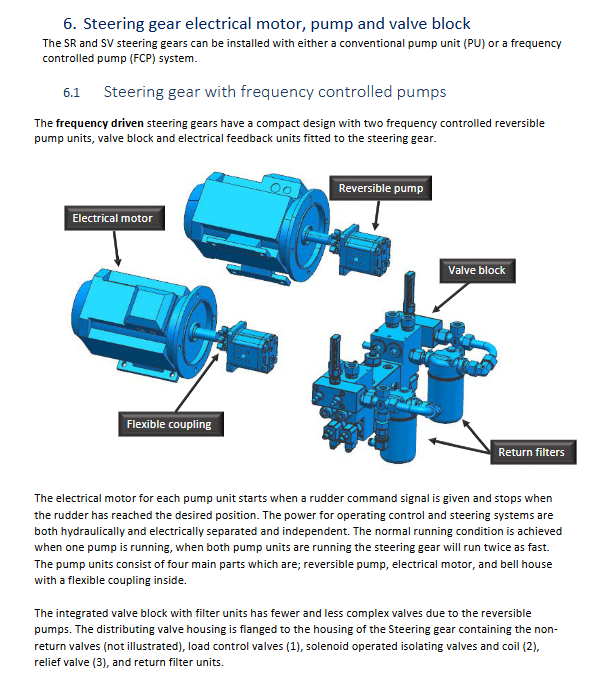
Variable frequency pump system: New equipment after 2019 comes standard with dual reversible frequency pump units, valve blocks, and electrical feedback units. The pump starts and stops with the rudder command, and the single pump operates at a regular speed. The dual pump operates at double the speed, and the valve block integrates a filter. The number of valves is small and the structure is simple.
Conventional pump system: The pump operates continuously and controls the hydraulic oil through a control valve. It is divided into models such as PU30/45/50, where PU30 is a gear pump and the rest are vane pumps. The pump is immersed in oil and connected to the actuator and oil storage tank through three pipes.
System oil capacity: Different models/pump types have different oil capacities. The variable frequency pump system SR562 is about 35L, SV850 is about 230L; the conventional pump system SR562+PU30 is about 60L, SV570+PU50 is about 570L.
Core maintenance process and testing
The manual provides detailed operating procedures for hydraulic oil management, core performance testing, and specialized maintenance. The testing processes for variable frequency pumps and conventional pumps are completely independent, and the core operations are as follows:
Hydraulic oil management
Oil requirements: Must comply with DIN 51524 standard, ISO32 viscosity grade, pour point < -30 ℃, contain anti-wear, water-resistant/anti foaming additives, and prohibit mixing with other oils; Kongsberg has designated AGIP ARNICA 32, SHELL TELLUS S2 VX 32 and other oils, and CASTROL Biobar 32 biodegradable oil can be selected.
Oil change standard: If the oil sample test shows that the neutralization value is too high, the residual amount of extreme pressure additives is low, there are too many insoluble particles, or the cleanliness is lower than ISO 4406 17/14 (NAS 1638 level 8), or if the hydraulic system components are damaged, the oil needs to be changed immediately.
Oil sample collection: After the equipment is running, collect samples from the sampling points of the actuator/valve block/filter. Rinse the hose first, then fill it into a clean sample bottle, label the oil type/date/duration of use, visually detect color/impurities, and immediately send the sample for analysis.
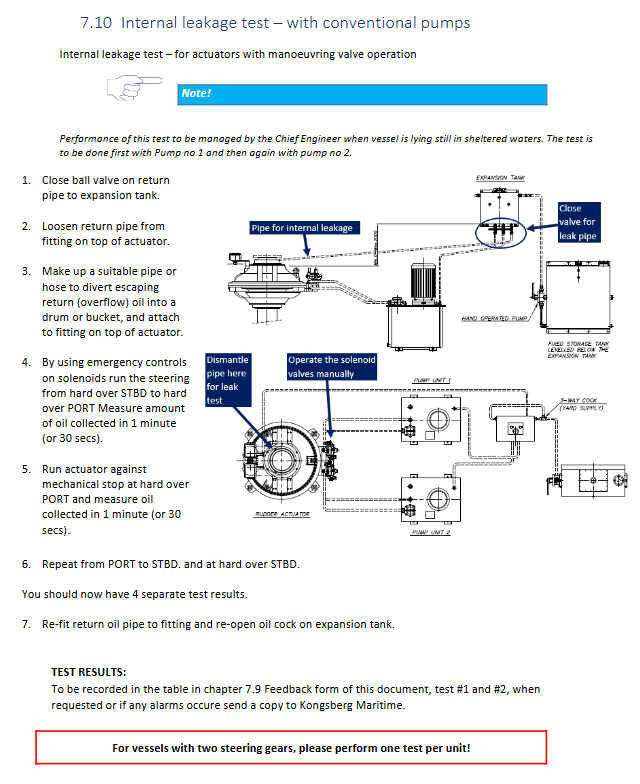
Core performance testing: All tests are carried out by the chief engineer in sheltered waters, and pumps 1 and 2 need to be tested separately. The test results are recorded in the feedback form and sent to the designated email of Kongsberg. The core tests include internal leakage testing and steering time testing. The variable frequency pump test involves bidirectional switching of 30 ° steering angle, while the conventional pump requires bidirectional switching of 30 ° -35 ° steering angle. At the same time, the leakage oil volume, pressure, and oil temperature are recorded.
Special maintenance process
Inverter fault log: Check that the cooling air duct is not blocked, press the alarm log button, view the fault record of timestamp+running hours through the up and down keys, and press the status key to exit.
Emergency steering test: Adjust the motor controller to local control, operate the steering through the emergency button, restore remote control after testing, and communicate wirelessly with the bridge throughout the process.
Filter replacement: Stop the machine and close the expansion tank oil valve, drain the oil in the filter chamber, replace the filter element and reinstall it, open the oil valve and release the air from the distribution valve, and restore remote control.
Cooler cleaning (B10/M10-30 type): Mild pollution can be backwashed with water, severe pollution can be washed with 5% phosphoric acid/oxalic acid solution, M10 type can be disassembled and manually cleaned (board width not exceeding 88.4mm), B10 type cannot be washed and replaced. After cleaning, the gasket needs to be dried 24 hours or replaced directly.
- YOKOGAWA
- Reliance
- ADVANCED
- SEW
- ProSoft
- WATLOW
- Kongsberg
- FANUC
- VSD
- DCS
- PLC
- man-machine
- Covid-19
- Energy and Gender
- Energy Access
- Renewable Integration
- Energy Subsidies
- Energy and Water
- Net zero emission
- Energy Security
- Critical Minerals
- A-B
- petroleum
- Mine scale
- Sewage treatment
- cement
- architecture
- Industrial information
- New energy
- Automobile market
- electricity
- Construction site
- HIMA
- ABB
- Rockwell
- Schneider Modicon
- Siemens
- xYCOM
- Yaskawa
- Woodward
- BOSCH Rexroth
- MOOG
- General Electric
- American NI
- Rolls-Royce
- CTI
- Honeywell
- EMERSON
- MAN
- GE
- TRICONEX
- Control Wave
- ALSTOM
- AMAT
- STUDER
- KONGSBERG
- MOTOROLA
- DANAHER MOTION
- Bentley
- Galil
- EATON
- MOLEX
- Triconex
- DEIF
- B&W
- ZYGO
- Aerotech
- DANFOSS
- KOLLMORGEN
- Beijer
- Endress+Hauser
- schneider
- Foxboro
- KB
- REXROTH
- YAMAHA
- Johnson
- Westinghouse
- WAGO
- TOSHIBA
- TEKTRONIX
- BENDER
- BMCM
- SMC
- HITACHI
- HIRSCHMANN
- XP POWER
- Baldor
- Meggitt
- SHINKAWA
- Other Brands
- UniOP
- KUKA
- IBA
- Beckhoff
- ADLINK
-
Siemens 6SL3244-0SA01-1AA0 - SINAMICS G120 Control Unit
-
DANFOSS 175Z2688 - COATEDE CONTROLUNIT VLT5000
-
SIEMENS 6FM1721-3AA20 - Positioning Module
-
REXORTH VTS0605 PVAR S21 - Drive Module
-
BECKHOFF 2915-0000 - Control Module
-
COOPER EATON CGLine 400 40071347901 - CEAG CG Controller
-
SIEMENS 3UF5031-3AN00-1 - SIMOCODE DP Basic Unit
-
SIGMATEK DNC305 05-011-305 - Drive Controller
-
Multivac MV1 10249768 - Control Module
-
SCHNEIDER ELECTRIC MES114 59646 & 59645 - Circuit Breaker Accessory
-
CAMILLE BAUER CAPAX 44-580-0012 - Transmitter
-
HENGSTLER VT360P LS1/TOK - Encoder
-
BURKERT 8792 - 24V DC IP65 / IP67 Positioner
-
SENSOPART V10-OB-A1-W6 - Vision Sensor
-
ALLEN-BRADLEY 1762-L40BXB SER.C REV.J - MicroLogix 1200 Controller
-
HITACHI CPU22-02HC 33025801-2 - CPU Module
-
HITACHI AGH-0 33034810-2 - Control Board
-
PHILIPS AIH110 VER 1.0 - Control Module
-
BAUMULLER DO8000 - Drive Controller
-
B&R PS477 3PS477.9 Rev.C0 - Power Supply
-
ABB ALFA LAVAL 200-CISB - Communication Interface 2 x SatBus
-
Moeller MI4-570-TA1 - HMI Operator Panel
-
ABB ACH550-01-06A9-4+B055 - Variable Frequency Drive
-
ABB TPU2 3HNE00313-1 REV 12 - Teach Pendant Unit
-
Schneider Electric BRS368H130ABA - Stepper Motor
-
Foxboro FCM100E P0972ZA - I/A Series Communication Module
-
Siemens 6ES7 450-1AP00-0AE0 6ES7450-1AP00-0AE0 - Simatic S7 Version:04 Counter Module
-
Schneider Electric ATV320U07N4W - Altivar Machine Drive
-
Priva TouchPoint Flush V06:02 5060002 - Control Panel
-
Lenze ESMD402L4TXA - 4kW SMD Inverter Drive
-
Lenze ESMD402L4TXA - 4kW SMD Inverter Drive
-
Schneider Electric PM210 PM210MG - Powerlogic Power Meter
-
ASCOM U982-DB/1C U982 - Power Supply / Communication Module
-
DYADIC SYSTEMS SCN5-010-050-S03-NA - Servo Cylinder
-
Reliance Electric GMI-S04 - AC/AC CONVERTER 380/400V 50/60Hz 3.9/5.2A
-
Pro-Face GLC150-BG41-XY32KF-24V 3080060 PFXGLC150BDBP - Touch Screen HMI
-
ROFIN RSL TERMINAL V2 0185.01/03 - TERMINAL
-
HONEYWELL R7241E1077 - Burner Control / Amplifier
-
SEW MM22C-503-00 8241201 - 2.2kW Movimot Drive
-
Brand Digital III 50mL - Burette
-
Danfoss 195N0039 VLT2811PS2B20STR1DBF00A00C0 - 2.4kVA VLT Drive
-
SONY LG10-2 EK1 - Digital Gauge Indicator
-
EMERSON SKD3400750 - 7.5kW AC Drive
-
SIEMENS 6AV6 542-0AG10-0AX0 - MULTIPANEL HMI
-
TELEMECANIQUE ATV21HU55N4 - ALTIVAR21 5.5KW Variable Speed Drive
-
MITSUBISHI A985GOT-TBA-EU - GOT900 Touch Screen HMI
-
SCHNEIDER LXM32AD30N4 - Lexium 32 Servo Drive
-
SICK PSR01-1501 M20Z-02550A122 - Safety Laser Scanner
-
GECMA CHALLENGER 15-2-FMO - LITE TOUCH Monitor
-
Uniop EK02 6ZA982 - HMI Operator Panel
-
TELEMECANIQUE ATV18U54M2 - SQUARE D ALTIVAR 18 3kW Drive
-
Schneider Electric ATV312HU75S6 - 7.5kW Altivar 312 Drive
-
Siemens 6GK7243-5DX30-0XE0 6GK7 243-5DX30-0XE0 - Communications Processor
-
Schneider Electric LV432455 VIGI630 - 3POLE Earth Leakage Module
-
Rexroth PSI 6100.750 L1 R911170694-107 - frequency inverter / inverter
-
SWEDISH MICROWAVE AB Ku-Band BDC 138010-45-D0 - Block Downconverter
-
METTLER TOLEDO IND429 IND429-BB30 - Weighing Terminal
-
Siemens 6SL3210-5HE10-4UF0 - Sinamics V90 Servo Drive
-
B&R X20CP0482 Rev.D0 - X20 CPU Module
-
Mitsubishi FR-E720S-110SC-EC FRE720S110SCEC - 31A~11A Drive With Filter
-
ABB ACH580-01-026A-4 - Variable Frequency Drive
-
Siemens 6SL3210-1KE13-2AP1 - SINAMIC G120CDP 1.1kw Drive
-
Schneider Electric TM250D 4P3D LV431440 - Compact NSX250 Circuit Breaker
-
RELIANCE ELECTRIC GD.722.81.00-A 802288-74C - MAXITRON Servo Control Card
-
Uniop EK02 6ZA982 - HMI Operator Panel
-
Siemens 6SE9113-7JA13 - MICRO MASTER Junior 1.5kW Inverter
-
Mitsubishi FR-E720S-110SC-EC FRE720S110SCEC - 31A~11A Drive with Filter
-
Johnson Controls FEC2621 MS-FEC2621-0 - Field Equipment Controller
-
BENDER IR475LYT-429 - A-ISOMETER Insulation Monitor
-
Berger lahr D550 RS15 22.550-00-30b - Stepper Drive
-
Rexroth PSI 6100.750 L1 R911170694-107 - Frequency Inverter / INVERTER
-
KOYO 205 D2-06B-1 D2-240 H2-ECOM D2-08ND3 F2-08TRS - DIRECT LOGIC PLC WITH MODULE
-
TELEMECANIQUE ATV18U54M2 ATV18U54M - SQUARE D ALTIVAR 18 3kW Drive
-
Lenze 471-E1.D - Board / Controller Speed
-
Mitsubishi FR-A740-00038-EC - Frequency Inverter
-
Johnson Controls IOM3723 MS-IOM3723-0 - Input/Output Module
-
CURTIS 1238-5602 - AC Motor Controller
-
FOXBORO P0912XX REV.A - 220VAC Power Supply
-
Siemens 6SE9113-7JA13 - MICRO MASTER Junior 1.5kW Inverter
-
Mitsubishi FR-A740-00038-EC - Frequency Inverter
-
KOYO 205 D2-06B-1 D2-240 H2-ECOM D2-08ND3 F2-08TRS - DIRECT LOGIC PLC WITH MODULE
-
AUTZ M406D-00101 - Servo Motor
-
Lauer PCS095 PG095.508.BB - Operator Panel
-
ABB SCOP45SB/DX232 - SattCon OP45 SB Operator Panel
-
SEW Eurodrive MCH42A0030-5A3-4-00 MDX60A0030-5A3-4-00 - 4.8kVA Movidrive Inverter
-
BENDER IR475LYT-429 - A-ISOMETER Insulation Monitor
-
Johnson Controls FEC2621 MS-FEC2621-0 - Field Equipment Controller
-
Johnson Controls IOM3723 MS-IOM3723-0 - Input/Output Module
-
Berger lahr D550 RS15 22550-00-30b - Stepper Drive
-
SIEMENS 6FX1120-4BD03 6FX11204BD03 5702049304.00 E-Stand: A - Sinumerik Module
-
Allen-Bradley 1771-NIV B - HIGH RESOLUTION ISOLATED ANALOG SERIES Module
-
HONEYWELL XFC2D06001 - Flow Computer / Controller
-
Contraves Varidyn Compact ADB 380.90M - DC Drive 380v - 400v 90A 50kVA
-
Red Lion Control GEM52000 - Control Module
-
Siemens 6ES5 955-3NC13 - modular power supply TYPE:DIN41752
-
Danfoss ICV50 G20Mn50T / 027H5200 - Valve zaw
-
Eberle PLS508 P-814 / 2X EA-88 / A-812 / MT-81 / S-11 - PLC with Modules
-
Siemens 6ES7 314-6CF01-0AB0 6ES7314-6CF01-0AB0 - SIMATIC CPU314C-2 DP
-
EBERLE EM-525-87 EM52487 - ICE DETECTOR BASE UNIT
-
Telemecanique / Schneider TSXRKZ02 - TSX Micro automation plus 7module
-
B&R 5DLSDL.1001-00 - Display Link Receiver
-
Siemens 6FX1120-4BD03 6FX11204BD03 5702049304.00 E-Stand: A - Sinumerik Module
-
ALLEN-BRADLEY 1771-NIV A - HIGH RESOLUTION ISOLATED ANALOG SERIES Module
-
ALLEN-BRADLEY 1771-NIV B - HIGH RESOLUTION ISOLATED ANALOG SERIES Module
-
Contraves Varidyn Compact ADB 380.90M - DC Drive 380V - 400V 90A 50kVA
-
Contraves Varidyn Compact ADB 380.90M - DC Drive 380V - 400V 90A 50kVA
-
Ropex RES-202 - Resistron Temperature Controller
-
HONEYWELL XFC2D06001 - Flow Computer / Controller
-
Telemechanics ATV452U40 - DIMMER ALTIVAR5 SERIES 452 4kW 5HP Frequency Inverter
-
VEGA VEGAPLUS61 PS61.XXAGPHAMAX - Radar Level Sensor
-
BRANSON ULTRASONIC TRANSDUCER - Ultrasonic Transducer
-
Danfoss ICV50 G20Mn50T / 027H5200 - Valve Valvola Zaw
-
Schneider Electric 2001549/1 GALAXY PW 5102851200 NT07 - panler card
-
REXROTH VT3006-36 A - Proportional Valve Amplifier
-
Allen-Bradley 1746-OBP16 SERIES:C - SLC 500 OUTPUT MODULE
-
SCHNEIDER LXM32MD12N4 - Lexium 32 Servo Drive
-
Schneider Electric ATV630U22N4 - 2.2KW Altivar Process Drive
-
Allen-Bradley 1746-OBP16 SERIES:C - SLC 500 OUTPUT MODULE
-
Vanderlande 0E2550-00002... - Bagtrax Integrated Power Module 400V 32A
-
B&R X20CP0410 Rev.D0 - X20 CPU Module
-
VANDERLANDE 0E2550-00002 02EDD2B0100 - BAGTRAX Integrated Power Module 400V 32A
-
Rexroth R061205010 - Linear Bushing / Bearing
-
INDRAMAT TVM1.2-50-220/300-W0-220/380 - Power Supply Module
-
Vanderlande 0E2550-00002... - Bagtrax Integrated Power Module 400V 32A
-
HOMAG KEB 07F5S1A-YA00 09E5T60-1001 - Combivert Inverter WITH KEYPAID AND FILTER
-
Siemens 3RW3047-1BB14 - Soft Starter
-
Sumitomo AF-500 AF502-A40 - 0.4kW Transistor Inverter
-
Sumitomo AF-500 AF502-A40 - 0.4kW Transistor Inverter

K-JIANG

Add: Jimei North Road, Jimei District, Xiamen, Fujian, China
Tell:+86-15305925923