

K-WANG


Teknic SSt-6000-U Digital Servo Drive
Teknic SSt-6000-U Digital Servo Drive
Product core positioning
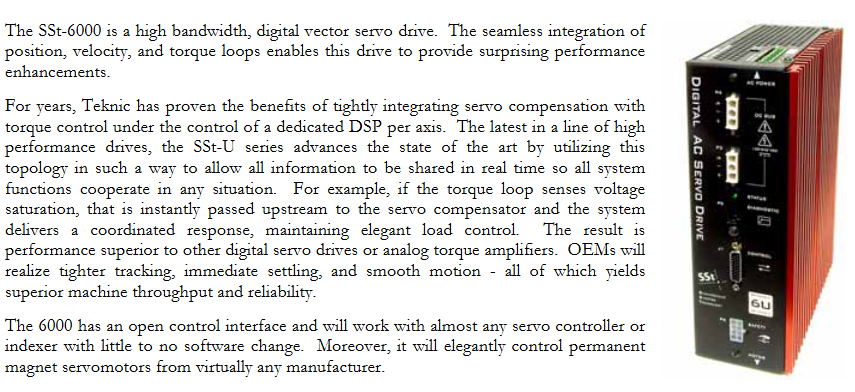
SSt-6000-U is a high bandwidth digital vector servo driver launched by Teknic Corporation in the United States, designed specifically for high-precision motion control scenarios. Its core function is to achieve precise control of the position, speed, and torque of permanent magnet servo motors (including rotary, linear, brushed/brushless, and other types) in three closed loops. It adopts a "dedicated DSP for each axis" architecture, which solves the pain points of traditional servo drives in dynamic response, load adaptation, anti-interference, and other aspects through real-time data sharing and collaborative control algorithms. It is suitable for OEM applications such as machine tools, automated production lines, and precision equipment that require high motion accuracy (such as zero setting time, ultra-low tracking error) and reliability. It can directly replace stepper drives or upgrade traditional servo systems without requiring a large amount of software adaptation.
Key technical specifications
1. Basic and environmental parameters
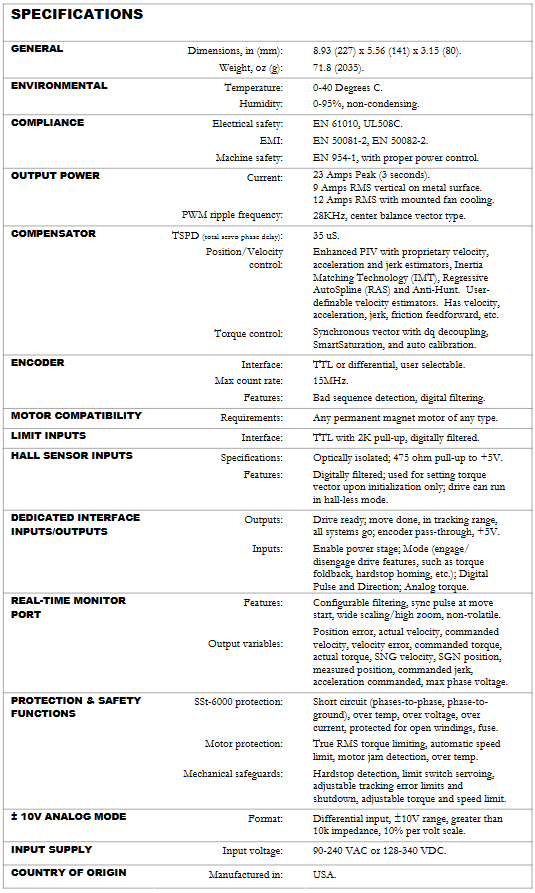
Physical dimensions and weight - Dimensions: 8.93 x 5.56 x 3.15 inches (227 x 141 x 80 mm)
-Weight: 71.8 ounces (2035 g)
Working environment - Temperature: 0~40 ℃ (no condensation)
-Humidity: 0~95% RH (non condensing)
-Installation: Vertical installation on metal surface (with reserved heat dissipation space)
Compliance - Electrical Safety: EN 61010, UL 508C
-Electromagnetic compatibility (EMC): EN 50081-2 (emission), EN 50082-2 (anti-interference)
-Mechanical safety: EN 954-1 (requires compliant power control)
2. Power output and motor compatibility
Output current - peak current: 23 A (continuous for 3 seconds)
-Rated current: 9 A RMS (vertically installed on metal surface), 12 A RMS (with fan cooling)
PWM characteristics: 28 kHz center balanced vector PWM ripple frequency, reducing motor operating noise and heat generation
Motor compatibility supports almost all manufacturers' permanent magnet motors (without electrical restrictions), including:
-Rotary/linear servo motor, brushed/brushless motor
-Special types such as galvanometer motors and voice coil motors
3. Control performance and algorithms
Total servo phase delay (TSPD) 35 μ s (industry-leading, fully deterministic delay from position feedback reading to motor torque update)
Control closed-loop three loop collaboration (position+speed+torque), supporting:
-Position mode: Tracking error compensation, zero setting time (≤ 1 ms, requiring mechanical bandwidth matching)
-Speed mode: adaptive load inertia, anti resonance
-Torque mode: synchronous vector control, DQ decoupling, SmartSaturation (maintaining control stability when voltage/current saturates)
Core algorithm - IMT (Inertial Matching Technology): Adaptive control based on neural fuzzy logic, eliminating inertia matching concerns and adapting to large/variable inertia loads
-RAS (Regression Automatic Spline): jerk (Acceleration) restricts trajectory planning to reduce impact, vibration, and wear
-Anti Hunt: Small signal sliding mode automatic gain modulation to avoid axis oscillation under high gain conditions
-Multi order feedforward compensation: improves tracking accuracy without the noise and torque jitter of traditional feedforward
4. Feedback and Interface
Encoder Interface - Type: TTL/Differential (User Optional)
-Maximum count rate: 15 MHz
-Function: Fault sequence detection, digital filtering, support for position recovery
Hall sensor interface - isolation: photoelectric isolation, 475 Ω pull-up to+5V
-Function: Used only for torque vector setting during initialization, supports no Hall mode operation
Dedicated I/O interface - Output: Drive ready, motion completed, within tracking range, encoder pass through,+5V power supply
-Input: power level enable, mode selection (torque return, hard limit return to zero, etc.), digital pulse/direction command, analog torque command
Analog input (± 10V) differential input, impedance>10 k Ω, scaling ratio 10%/V, used for simulating torque command input
The real-time monitoring port can be configured with filtering and synchronization pulses, and the output variables include position error, actual/commanded speed, torque, acceleration, maximum phase voltage, etc. It supports non-volatile storage
5. Power Supply and Protection
Input power supply wide voltage adaptation: 90~240 VAC or 128~340 VDC (no need to manually switch voltage levels)
Driver Protection - Electrical Protection: Short Circuit (Phase to Phase/Relative Ground), Over Temperature, Over Voltage, Over Current, Winding Open Circuit Protection, Fuse
-Motor protection: true RMS torque limit, automatic speed limit, motor stalling detection, over temperature protection
Mechanical safety protection hard limit detection, limit switch servo control, adjustable tracking error limit and shutdown, adjustable torque/speed limit
Core functions and advantages
1. High precision motion control capability
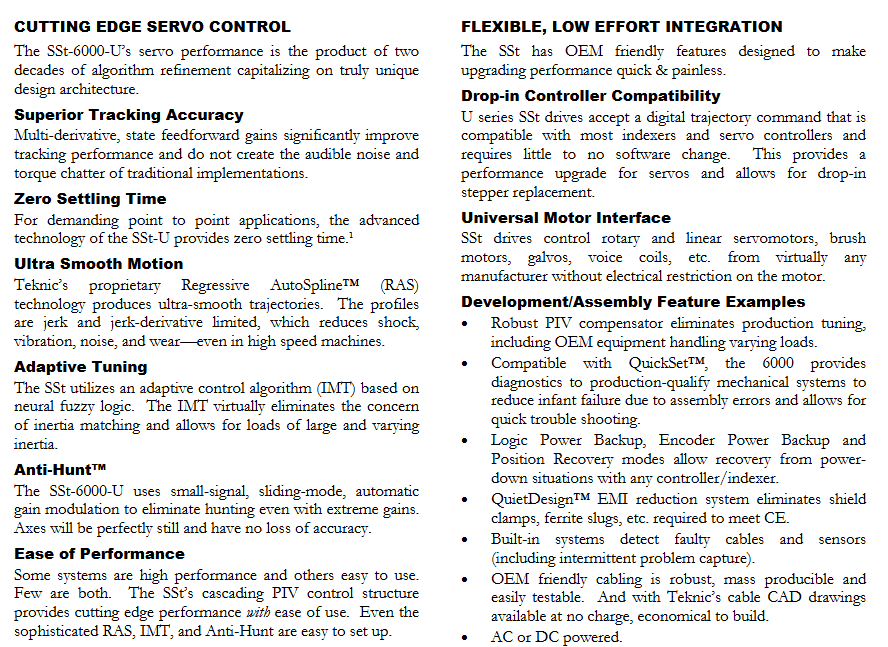
Zero setting time: For point-to-point motion scenarios, under the premise of mechanical bandwidth matching, the setting time is ≤ 1 ms, greatly improving device throughput;
Ultra smooth trajectory: RAS technology generates jerk limited motion curves, which can reduce equipment vibration, noise, and mechanical wear even at high speeds;
Anti interference and stability: The Anti Hunt algorithm eliminates shaft oscillations under high gain, ensuring no drift and no loss of accuracy when the shaft is stationary.
2. Flexible integration and ease of use
Plug and play compatibility: The digital trajectory command interface is compatible with most indexes/servo controllers, requiring no or only a small amount of software modification, and can directly replace stepper drivers;
Universal motor control: No manufacturer/type restrictions, supports brushed/brushless, rotary/linear motors, reducing OEM stocking and adaptation costs;
Simplify debugging and maintenance:
Collaborate with Teknic QuickSet ™ Tools that provide mechanical system diagnosis and reduce early failures caused by assembly errors;
Logical power backup (DSP still works when the main power is disconnected), power failure location recovery (no need to reset to zero), to improve equipment fault tolerance and operation efficiency;
Built in cable/sensor fault detection (including intermittent problem capture) simplifies troubleshooting.
3. Safety and reliability
Full scenario protection: multi-layer protection from electrical (overcurrent/overvoltage), motor (stalling/overheating) to mechanical (hard limit/tracking error) to avoid equipment damage;
True RMS torque limit: Compared to traditional I ² t or temperature controllers, it is more precise in preventing motor burnout and does not require additional wiring or sensors;
EMI optimization: QuietDesign ™ The electromagnetic interference suppression system can meet CE certification without the need for shielding clamps or ferrite cores, reducing wiring complexity.
Typical application scenarios
Precision machine tools: zero setting time and high tracking accuracy, suitable for precise control of tool paths;
Automated assembly line: with torque reversal and force control functions, suitable for contact operations such as part insertion and pressing;
Semiconductor equipment: low latency and anti vibration characteristics, meeting high-precision motion requirements such as wafer handling and photolithography;
Alternative stepper system: Directly replace the stepper driver to improve motion smoothness and positioning accuracy without modifying the original controller software.
Product core positioning
SSt-6000-U is a high bandwidth digital vector servo driver launched by Teknic Corporation in the United States, designed specifically for high-precision motion control scenarios. Its core function is to achieve precise control of the position, speed, and torque of permanent magnet servo motors (including rotary, linear, brushed/brushless, and other types) in three closed loops. It adopts a "dedicated DSP for each axis" architecture, which solves the pain points of traditional servo drives in dynamic response, load adaptation, anti-interference, and other aspects through real-time data sharing and collaborative control algorithms. It is suitable for OEM applications such as machine tools, automated production lines, and precision equipment that require high motion accuracy (such as zero setting time, ultra-low tracking error) and reliability. It can directly replace stepper drives or upgrade traditional servo systems without requiring a large amount of software adaptation.
Key technical specifications
1. Basic and environmental parameters
Physical dimensions and weight - Dimensions: 8.93 x 5.56 x 3.15 inches (227 x 141 x 80 mm)
-Weight: 71.8 ounces (2035 g)
Working environment - Temperature: 0~40 ℃ (no condensation)
-Humidity: 0~95% RH (non condensing)
-Installation: Vertical installation on metal surface (with reserved heat dissipation space)
Compliance - Electrical Safety: EN 61010, UL 508C
-Electromagnetic compatibility (EMC): EN 50081-2 (emission), EN 50082-2 (anti-interference)
-Mechanical safety: EN 954-1 (requires compliant power control)
2. Power output and motor compatibility
Output current - peak current: 23 A (continuous for 3 seconds)
-Rated current: 9 A RMS (vertically installed on metal surface), 12 A RMS (with fan cooling)
PWM characteristics: 28 kHz center balanced vector PWM ripple frequency, reducing motor operating noise and heat generation
Motor compatibility supports almost all manufacturers' permanent magnet motors (without electrical restrictions), including:
-Rotary/linear servo motor, brushed/brushless motor
-Special types such as galvanometer motors and voice coil motors
3. Control performance and algorithms
Total servo phase delay (TSPD) 35 μ s (industry-leading, fully deterministic delay from position feedback reading to motor torque update)
Control closed-loop three loop collaboration (position+speed+torque), supporting:
-Position mode: Tracking error compensation, zero setting time (≤ 1 ms, requiring mechanical bandwidth matching)
-Speed mode: adaptive load inertia, anti resonance
-Torque mode: synchronous vector control, DQ decoupling, SmartSaturation (maintaining control stability when voltage/current saturates)
Core algorithm - IMT (Inertial Matching Technology): Adaptive control based on neural fuzzy logic, eliminating inertia matching concerns and adapting to large/variable inertia loads
-RAS (Regression Automatic Spline): jerk (Acceleration) restricts trajectory planning to reduce impact, vibration, and wear
-Anti Hunt: Small signal sliding mode automatic gain modulation to avoid axis oscillation under high gain conditions
-Multi order feedforward compensation: improves tracking accuracy without the noise and torque jitter of traditional feedforward
4. Feedback and Interface
Encoder Interface - Type: TTL/Differential (User Optional)
-Maximum count rate: 15 MHz
-Function: Fault sequence detection, digital filtering, support for position recovery
Hall sensor interface - isolation: photoelectric isolation, 475 Ω pull-up to+5V
-Function: Used only for torque vector setting during initialization, supports no Hall mode operation
Dedicated I/O interface - Output: Drive ready, motion completed, within tracking range, encoder pass through,+5V power supply
-Input: power level enable, mode selection (torque return, hard limit return to zero, etc.), digital pulse/direction command, analog torque command
Analog input (± 10V) differential input, impedance>10 k Ω, scaling ratio 10%/V, used for simulating torque command input
The real-time monitoring port can be configured with filtering and synchronization pulses, and the output variables include position error, actual/commanded speed, torque, acceleration, maximum phase voltage, etc. It supports non-volatile storage
5. Power Supply and Protection
Input power supply wide voltage adaptation: 90~240 VAC or 128~340 VDC (no need to manually switch voltage levels)
Driver Protection - Electrical Protection: Short Circuit (Phase to Phase/Relative Ground), Over Temperature, Over Voltage, Over Current, Winding Open Circuit Protection, Fuse
-Motor protection: true RMS torque limit, automatic speed limit, motor stalling detection, over temperature protection
Mechanical safety protection hard limit detection, limit switch servo control, adjustable tracking error limit and shutdown, adjustable torque/speed limit
Core functions and advantages
1. High precision motion control capability
Zero setting time: For point-to-point motion scenarios, under the premise of mechanical bandwidth matching, the setting time is ≤ 1 ms, greatly improving device throughput;
Ultra smooth trajectory: RAS technology generates jerk limited motion curves, which can reduce equipment vibration, noise, and mechanical wear even at high speeds;
Anti interference and stability: The Anti Hunt algorithm eliminates shaft oscillations under high gain, ensuring no drift and no loss of accuracy when the shaft is stationary.
2. Flexible integration and ease of use
Plug and play compatibility: The digital trajectory command interface is compatible with most indexes/servo controllers, requiring no or only a small amount of software modification, and can directly replace stepper drivers;
Universal motor control: No manufacturer/type restrictions, supports brushed/brushless, rotary/linear motors, reducing OEM stocking and adaptation costs;
Simplify debugging and maintenance:
Collaborate with Teknic QuickSet ™ Tools that provide mechanical system diagnosis and reduce early failures caused by assembly errors;
Logical power backup (DSP still works when the main power is disconnected), power failure location recovery (no need to reset to zero), to improve equipment fault tolerance and operation efficiency;
Built in cable/sensor fault detection (including intermittent problem capture) simplifies troubleshooting.
3. Safety and reliability
Full scenario protection: multi-layer protection from electrical (overcurrent/overvoltage), motor (stalling/overheating) to mechanical (hard limit/tracking error) to avoid equipment damage;
True RMS torque limit: Compared to traditional I ² t or temperature controllers, it is more precise in preventing motor burnout and does not require additional wiring or sensors;
EMI optimization: QuietDesign ™ The electromagnetic interference suppression system can meet CE certification without the need for shielding clamps or ferrite cores, reducing wiring complexity.
Typical application scenarios
Precision machine tools: zero setting time and high tracking accuracy, suitable for precise control of tool paths;
Automated assembly line: with torque reversal and force control functions, suitable for contact operations such as part insertion and pressing;
Semiconductor equipment: low latency and anti vibration characteristics, meeting high-precision motion requirements such as wafer handling and photolithography;
Alternative stepper system: Directly replace the stepper driver to improve motion smoothness and positioning accuracy without modifying the original controller software.
- YOKOGAWA
- Reliance
- ADVANCED
- SEW
- ProSoft
- WATLOW
- Kongsberg
- FANUC
- VSD
- DCS
- PLC
- man-machine
- Covid-19
- Energy and Gender
- Energy Access
- Renewable Integration
- Energy Subsidies
- Energy and Water
- Net zero emission
- Energy Security
- Critical Minerals
- A-B
- petroleum
- Mine scale
- Sewage treatment
- cement
- architecture
- Industrial information
- New energy
- Automobile market
- electricity
- Construction site
- HIMA
- ABB
- Rockwell
- Schneider Modicon
- Siemens
- xYCOM
- Yaskawa
- Woodward
- BOSCH Rexroth
- MOOG
- General Electric
- American NI
- Rolls-Royce
- CTI
- Honeywell
- EMERSON
- MAN
- GE
- TRICONEX
- Control Wave
- ALSTOM
- AMAT
- STUDER
- KONGSBERG
- MOTOROLA
- DANAHER MOTION
- Bentley
- Galil
- EATON
- MOLEX
- Triconex
- DEIF
- B&W
- ZYGO
- Aerotech
- DANFOSS
- KOLLMORGEN
- Beijer
- Endress+Hauser
- schneider
- Foxboro
- KB
- REXROTH
- YAMAHA
- Johnson
- Westinghouse
- WAGO
- TOSHIBA
- TEKTRONIX
- BENDER
- BMCM
- SMC
- HITACHI
- HIRSCHMANN
- XP POWER
- Baldor
- Meggitt
- SHINKAWA
- Other Brands
- UniOP
- KUKA
- IBA
- Beckhoff
- ADLINK
-
FANUC A06B-0169-B088 - AC Servo Motor Alpha M40 3000 3 KW
-
ALPHA WIRE 1299C-SLATE-1000 - Multi-Conductor Cable Wire
-
alpha / Wittenstein SK+180S-MF1-10-1M1-1K - Hypoid Gearbox i=10
-
ALPHA WIRE 1181/40C SL005 - Multi-Conductor Cable Wire
-
Generic / DSI Straight Anatomic Plastic Adapter Head + Screw Hex - Dental Implant Fixture
-
Alpha II-650 MV6500526A - Power Supply Unit
-
ALPHA WIRE 7036 WH001 - Hook-Up Wire
-
FANUC RDCGM00000004O / TP 050-MF1-7-061-000 - Gear Reducer / Alpha Gearbox
-
Alpha II-650 MV6500436A - TDK-Lambda Power Supply Unit
-
Alpha S-Alpha600 J60033 - 600W Switching Power Supply Unit
-
Alpha 1500W J00032 - Power Supply Unit
-
Alpha 600W H60638 - Switching Power Supply Unit
-
Alpha 650 MV6500314A - Power Supply Unit
-
Aloka UST-5413 - Linear Probe for Prosound Alpha 6
-
ALPHA WIRE TFT25015 NA002 - High Temperature Heat Shrink Tubing Wire Sleeving
-
JAVAD ALPHA2 / GrAnt-G3 - GPS Receiver
-
Alpha 400W H47318 - Switching Power Supply Unit
-
Alpha SG-ALPHA-202-001 / Q1001-010-001 - Circuit Board Module
-
Antlia Dual ERF H-Alpha & Cak/CaH - Density Astronomical Accessory
-
ALPHA WIRE 5100C SL033 - Multi-Conductor Cable Wire
-
ALPHA WIRE 5098C-SL033 - Multi-Conductor Cable Wire
-
Fanuc A06B-6290-H105 - Alpha Sv 80hv-B Module Servo Amplifier
-
FANUC A06B-6240-H105 - Aux Axis Alpha aiSV 80 Servo Amplifier
-
Endress+Hauser Alpha-Log RSA10-61B1S / 42974737/0130 - Data Logger Measurement Instrument
-
ALPHA WIRE 6363-SL002 - Multi-Conductor Cable Wire
-
Alpha SP100S-MF1-7-1K1-2S - Gear Reducer
-
Alpha SP 100G-MF1-4-0H1-2S-PGG - Planetary Gear Reducer
-
FANUC A06B-0143-B175 #0275 - Alpha 12/3000 AC Servo Motor
-
James Burn Alpha Doc P33 / GBC PDI - Automatic Punch DocuPunch
-
Titus HVAC 105383-01 - ALPHA BAC Controller and Actuator
-
Wittenstein Alpha SP 100S-MF2-20-0E0-2S - Planetary Gearbox i=20
-
Kashiyama Alpha-85-ZV / SP-8026G - Pump Controller
-
Christ Alpha 2-4 LDplus - Freeze Drier Part N/ 101542
-
Lambda / Alpha H40896 - 400W Power Supply Unit
-
Wittenstein Alpha LP-070S-MF1-3-1E1-38 - Planetary Gearbox
-
Matrox / EXO-2480 133-D06-3 / 398-17962-1 - Alpha Numeric PCB Board
-
Fanuc A06B-6096-H204 - Dual Axis Alpha Servo Amplifier Module
-
Alpha Wire 5002C-SL001 - Multi-Conductor Cable 2 Conductors 22AWG 300VAC
-
Alpha 600W H60638 - Switching Power Supply Unit
-
Alpha Scientific Spin Precession Dual Electro Magnet Beam Line Chamber - Electro Magnet Beam Line Chamber
-
ALPHA WIRE 6017C SL005 - Multi-Conductor Cable Wire
-
ALPHA WIRE 65804 SL002 - Multi-Conductor Cable Wire
-
Fanuc A06B-0152-B010 - AC Servo Motor Alpha A30/2000 with Brake
-
ALPHA WIRE 5856-VI001 - Hook-Up Wire
-
ALPHA WIRE M13142-SL001 - Multi-Conductor Cable Wire
-
Alpha & Omega AOZ1017 - 8-Pin SOIC SMD Buck Switching Regulator IC
-
Alpha 600W H67027 CA600 - 600W Switching Power Supply Unit
-
ALPHA WIRE 2845/7-RD001 - Hook-Up Wire
-
Wittenstein Alpha VH+063S-MF1-10-6H1-1K-0C2 - Worm Gear Reducer i=10
-
ALPHA WIRE 2414C SL022 - Multi-Conductor Cable Wire
-
ALPHA WIRE 5672-SL005 - Multi-Conductor Cable Wire
-
BECKHOFF / Alpha AM8021-0B10-0000 + CP 040-MO1-10 - Servo Motor with Planetary Gearbox
-
ALPHA Systems Lab Inc MBA-WV1-F / PCB-WV1-F - PCB Board
-
FANUC A06B-0826-B201 - Alpha P12 AC Spindle Motor
-
WF & HC / Alpha-E 10045 - Tiller Bar Flat Flange Inlet 3150LB 3X 2.5 Inch
-
Seiler Alpha Air 3 - Dental Microscope
-
Alpha 400W H47223 - Switching Power Supply Unit
-
Wittenstein Alpha SP 180S-MC1-5-1M0-2K - Planetary Gearbox
-
FANUC A06B-6117-H211 - Servo Amplifier Module Alpha iSV 160/160 Amp
-
Alpha S-Alpha600 J60033 - 600W Switching Power Supply Unit
-
Adaptive Alpha Eclipse StreetSmart Model 17X - Master Slave LED Sign 44 x 44 Inch
-
ALPHA WIRE 391697-WH005 / 391697WH005 - Hook-Up Wire
-
Generic 22W Laser Engraver Cutter - Smart Air Pump APP Control CNC Dual-core CPU DIY Tools
-
FANUC A06B-6102-H226 / A06B6102H226 - Spindle Amplifier Module
-
FANUC A06B-6090-H006 / A06B6090H006 - Servo Power Supply Module
-
Alpha Wire Apr-19 - High Low Temperature Cable 75 FT
-
Wittenstein Alpha HG+ 075S-MF2-28-6E1-1S10 - Hypoid Gearbox Reducer i=28
-
Alpha J00032 - 1500W Power Supply Unit
-
Alpha H47038 - 400W Power Supply Unit
-
FANUC A06B-6096-H204 - Dual Axis Alpha Servo Amplifier Module
-
Wittenstein Alpha LPB090-MO1-10-111-00 - Alpha Planetary Gearbox
-
ALPHA WIRE 2842/19-YL001 - Hook-Up Wire
-
WITTENSTEIN ALPHA HG+060S-MF1-56C1-1K00 - Planetary Gearbox
-
Basler A102K Alpha VIS - Black and White CCD Industrial Camera
-
Alpha H40935 - 400W Power Supply Unit
-
FANUC A06B-6114-H207 - 2-Axis Servo Amplifier Module SVM20/40i Alpha i Series
-
TDK-Lambda / Alpha H47318 - 400W Switching Power Supply Unit
-
HITACHI Aloka Prosound Alpha 7 Premier - Diagnostic Ultrasound System
-
Alpha SP100S-MF1-4-1E1-2S - Precision Gear Reducer
-
FANUC A20B-2001-0950 - Control Circuit Board PCB
-
ALPHA WIRE 2855/1-GR001 - Hook-Up Wire
-
FANUC A06B-6096-H204 - Dual Axis Alpha Servo Amplifier Module
-
Wittenstein Alpha LPB090-MO1-10-111-00 - Alpha Planetary Gearbox
-
ALPHA WIRE 2842/19-YL001 - Hook-Up Wire
-
Basler A102K Alpha VIS - Black and White CCD Industrial Camera
-
Wittenstein Alpha LP 090-M01-7-111-000 / Schneider - Gear Box i:7 Schneider Electric Servo Motor
-
LAMBDA ALPHA 600W H60554 - Switching Power Supply Unit
-
Fanuc A06B-0238-B100 / A860-2000-T301 - AC Servo Motor with Encoder
-
FANUC A06B-6290-H322 - ALPHA iSV 10/10/10HV-B 3-Axis Servo Drive
-
Polymotor Italiana 9919 121 90332 / Alpha SP75-M1-3 - D.C. Permanent Magnet Motor with Gearbox
-
MJ Research PTC-200 - PCR DNA Engine Thermal Cycler with Dual 48-Well Alpha Block
-
ALPHA WIRE 5002C-SL002 - Multi-Conductor Cable Wire
-
Fluke / Victoreen ASM 990 / 489-110D - Biomedical Radiation Detector Probe with Pelican Case
-
ALPHA WIRE 5855-BK001 - Hook-Up Wire 22AWG Silver Plated Copper
-
Tetra / Alpha 600W H60552 - Switching Power Supply Unit
-
Bruker Alpha FTIR Spectrometer / Alpha-P ATR - Infrared Spectrometer FTIR Instrument
-
Simagic AlphaM-FX-C 290mm FX-C - Formula Steering Wheel with Alpha Mini Wheel Base
-
Alpha Wire 5152C 20/2C - XtraGuard High Performance Instrumentation/Control Cable
-
ALPHA WIRE 1219/40C SL005 - Multi-Conductor Cable Wire
-
ALPHA WIRE 3131441 TN005 - Multi-Conductor Cable Wire
-
ALPHA WIRE 2172-SV005 - Multi-Conductor Cable Wire
-
FANUC A20B-2100-0742 - ALPHA ia Servo Control Board
-
Olympus Endo Alpha Cart TI-A1 - Medical Equipment Cart with Accessories
-
ALPHA WIRE 74010-BK002 - Multi-Conductor Cable Wire
-
Fanuc A06B-6110-H026#N - ALPHA i Power Supply Module PSM-26i
-
Alpha Laval SX2/013 - Rotary Lobe Pump
-
Alpha II-450P MV4500007B - Switching Power Supply Unit
-
TDK-Lambda / Alpha 400W - Switching Power Supply Unit
-
ALPHA ALPHA6000E-3015GB/3018PB - Frequency Inverter Drive Power Converter
-
ALPHA WIRE 391245-WH005 - Hook-Up Wire
-
Alpha H60562 CA600 - 600W Switching Power Supply Unit
-
Fanuc A06B-0147-B675 - Alpha 22/2000 3.8kW 2000rpm AC Servo Motor
-
ALPHA WIRE 9821 - Twinaxial Cable 1PR 25AWG Poly Insulation
-
Fanuc / Alpha A16B-2203-0820 - ALPHA i Spindle Wiring PCB
-
FANUC A20B-2100-0742 - ALPHA ia Servo Control Board
-
Fanuc A06B-6096-H104 - Alpha Servo Module
-
Fuji Electric RYT202D5-VV2 / Faldic Alpha5 - Servo Amplifier
-
ALPHA WIRE 2817/6 20 AWG - PTFE High Temperature Cable
-
Aloka Prosound Alpha 10 / EU-6031C / JB-274D - High Voltage Power Supply for Ultrasound
-
Wittenstein Alpha SP 140S-MF1-5-01F-2S - Planetary Gearbox
-
FANUC A06B-6124-H205 - Alpha iSV Servo Amplifier Module
-
TDK-Lambda / Alpha MV6500314A - 650W Power Supply Unit
-
TDK-Lambda / Alpha H47318 - 400W Switching Power Supply Unit
-
Alpha H47318 - 400W Switching Power Supply Unit
-
CNC Bearing / Alpha AR090-S1-300-20-N - Robotics Bearing Component
-
Alpha CA400 5A,3.3Q,5B,12/12E / DXH47037 - 400W Power Supply Unit
-
FANUC A20B-2100-0742 - ALPHA ia Servo Control Board
-
Fanuc / Amada A04B-0810-C403 / LC1212 alpha II - Pressure Regulator

K-JIANG

Add: Jimei North Road, Jimei District, Xiamen, Fujian, China
Tell:+86-15305925923