

K-WANG


TEKTRONIX 5400 Series Oscilloscope: Classic Integration of Plug in Architecture and CRT Reading Technology
Tektronix 5400 Series Oscilloscope: Classic Integration of Plug in Architecture and CRT Reading Technology
In the development of general electronic testing instruments, the Tektronix 5400 series oscilloscope represents an engineering paradigm in the late 20th century that cleverly balances high performance, modular design, and cost control. This series is centered around the 5403 mainframe, integrating advanced CRT (cathode ray tube) screen reading technology, comprehensive plug-in compatibility, and flexible system configuration, providing a powerful and cost-effective testing platform for research and development, maintenance, and education fields. This article is based on the original technical data of Tektronix, and deeply analyzes the design characteristics, technical specifications, and value of the 5400 series in contemporary instrument history and practical scenarios.
Series Overview and Core Positioning: A Low Cost, High Flexibility 60MHz Platform
The 5400 series is positioned as a "low-cost DC to 60MHz, sampling up to 1GHz" universal oscilloscope system. Its core advantage lies in the "three plugin" main framework design, where users can freely choose vertical amplifiers and horizontal timing modules from the left, middle, and right plugin slots according to their testing needs. This design enables a single host to achieve various functions such as multi-channel voltage measurement, high-speed sampling, transistor characteristic curve tracking, and differential comparison by replacing plugins, greatly expanding the application range and economy of the instrument.
Compared to many high-end models at the time, the 5400 series successfully downgraded the key function of CRT READOUT, which improves operational efficiency, to a more economical level. This function can directly overlay and display the deflection coefficient, time base scanning speed, and other setting parameters of the plugin on the CRT screen. The operator does not need to frequently look down at the knob position, thereby reducing measurement time and lowering the risk of misreading. The system can also automatically calibrate the reading display when using x10/x100 probes or scanning magnification. It is worth noting that some early or simplified plugins (models with an "N" suffix, such as 5A13N) do not support this reading function.
Deep technical analysis of 5403 host framework
As a representative model of the series, the 5403 host constitutes the control and display center of the system.
Vertical system:
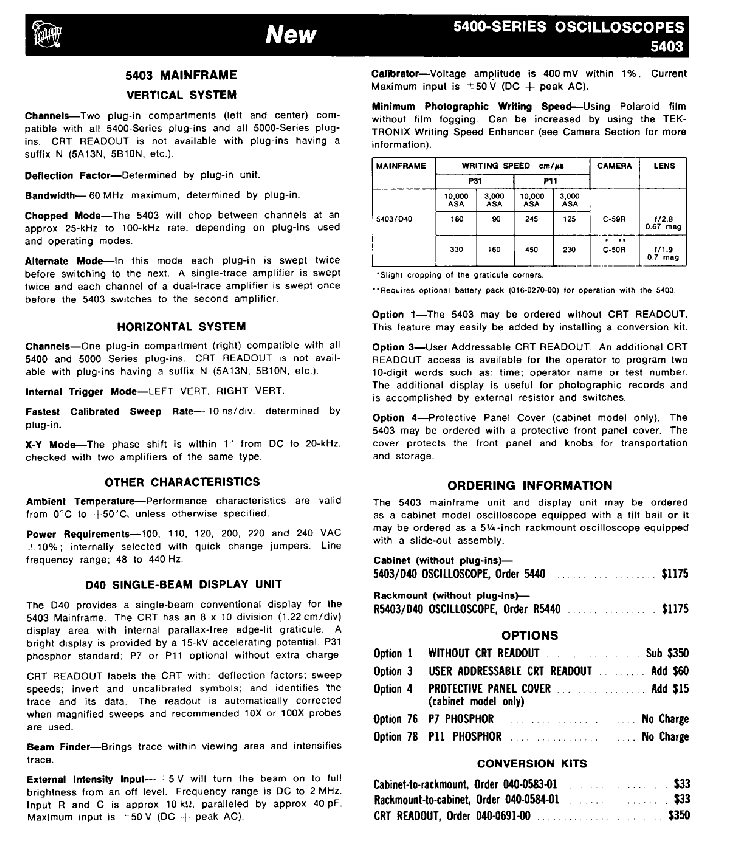
Channel and plugin compatibility: The left and center two plugin slots are used to install vertical amplifier plugins, compatible with all 5400 series and previous generation 5000 series vertical plugins. This provides users with a vast library of optional plugins, such as amplifiers that can achieve up to four track displays.
Bandwidth and deflection factor: The overall bandwidth of the system is up to 60MHz, depending on the performance of the installed vertical amplifier plugin.
Multi channel display mode: supports alternate and chopped modes. In alternating mode, the channels within each plugin are scanned in their entirety in sequence; In chopper mode, the channels quickly switch at a frequency of approximately 25kHz to 100kHz, suitable for multi-channel simultaneous observation of low-frequency signals.
Horizontal system:
Time base plugin slot: The separate plugin slot on the right is used to install the time base (horizontal scanning) module, which is also fully compatible with new and old series plugins.
Trigger and Scan: Supports internal triggering from the left or right vertical channel. The fastest calibration scanning rate can reach 10 ns/div (determined by the plugin), and it has X-Y mode function, with a phase shift of less than 1 degree in the range of DC to 20kHz.
Display unit (D40):
The 5403 comes standard with a D40 single beam display unit, featuring an 8x10 grid (1.22 cm per grid) display screen that ignores internal lighting markings. The standard configuration is P31 fluorescent powder with an acceleration voltage of 15kV, and P7 or P11 fluorescent powder can also be optionally selected for free to meet different photography or observation needs.
CRT reading enhancement function: In addition to displaying set parameters, the reading can also identify channels, reversals, and uncalibrated states.
Auxiliary functions: including Beam Finder, which can pull light traces that deviate from the screen back into the visible area; External brightness modulation input, allowing external signals (DC-2MHz) to control the brightness of light tracks for special displays or blanking.
Calibrator: Provides a 400mV standard square wave signal with an accuracy of less than 1% for probe compensation and vertical calibration.
Recording capability: The oscilloscope has a high recording write speed, and when paired with specific cameras (such as C-5 type) and film (such as Polaroid), its P31 phosphor can achieve a write speed of up to 10000 cm/µ s, meeting the requirements for capturing transient signals.
Plugin ecosystem: Building the core of infinite possibilities
The true power of the 5400 series comes from its rich plugin ecosystem. The host itself serves as a universal platform, and all measurement functions - including bandwidth, sensitivity, number of channels, and scanning methods - are defined by plugins.
Vertical amplifier plugin: covering various models from high sensitivity (such as 1 mV/div), high bandwidth differential amplification to multi-channel universal amplification. For example, the combination of "5A48/5B42" plugins enables the system to achieve high sensitivity of 1 mV/div at 25MHz, making it suitable for detecting small signals such as disk/tape drives.
Horizontal Time Base Plugin: Includes dual delay scanning time base for complex timing analysis.
Special function plugin: such as transistor curve tracker plugin, which can directly display the characteristic curve of semiconductor devices on CRT; 1 GHz sampling plugin extends the system's time-domain analysis capability to the microwave frequency band.
This concept of "fixed host and plugin based functionality" not only protects users' long-term investments, but also enables instruments to keep up with technological developments and obtain new functions by updating plugins.
System configuration, options, and ordering information
The 5403/D40 system provides a high degree of configuration flexibility:
Structural form: It can be ordered as a Cabinet model with a tilted base, or as a 5 ¼ inch Rack mount model with a sliding mounting kit. The two can be converted to each other through a conversion kit (approximately $33).
Key options:
Option 1 (minus $335): Cancel CRT reading function (can be added later through upgrade kit).
Option 3 (plus $560): User addressable CRT reading. This advanced feature allows users to program and display two sets of 10 characters (such as time, operator name, test number) through external resistors and switches, greatly enhancing the traceability and management efficiency of test records.
Option 4 (plus $515): Add a front panel protective cover to the countertop model for easy transportation and storage.
Fluorescent powder selection: P7 or P11 fluorescent powder can be selected for free.
Conversion kit: Tektronix provides a complete conversion kit from countertop to rack, rack to countertop, and later installation of CRT reading function, reflecting the emphasis on product lifecycle maintainability and upgradability.
Technological Heritage and Contemporary Value
Although the 60MHz bandwidth and CRT display technology of the 5400 series are no longer cutting-edge by today's standards, its design philosophy still has important reference value:
A paradigm of modular design: It successfully demonstrates a highly configurable and scalable path for instrument functionality through standardized interfaces, which is inherited and developed in modern modular instrument systems such as PXI and AXIe.
Early attention to user experience: CRT reading function is an innovative measure to improve human-computer interaction efficiency and reduce operational errors. It is a pioneer in enriching parameter display and information identification on digital intelligent oscilloscope screens today.
The enduring vitality of classic instruments: Due to their robust design, abundant plugins, and vast stock market, many 5400 series oscilloscopes are still in service in laboratories, teaching institutions, and maintenance workshops. Professional second-hand instrument suppliers (such as Artisan Technology Group mentioned in the information) provide maintenance, repair, and supply assurance, extending their service life.
Summary
The Tektronix 5400 series oscilloscope, especially the 5403 model, is not only a measuring instrument, but also an iconic solution in the history of electronic testing engineering. It achieves an excellent balance between performance, functionality, and cost through innovative CRT readings, highly flexible three plug architecture, and solid manufacturing processes. For today's engineers, studying the 5400 series not only helps to understand the development of oscilloscope technology, but its modular and upgradable design ideas also have enlightening significance for planning and purchasing modern testing equipment. In the second-hand instrument market, a well maintained 5400 series oscilloscope, with appropriate plugins, is still capable of handling a large number of mid to low frequency universal testing tasks and is a classic tool with extremely high cost-effectiveness.
- YOKOGAWA
- Reliance
- ADVANCED
- SEW
- ProSoft
- WATLOW
- Kongsberg
- FANUC
- VSD
- DCS
- PLC
- man-machine
- Covid-19
- Energy and Gender
- Energy Access
- Renewable Integration
- Energy Subsidies
- Energy and Water
- Net zero emission
- Energy Security
- Critical Minerals
- A-B
- petroleum
- Mine scale
- Sewage treatment
- cement
- architecture
- Industrial information
- New energy
- Automobile market
- electricity
- Construction site
- HIMA
- ABB
- Rockwell
- Schneider Modicon
- Siemens
- xYCOM
- Yaskawa
- Woodward
- BOSCH Rexroth
- MOOG
- General Electric
- American NI
- Rolls-Royce
- CTI
- Honeywell
- EMERSON
- MAN
- GE
- TRICONEX
- Control Wave
- ALSTOM
- AMAT
- STUDER
- KONGSBERG
- MOTOROLA
- DANAHER MOTION
- Bentley
- Galil
- EATON
- MOLEX
- Triconex
- DEIF
- B&W
- ZYGO
- Aerotech
- DANFOSS
- KOLLMORGEN
- Beijer
- Endress+Hauser
- schneider
- Foxboro
- KB
- REXROTH
- YAMAHA
- Johnson
- Westinghouse
- WAGO
- TOSHIBA
- TEKTRONIX
- BENDER
- BMCM
- SMC
- HITACHI
- HIRSCHMANN
- XP POWER
- Baldor
- Meggitt
- SHINKAWA
- Other Brands
- UniOP
- KUKA
- IBA
- Beckhoff
- ADLINK
-
Siemens 6SL3244-0SA01-1AA0 - SINAMICS G120 Control Unit
-
DANFOSS 175Z2688 - COATEDE CONTROLUNIT VLT5000
-
SIEMENS 6FM1721-3AA20 - Positioning Module
-
REXORTH VTS0605 PVAR S21 - Drive Module
-
BECKHOFF 2915-0000 - Control Module
-
COOPER EATON CGLine 400 40071347901 - CEAG CG Controller
-
SIEMENS 3UF5031-3AN00-1 - SIMOCODE DP Basic Unit
-
SIGMATEK DNC305 05-011-305 - Drive Controller
-
Multivac MV1 10249768 - Control Module
-
SCHNEIDER ELECTRIC MES114 59646 & 59645 - Circuit Breaker Accessory
-
CAMILLE BAUER CAPAX 44-580-0012 - Transmitter
-
HENGSTLER VT360P LS1/TOK - Encoder
-
BURKERT 8792 - 24V DC IP65 / IP67 Positioner
-
SENSOPART V10-OB-A1-W6 - Vision Sensor
-
ALLEN-BRADLEY 1762-L40BXB SER.C REV.J - MicroLogix 1200 Controller
-
HITACHI CPU22-02HC 33025801-2 - CPU Module
-
HITACHI AGH-0 33034810-2 - Control Board
-
PHILIPS AIH110 VER 1.0 - Control Module
-
BAUMULLER DO8000 - Drive Controller
-
B&R PS477 3PS477.9 Rev.C0 - Power Supply
-
ABB ALFA LAVAL 200-CISB - Communication Interface 2 x SatBus
-
Moeller MI4-570-TA1 - HMI Operator Panel
-
ABB ACH550-01-06A9-4+B055 - Variable Frequency Drive
-
ABB TPU2 3HNE00313-1 REV 12 - Teach Pendant Unit
-
Schneider Electric BRS368H130ABA - Stepper Motor
-
Foxboro FCM100E P0972ZA - I/A Series Communication Module
-
Siemens 6ES7 450-1AP00-0AE0 6ES7450-1AP00-0AE0 - Simatic S7 Version:04 Counter Module
-
Schneider Electric ATV320U07N4W - Altivar Machine Drive
-
Priva TouchPoint Flush V06:02 5060002 - Control Panel
-
Lenze ESMD402L4TXA - 4kW SMD Inverter Drive
-
Lenze ESMD402L4TXA - 4kW SMD Inverter Drive
-
Schneider Electric PM210 PM210MG - Powerlogic Power Meter
-
ASCOM U982-DB/1C U982 - Power Supply / Communication Module
-
DYADIC SYSTEMS SCN5-010-050-S03-NA - Servo Cylinder
-
Reliance Electric GMI-S04 - AC/AC CONVERTER 380/400V 50/60Hz 3.9/5.2A
-
Pro-Face GLC150-BG41-XY32KF-24V 3080060 PFXGLC150BDBP - Touch Screen HMI
-
ROFIN RSL TERMINAL V2 0185.01/03 - TERMINAL
-
HONEYWELL R7241E1077 - Burner Control / Amplifier
-
SEW MM22C-503-00 8241201 - 2.2kW Movimot Drive
-
Brand Digital III 50mL - Burette
-
Danfoss 195N0039 VLT2811PS2B20STR1DBF00A00C0 - 2.4kVA VLT Drive
-
SONY LG10-2 EK1 - Digital Gauge Indicator
-
EMERSON SKD3400750 - 7.5kW AC Drive
-
SIEMENS 6AV6 542-0AG10-0AX0 - MULTIPANEL HMI
-
TELEMECANIQUE ATV21HU55N4 - ALTIVAR21 5.5KW Variable Speed Drive
-
MITSUBISHI A985GOT-TBA-EU - GOT900 Touch Screen HMI
-
SCHNEIDER LXM32AD30N4 - Lexium 32 Servo Drive
-
SICK PSR01-1501 M20Z-02550A122 - Safety Laser Scanner
-
GECMA CHALLENGER 15-2-FMO - LITE TOUCH Monitor
-
Uniop EK02 6ZA982 - HMI Operator Panel
-
TELEMECANIQUE ATV18U54M2 - SQUARE D ALTIVAR 18 3kW Drive
-
Schneider Electric ATV312HU75S6 - 7.5kW Altivar 312 Drive
-
Siemens 6GK7243-5DX30-0XE0 6GK7 243-5DX30-0XE0 - Communications Processor
-
Schneider Electric LV432455 VIGI630 - 3POLE Earth Leakage Module
-
Rexroth PSI 6100.750 L1 R911170694-107 - frequency inverter / inverter
-
SWEDISH MICROWAVE AB Ku-Band BDC 138010-45-D0 - Block Downconverter
-
METTLER TOLEDO IND429 IND429-BB30 - Weighing Terminal
-
Siemens 6SL3210-5HE10-4UF0 - Sinamics V90 Servo Drive
-
B&R X20CP0482 Rev.D0 - X20 CPU Module
-
Mitsubishi FR-E720S-110SC-EC FRE720S110SCEC - 31A~11A Drive With Filter
-
ABB ACH580-01-026A-4 - Variable Frequency Drive
-
Siemens 6SL3210-1KE13-2AP1 - SINAMIC G120CDP 1.1kw Drive
-
Schneider Electric TM250D 4P3D LV431440 - Compact NSX250 Circuit Breaker
-
RELIANCE ELECTRIC GD.722.81.00-A 802288-74C - MAXITRON Servo Control Card
-
Uniop EK02 6ZA982 - HMI Operator Panel
-
Siemens 6SE9113-7JA13 - MICRO MASTER Junior 1.5kW Inverter
-
Mitsubishi FR-E720S-110SC-EC FRE720S110SCEC - 31A~11A Drive with Filter
-
Johnson Controls FEC2621 MS-FEC2621-0 - Field Equipment Controller
-
BENDER IR475LYT-429 - A-ISOMETER Insulation Monitor
-
Berger lahr D550 RS15 22.550-00-30b - Stepper Drive
-
Rexroth PSI 6100.750 L1 R911170694-107 - Frequency Inverter / INVERTER
-
KOYO 205 D2-06B-1 D2-240 H2-ECOM D2-08ND3 F2-08TRS - DIRECT LOGIC PLC WITH MODULE
-
TELEMECANIQUE ATV18U54M2 ATV18U54M - SQUARE D ALTIVAR 18 3kW Drive
-
Lenze 471-E1.D - Board / Controller Speed
-
Mitsubishi FR-A740-00038-EC - Frequency Inverter
-
Johnson Controls IOM3723 MS-IOM3723-0 - Input/Output Module
-
CURTIS 1238-5602 - AC Motor Controller
-
FOXBORO P0912XX REV.A - 220VAC Power Supply
-
Siemens 6SE9113-7JA13 - MICRO MASTER Junior 1.5kW Inverter
-
Mitsubishi FR-A740-00038-EC - Frequency Inverter
-
KOYO 205 D2-06B-1 D2-240 H2-ECOM D2-08ND3 F2-08TRS - DIRECT LOGIC PLC WITH MODULE
-
AUTZ M406D-00101 - Servo Motor
-
Lauer PCS095 PG095.508.BB - Operator Panel
-
ABB SCOP45SB/DX232 - SattCon OP45 SB Operator Panel
-
SEW Eurodrive MCH42A0030-5A3-4-00 MDX60A0030-5A3-4-00 - 4.8kVA Movidrive Inverter
-
BENDER IR475LYT-429 - A-ISOMETER Insulation Monitor
-
Johnson Controls FEC2621 MS-FEC2621-0 - Field Equipment Controller
-
Johnson Controls IOM3723 MS-IOM3723-0 - Input/Output Module
-
Berger lahr D550 RS15 22550-00-30b - Stepper Drive
-
SIEMENS 6FX1120-4BD03 6FX11204BD03 5702049304.00 E-Stand: A - Sinumerik Module
-
Allen-Bradley 1771-NIV B - HIGH RESOLUTION ISOLATED ANALOG SERIES Module
-
HONEYWELL XFC2D06001 - Flow Computer / Controller
-
Contraves Varidyn Compact ADB 380.90M - DC Drive 380v - 400v 90A 50kVA
-
Red Lion Control GEM52000 - Control Module
-
Siemens 6ES5 955-3NC13 - modular power supply TYPE:DIN41752
-
Danfoss ICV50 G20Mn50T / 027H5200 - Valve zaw
-
Eberle PLS508 P-814 / 2X EA-88 / A-812 / MT-81 / S-11 - PLC with Modules
-
Siemens 6ES7 314-6CF01-0AB0 6ES7314-6CF01-0AB0 - SIMATIC CPU314C-2 DP
-
EBERLE EM-525-87 EM52487 - ICE DETECTOR BASE UNIT
-
Telemecanique / Schneider TSXRKZ02 - TSX Micro automation plus 7module
-
B&R 5DLSDL.1001-00 - Display Link Receiver
-
Siemens 6FX1120-4BD03 6FX11204BD03 5702049304.00 E-Stand: A - Sinumerik Module
-
ALLEN-BRADLEY 1771-NIV A - HIGH RESOLUTION ISOLATED ANALOG SERIES Module
-
ALLEN-BRADLEY 1771-NIV B - HIGH RESOLUTION ISOLATED ANALOG SERIES Module
-
Contraves Varidyn Compact ADB 380.90M - DC Drive 380V - 400V 90A 50kVA
-
Contraves Varidyn Compact ADB 380.90M - DC Drive 380V - 400V 90A 50kVA
-
Ropex RES-202 - Resistron Temperature Controller
-
HONEYWELL XFC2D06001 - Flow Computer / Controller
-
Telemechanics ATV452U40 - DIMMER ALTIVAR5 SERIES 452 4kW 5HP Frequency Inverter
-
VEGA VEGAPLUS61 PS61.XXAGPHAMAX - Radar Level Sensor
-
BRANSON ULTRASONIC TRANSDUCER - Ultrasonic Transducer
-
Danfoss ICV50 G20Mn50T / 027H5200 - Valve Valvola Zaw
-
Schneider Electric 2001549/1 GALAXY PW 5102851200 NT07 - panler card
-
REXROTH VT3006-36 A - Proportional Valve Amplifier
-
Allen-Bradley 1746-OBP16 SERIES:C - SLC 500 OUTPUT MODULE
-
SCHNEIDER LXM32MD12N4 - Lexium 32 Servo Drive
-
Schneider Electric ATV630U22N4 - 2.2KW Altivar Process Drive
-
Allen-Bradley 1746-OBP16 SERIES:C - SLC 500 OUTPUT MODULE
-
Vanderlande 0E2550-00002... - Bagtrax Integrated Power Module 400V 32A
-
B&R X20CP0410 Rev.D0 - X20 CPU Module
-
VANDERLANDE 0E2550-00002 02EDD2B0100 - BAGTRAX Integrated Power Module 400V 32A
-
Rexroth R061205010 - Linear Bushing / Bearing
-
INDRAMAT TVM1.2-50-220/300-W0-220/380 - Power Supply Module
-
Vanderlande 0E2550-00002... - Bagtrax Integrated Power Module 400V 32A
-
HOMAG KEB 07F5S1A-YA00 09E5T60-1001 - Combivert Inverter WITH KEYPAID AND FILTER
-
Siemens 3RW3047-1BB14 - Soft Starter
-
Sumitomo AF-500 AF502-A40 - 0.4kW Transistor Inverter
-
Sumitomo AF-500 AF502-A40 - 0.4kW Transistor Inverter

K-JIANG

Add: Jimei North Road, Jimei District, Xiamen, Fujian, China
Tell:+86-15305925923