

K-WANG


Baldor Reliability CDPT3320 DC Motor
Baldor Reliance Brushed DC Motor: Technical Parameters, Industrial Adaptation, and Energy Efficiency Upgrade Solutions
In the fields of industrial automation, material handling, precision transmission, etc., DC motors always occupy the core power position with excellent starting performance, wide range speed regulation capability, and stable torque output. The brushed DC motor series launched by ABB's Baldor Reliance brand has become the preferred solution for industrial users with strict manufacturing standards, precise performance parameters, and wide adaptability to various scenarios. This article is based on product technical documents and provides a deep analysis of the core technical characteristics, parameter system, application scenarios, and selection and maintenance points of this series of motors, providing professional references for equipment upgrading and efficient operation in industrial enterprises.
Product Core Parameters and Technical Architecture
Baldor Reliability brushed DC motors are designed with "universal adaptation+precise performance" as the core, and have built a product system covering low-power universal scenarios. Its core parameters and technical architecture highlight industrial grade reliability and adaptability.
1. Basic performance parameter system
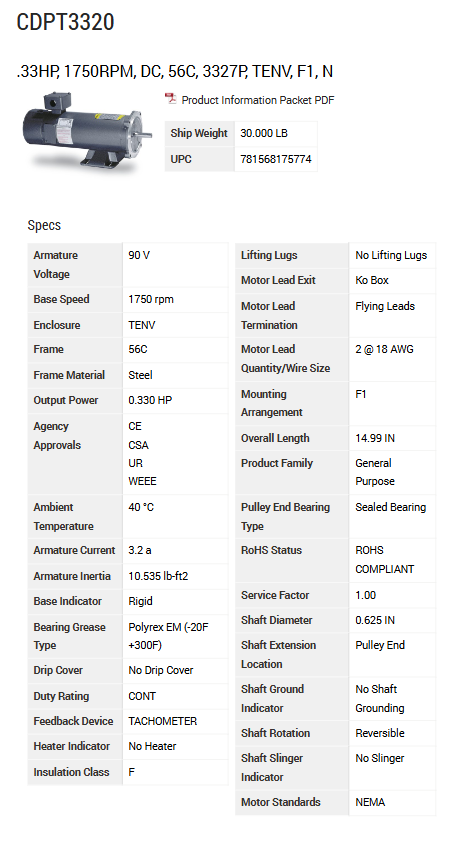
The core parameters of the representative model of this series (CDPT3320) establish the performance benchmark for universal brushed DC motors:
Power and speed: rated power of 0.33HP (0.25kW), base speed of 1750RPM, supporting wide range speed regulation to meet the speed regulation requirements under different loads;
Electrical parameters: armature rated voltage of 90V, rated current of 3.2A, armature resistance of 2.164 Ω, F-class insulation level, able to withstand high temperature operating environment, service factor of 1.00, ensuring stable output under continuous working conditions;
Mechanical structure: It adopts a 56C steel frame, with a total length of 14.99IN and a shaft diameter of 0.625IN. It is equipped with 6203 sealed bearings and uses Polyrex EM long-lasting grease (applicable temperature range -20F~+300F), significantly reducing mechanical wear and maintenance frequency.
2. Protection and compliance design
Protection level: TENV (fully enclosed without ventilation) structure with IP44 protection, effectively blocking dust and splashing liquids, suitable for complex industrial environments;
Compliance certification: Passed multiple international certifications including CE, CSA, UL, and WEEE, compliant with RoHS environmental standards, strictly following NEMA (National Electrical Manufacturers Association) technical specifications, and possessing global market access qualifications;
Safety configuration: Equipped with ISO/ANSI standard graphic warning labels and installation maintenance labels, supporting reversible shaft rotation and F1 rigid base installation, meeting the diverse installation needs of industrial equipment.
3. Load performance characteristic curve
The motor exhibits typical DC motor load characteristics. As the armature current increases from 0.21A to 4.59A, the speed smoothly decreases from 1854RPM to 1526RPM, and the torque linearly increases from 0 to 1.48N · m, achieving an optimized matching of "load increase - stable speed decrease - precise torque increase". This hard characteristic curve enables it to perform excellently in heavy load start-up scenarios, achieving even and smooth stepless speed regulation, fully meeting the core requirements of industrial transmission for load adaptability.
Core technological advantages and industry competitiveness
The technological advantages of Baldor Reliance brushed DC motors are mainly reflected in three dimensions: structural design, performance stability, and scene adaptability, forming significant competitive barriers in the global DC motor market.
1. Structural and material optimization
Reversing system: using high-performance molded commutators, optimizing the precision of the brush and commutator coordination, reducing friction losses, improving commutation stability, and extending the service life of the motor;
Insulation system: F-level insulation design reserves additional safety margins, effectively eliminating hot spot issues during operation, adapting to a maximum ambient temperature of 40 ° C, and meeting the requirements of industrial high-temperature working conditions;
Mechanical strength: The steel frame is combined with galvanized hardware, and through rigorous structural strength testing, the vibration peak is controlled within the industrial low vibration standard range, reducing equipment operating noise.
2. Balance between performance and energy efficiency
Against the backdrop of global energy efficiency standard upgrades, this series of motors achieves a precise balance between energy efficiency and performance by optimizing magnetic circuit design and conductor materials. Its operational efficiency fully meets the energy efficiency requirements of general industrial motors, in conjunction with Mobil Polyrex ® The low friction characteristics of EM long-lasting grease reduce mechanical losses by more than 15% compared to ordinary motors, and have significant advantages in energy consumption throughout the entire life cycle. Compared to AC motors, this series consumes less energy in low-speed, high torque, and precise speed regulation scenarios, which meets the cost reduction and efficiency improvement needs of industrial enterprises.
3. Brand and technology endorsement
As a core brand of industrial motors under ABB, Baldor Reliance has established a comprehensive DC motor technology system based on a century of manufacturing experience. The design of its wound magnetic field motor ensures excellent commutation performance across the entire speed range, with a fault free operation time far exceeding the industry average; At the same time, the brand provides complete technical documents such as 2D/3D CAD files, wiring diagrams, and dimension tables, providing comprehensive support for equipment integration and maintenance.
Industrial application scenarios and selection guide
The technical characteristics of brushed DC motors give them irreplaceable advantages in specific industrial scenarios, and scientific selection is the key to unleashing their performance.
1. Core application areas
General industrial transmission: suitable for small machine tools, conveyor belts, blowers and other equipment, with a power level of 0.25kW and a base speed of 1750RPM to meet the power requirements of medium and low loads;
Material handling equipment: supports reversible shaft rotation and precise start stop control, suitable for small conveyors, lifting devices, etc., with stable torque output to ensure smooth material transportation;
Special equipment matching: As a power source for testing instruments, small pumps, and precision transmission mechanisms, it meets the integration requirements of IP44 protection and compact structure adaptation equipment.
2. Core elements of scientific selection
Load matching: Calculate the rated power according to the formula P=T × n/9550 (P is power kW, T is torque N · m, n is speed r/min), and reserve a reasonable load margin based on the motor service factor of 1.00;
Environmental adaptation: TENV protection type is preferred for dust and humid environments. For high temperature scenarios, it is necessary to confirm that the ambient temperature does not exceed 40 ° C. For special working conditions, customized solutions can be consulted;
Electrical adaptation: Ensure that the power supply voltage matches the rated voltage of the armature (90V), and use 18 AWG lead wires for wiring, in conjunction with a tachometer feedback device to achieve precise speed regulation;
Compliance requirements: Export equipment must confirm the certification requirements of the target market, prioritize the selection of models with CE and UL dual certification, and comply with local energy efficiency and safety standards.
3. Differentiated selection of scenarios with AC motors
Comparison dimension Baldor Reliance brushed DC motor ordinary AC motor
Core advantages include wide speed range, large starting torque, smooth speed regulation, simple structure, low maintenance cost, and adaptability to high-temperature and flammable environments
Applicable scenarios include precision speed regulation, heavy load start-up, reversible operation equipment with constant speed operation, high dust and high temperature environment, and large power equipment
Maintenance focus: regular inspection of carbon brush wear, cleaning of commutator debris, routine insulation testing, and maintenance of bearing lubrication
For scenarios that require uniform stepless speed regulation or heavy load starting, brushed DC motors are a better choice; For scenarios with constant speed operation, harsh environments, and inconvenient maintenance, AC motors can be given priority consideration.
Maintenance and troubleshooting
Standardized maintenance is the key to extending the service life of brushed DC motors, and its core lies in paying attention to the characteristics and common fault points of the brushed structure.
1. Key points of daily maintenance
Carbon brush maintenance: Regularly check the wear of the BP5011T01 model carbon brush, and replace it in a timely manner when the wear exceeds 1/3. Replace the BP5012A04SP brush spring and 33RK5004SP rocker arm to ensure good contact between the brush and the commutator;
Lubrication management: The bearings use Polyrex EM grease, which is replenished every 5000 hours of normal operation and shortened to 3000 hours in high temperature environments;
Cleaning and maintenance: Regularly clean the dust on the surface of the motor and the carbon powder around the commutator to avoid insulation degradation or mechanical jamming caused by accumulation;
Temperature monitoring: Monitor the temperature of the motor body during operation, which should not exceed 70 ° C, and the temperature of the bearings should not exceed 60 ° C. If there is an abnormal high temperature, immediately stop the machine for inspection.
2. Common troubleshooting
Unstable speed: Check the contact status of the carbon brush, clean the dirt on the surface of the commutator, confirm the stability of the armature voltage, and investigate the problem of poor contact of the leads;
Insufficient torque: Measure whether the armature current reaches the rated value (3.2A), check whether the winding insulation is aging, and confirm whether the load exceeds the rated power;
Abnormal noise: Check the lubrication status of the bearings, check the concentricity between the shaft and the coupling, and confirm whether the friction between the carbon brush and the commutator is uniform.
5、 Industry Trends and Future Prospects
Currently, the global industrial motor industry is undergoing a transformation towards high efficiency, intelligence, and environmental protection. At the policy level, countries are continuously improving their motor energy efficiency standards (MEPS). The IEC 60034-30 series standards have clearly defined the requirements for IE4 and IE5 high efficiency levels, promoting the upgrade of DC motor technology towards low loss and high power density. Baldor Reliance, as an industry benchmark, will further optimize the design of the commutation system in the future, reduce carbon brush wear, and integrate intelligent monitoring modules to achieve real-time warning of operating status and improve the level of motor intelligence.
Under the wave of Industry 4.0, the application scenarios of DC motors as precision transmission core equipment will continue to expand. Baldor Reliance brushed DC motors, with their stable performance, comprehensive certification system, and strong brand support, will continue to provide efficient power solutions for general industry, material handling, precision equipment, and other fields, helping enterprises achieve energy optimization and productivity improvement.
- YOKOGAWA
- Reliance
- ADVANCED
- SEW
- ProSoft
- WATLOW
- Kongsberg
- FANUC
- VSD
- DCS
- PLC
- man-machine
- Covid-19
- Energy and Gender
- Energy Access
- Renewable Integration
- Energy Subsidies
- Energy and Water
- Net zero emission
- Energy Security
- Critical Minerals
- A-B
- petroleum
- Mine scale
- Sewage treatment
- cement
- architecture
- Industrial information
- New energy
- Automobile market
- electricity
- Construction site
- HIMA
- ABB
- Rockwell
- Schneider Modicon
- Siemens
- xYCOM
- Yaskawa
- Woodward
- BOSCH Rexroth
- MOOG
- General Electric
- American NI
- Rolls-Royce
- CTI
- Honeywell
- EMERSON
- MAN
- GE
- TRICONEX
- Control Wave
- ALSTOM
- AMAT
- STUDER
- KONGSBERG
- MOTOROLA
- DANAHER MOTION
- Bentley
- Galil
- EATON
- MOLEX
- Triconex
- DEIF
- B&W
- ZYGO
- Aerotech
- DANFOSS
- KOLLMORGEN
- Beijer
- Endress+Hauser
- schneider
- Foxboro
- KB
- REXROTH
- YAMAHA
- Johnson
- Westinghouse
- WAGO
- TOSHIBA
- TEKTRONIX
- BENDER
- BMCM
- SMC
- HITACHI
- HIRSCHMANN
- XP POWER
- Baldor
- Meggitt
- SHINKAWA
- Other Brands
- UniOP
- KUKA
- IBA
- Beckhoff
- ADLINK
-
Siemens 6SL3244-0SA01-1AA0 - SINAMICS G120 Control Unit
-
DANFOSS 175Z2688 - COATEDE CONTROLUNIT VLT5000
-
SIEMENS 6FM1721-3AA20 - Positioning Module
-
REXORTH VTS0605 PVAR S21 - Drive Module
-
BECKHOFF 2915-0000 - Control Module
-
COOPER EATON CGLine 400 40071347901 - CEAG CG Controller
-
SIEMENS 3UF5031-3AN00-1 - SIMOCODE DP Basic Unit
-
SIGMATEK DNC305 05-011-305 - Drive Controller
-
Multivac MV1 10249768 - Control Module
-
SCHNEIDER ELECTRIC MES114 59646 & 59645 - Circuit Breaker Accessory
-
CAMILLE BAUER CAPAX 44-580-0012 - Transmitter
-
HENGSTLER VT360P LS1/TOK - Encoder
-
BURKERT 8792 - 24V DC IP65 / IP67 Positioner
-
SENSOPART V10-OB-A1-W6 - Vision Sensor
-
ALLEN-BRADLEY 1762-L40BXB SER.C REV.J - MicroLogix 1200 Controller
-
HITACHI CPU22-02HC 33025801-2 - CPU Module
-
HITACHI AGH-0 33034810-2 - Control Board
-
PHILIPS AIH110 VER 1.0 - Control Module
-
BAUMULLER DO8000 - Drive Controller
-
B&R PS477 3PS477.9 Rev.C0 - Power Supply
-
ABB ALFA LAVAL 200-CISB - Communication Interface 2 x SatBus
-
Moeller MI4-570-TA1 - HMI Operator Panel
-
ABB ACH550-01-06A9-4+B055 - Variable Frequency Drive
-
ABB TPU2 3HNE00313-1 REV 12 - Teach Pendant Unit
-
Schneider Electric BRS368H130ABA - Stepper Motor
-
Foxboro FCM100E P0972ZA - I/A Series Communication Module
-
Siemens 6ES7 450-1AP00-0AE0 6ES7450-1AP00-0AE0 - Simatic S7 Version:04 Counter Module
-
Schneider Electric ATV320U07N4W - Altivar Machine Drive
-
Priva TouchPoint Flush V06:02 5060002 - Control Panel
-
Lenze ESMD402L4TXA - 4kW SMD Inverter Drive
-
Lenze ESMD402L4TXA - 4kW SMD Inverter Drive
-
Schneider Electric PM210 PM210MG - Powerlogic Power Meter
-
ASCOM U982-DB/1C U982 - Power Supply / Communication Module
-
DYADIC SYSTEMS SCN5-010-050-S03-NA - Servo Cylinder
-
Reliance Electric GMI-S04 - AC/AC CONVERTER 380/400V 50/60Hz 3.9/5.2A
-
Pro-Face GLC150-BG41-XY32KF-24V 3080060 PFXGLC150BDBP - Touch Screen HMI
-
ROFIN RSL TERMINAL V2 0185.01/03 - TERMINAL
-
HONEYWELL R7241E1077 - Burner Control / Amplifier
-
SEW MM22C-503-00 8241201 - 2.2kW Movimot Drive
-
Brand Digital III 50mL - Burette
-
Danfoss 195N0039 VLT2811PS2B20STR1DBF00A00C0 - 2.4kVA VLT Drive
-
SONY LG10-2 EK1 - Digital Gauge Indicator
-
EMERSON SKD3400750 - 7.5kW AC Drive
-
SIEMENS 6AV6 542-0AG10-0AX0 - MULTIPANEL HMI
-
TELEMECANIQUE ATV21HU55N4 - ALTIVAR21 5.5KW Variable Speed Drive
-
MITSUBISHI A985GOT-TBA-EU - GOT900 Touch Screen HMI
-
SCHNEIDER LXM32AD30N4 - Lexium 32 Servo Drive
-
SICK PSR01-1501 M20Z-02550A122 - Safety Laser Scanner
-
GECMA CHALLENGER 15-2-FMO - LITE TOUCH Monitor
-
Uniop EK02 6ZA982 - HMI Operator Panel
-
TELEMECANIQUE ATV18U54M2 - SQUARE D ALTIVAR 18 3kW Drive
-
Schneider Electric ATV312HU75S6 - 7.5kW Altivar 312 Drive
-
Siemens 6GK7243-5DX30-0XE0 6GK7 243-5DX30-0XE0 - Communications Processor
-
Schneider Electric LV432455 VIGI630 - 3POLE Earth Leakage Module
-
Rexroth PSI 6100.750 L1 R911170694-107 - frequency inverter / inverter
-
SWEDISH MICROWAVE AB Ku-Band BDC 138010-45-D0 - Block Downconverter
-
METTLER TOLEDO IND429 IND429-BB30 - Weighing Terminal
-
Siemens 6SL3210-5HE10-4UF0 - Sinamics V90 Servo Drive
-
B&R X20CP0482 Rev.D0 - X20 CPU Module
-
Mitsubishi FR-E720S-110SC-EC FRE720S110SCEC - 31A~11A Drive With Filter
-
ABB ACH580-01-026A-4 - Variable Frequency Drive
-
Siemens 6SL3210-1KE13-2AP1 - SINAMIC G120CDP 1.1kw Drive
-
Schneider Electric TM250D 4P3D LV431440 - Compact NSX250 Circuit Breaker
-
RELIANCE ELECTRIC GD.722.81.00-A 802288-74C - MAXITRON Servo Control Card
-
Uniop EK02 6ZA982 - HMI Operator Panel
-
Siemens 6SE9113-7JA13 - MICRO MASTER Junior 1.5kW Inverter
-
Mitsubishi FR-E720S-110SC-EC FRE720S110SCEC - 31A~11A Drive with Filter
-
Johnson Controls FEC2621 MS-FEC2621-0 - Field Equipment Controller
-
BENDER IR475LYT-429 - A-ISOMETER Insulation Monitor
-
Berger lahr D550 RS15 22.550-00-30b - Stepper Drive
-
Rexroth PSI 6100.750 L1 R911170694-107 - Frequency Inverter / INVERTER
-
KOYO 205 D2-06B-1 D2-240 H2-ECOM D2-08ND3 F2-08TRS - DIRECT LOGIC PLC WITH MODULE
-
TELEMECANIQUE ATV18U54M2 ATV18U54M - SQUARE D ALTIVAR 18 3kW Drive
-
Lenze 471-E1.D - Board / Controller Speed
-
Mitsubishi FR-A740-00038-EC - Frequency Inverter
-
Johnson Controls IOM3723 MS-IOM3723-0 - Input/Output Module
-
CURTIS 1238-5602 - AC Motor Controller
-
FOXBORO P0912XX REV.A - 220VAC Power Supply
-
Siemens 6SE9113-7JA13 - MICRO MASTER Junior 1.5kW Inverter
-
Mitsubishi FR-A740-00038-EC - Frequency Inverter
-
KOYO 205 D2-06B-1 D2-240 H2-ECOM D2-08ND3 F2-08TRS - DIRECT LOGIC PLC WITH MODULE
-
AUTZ M406D-00101 - Servo Motor
-
Lauer PCS095 PG095.508.BB - Operator Panel
-
ABB SCOP45SB/DX232 - SattCon OP45 SB Operator Panel
-
SEW Eurodrive MCH42A0030-5A3-4-00 MDX60A0030-5A3-4-00 - 4.8kVA Movidrive Inverter
-
BENDER IR475LYT-429 - A-ISOMETER Insulation Monitor
-
Johnson Controls FEC2621 MS-FEC2621-0 - Field Equipment Controller
-
Johnson Controls IOM3723 MS-IOM3723-0 - Input/Output Module
-
Berger lahr D550 RS15 22550-00-30b - Stepper Drive
-
SIEMENS 6FX1120-4BD03 6FX11204BD03 5702049304.00 E-Stand: A - Sinumerik Module
-
Allen-Bradley 1771-NIV B - HIGH RESOLUTION ISOLATED ANALOG SERIES Module
-
HONEYWELL XFC2D06001 - Flow Computer / Controller
-
Contraves Varidyn Compact ADB 380.90M - DC Drive 380v - 400v 90A 50kVA
-
Red Lion Control GEM52000 - Control Module
-
Siemens 6ES5 955-3NC13 - modular power supply TYPE:DIN41752
-
Danfoss ICV50 G20Mn50T / 027H5200 - Valve zaw
-
Eberle PLS508 P-814 / 2X EA-88 / A-812 / MT-81 / S-11 - PLC with Modules
-
Siemens 6ES7 314-6CF01-0AB0 6ES7314-6CF01-0AB0 - SIMATIC CPU314C-2 DP
-
EBERLE EM-525-87 EM52487 - ICE DETECTOR BASE UNIT
-
Telemecanique / Schneider TSXRKZ02 - TSX Micro automation plus 7module
-
B&R 5DLSDL.1001-00 - Display Link Receiver
-
Siemens 6FX1120-4BD03 6FX11204BD03 5702049304.00 E-Stand: A - Sinumerik Module
-
ALLEN-BRADLEY 1771-NIV A - HIGH RESOLUTION ISOLATED ANALOG SERIES Module
-
ALLEN-BRADLEY 1771-NIV B - HIGH RESOLUTION ISOLATED ANALOG SERIES Module
-
Contraves Varidyn Compact ADB 380.90M - DC Drive 380V - 400V 90A 50kVA
-
Contraves Varidyn Compact ADB 380.90M - DC Drive 380V - 400V 90A 50kVA
-
Ropex RES-202 - Resistron Temperature Controller
-
HONEYWELL XFC2D06001 - Flow Computer / Controller
-
Telemechanics ATV452U40 - DIMMER ALTIVAR5 SERIES 452 4kW 5HP Frequency Inverter
-
VEGA VEGAPLUS61 PS61.XXAGPHAMAX - Radar Level Sensor
-
BRANSON ULTRASONIC TRANSDUCER - Ultrasonic Transducer
-
Danfoss ICV50 G20Mn50T / 027H5200 - Valve Valvola Zaw
-
Schneider Electric 2001549/1 GALAXY PW 5102851200 NT07 - panler card
-
REXROTH VT3006-36 A - Proportional Valve Amplifier
-
Allen-Bradley 1746-OBP16 SERIES:C - SLC 500 OUTPUT MODULE
-
SCHNEIDER LXM32MD12N4 - Lexium 32 Servo Drive
-
Schneider Electric ATV630U22N4 - 2.2KW Altivar Process Drive
-
Allen-Bradley 1746-OBP16 SERIES:C - SLC 500 OUTPUT MODULE
-
Vanderlande 0E2550-00002... - Bagtrax Integrated Power Module 400V 32A
-
B&R X20CP0410 Rev.D0 - X20 CPU Module
-
VANDERLANDE 0E2550-00002 02EDD2B0100 - BAGTRAX Integrated Power Module 400V 32A
-
Rexroth R061205010 - Linear Bushing / Bearing
-
INDRAMAT TVM1.2-50-220/300-W0-220/380 - Power Supply Module
-
Vanderlande 0E2550-00002... - Bagtrax Integrated Power Module 400V 32A
-
HOMAG KEB 07F5S1A-YA00 09E5T60-1001 - Combivert Inverter WITH KEYPAID AND FILTER
-
Siemens 3RW3047-1BB14 - Soft Starter
-
Sumitomo AF-500 AF502-A40 - 0.4kW Transistor Inverter
-
Sumitomo AF-500 AF502-A40 - 0.4kW Transistor Inverter

K-JIANG

Add: Jimei North Road, Jimei District, Xiamen, Fujian, China
Tell:+86-15305925923