

K-WANG


Yokogawa CENTUM VP series terminal block
Applicable system: Designed specifically for the Yokogawa CENTUM VP control system, only compatible with FIO modules with built-in In Barrier in this system
Core function: To achieve stable circuit connection between I/O modules with built-in barriers and field devices, playing a role in signal conversion, fixed wiring, and ensuring transmission reliability. It is widely used in signal acquisition and control scenarios of industrial automation
Yokogawa CENTUM VP series terminal block
Product Core Overview
Product type: Pressure Clamp Terminal Block, a key intermediate component for signal transmission in industrial control systems
Applicable system: Designed specifically for the Yokogawa CENTUM VP control system, only compatible with FIO modules with built-in In Barrier in this system
Core function: To achieve stable circuit connection between I/O modules with built-in barriers and field devices, playing a role in signal conversion, fixed wiring, and ensuring transmission reliability. It is widely used in signal acquisition and control scenarios of industrial automation
Compliance standard: Compliant with ISA S71.04 class G3 standard, which specifies requirements for the environmental adaptability and safety performance of industrial process measurement and control equipment, ensuring stable operation of terminal blocks in complex industrial environments
Temperature adaptation range: -20 ℃ to 70 ℃, covering the temperature conditions of most industrial sites (such as factory workshops, control rooms, outdoor equipment areas, etc.), with strong environmental adaptability
Model system and core specifications
(1) Model classification logic
This series of terminal blocks is divided into two core series based on redundancy design. Each series is subdivided into specific models according to application types. The suffix code for all models is fixed at -0, with no other optional configurations. The classification logic is clear, making it easy for users to quickly select according to their actual needs
Single series: The model suffix is "S", suitable for conventional industrial scenarios without redundancy requirements, with a simple structure and controllable cost
Dual Redundancy Series: The model suffix is "D" and is suitable for critical industrial scenarios that require extremely high system stability and reliability (such as core control links in industries such as chemical, power, and petroleum). The dual redundancy design ensures signal continuity in the event of a failure
(2) Detailed explanation of core specifications for all models
Model Application Type Channel Number Adaptation I/O Module Name Weight Core Adaptation Scenario
ATSA3S Analog Input (Single) 8-Point (8-Channel) ASI133 0.2 kg Analog Signal Acquisition in Conventional Scenarios, such as Input of Continuous Variables such as Temperature, Pressure, Flow, etc
ATSA3D analog input (Dual Redundant) 8-Point (8-channel) ASI133 analog signal acquisition under critical scenarios of 0.3 kg, ensuring uninterrupted signal acquisition, such as temperature acquisition of chemical reaction kettle
ATSS3S analog output (Single) 8-Point (8-channel) ASI533 0.2 kg analog signal output in conventional scenarios, such as controlling valve opening, adjusting pump speed, etc
ATSS3D analog output (Dual Redundant) 8-Point (8-channel) ASI533 analog signal output under critical scenarios of 0.3 kg, such as emergency stop control signal and core equipment speed control signal output
ATST4S thermocouple/mV (Single) 16 Point (16 channel) AST143 0.2 kg Temperature measurement signal or millivolt level small signal acquisition for thermocouples in conventional scenarios, such as furnace temperature and pipeline temperature monitoring
ATST4D thermocouple/mV (Dual Redundant) 16 Point (16 channel) AST143 high-precision temperature or small signal acquisition in critical scenarios of 0.3 kg, such as temperature monitoring in aerospace component processing
ATSR3S RTD/PAT (Single) 8-Point (8-Channel) ASR133 0.2 kg Thermal Resistance (RTD) temperature measurement or Potentiometer (POT) signal acquisition in conventional scenarios, such as equipment bearing temperature monitoring
ATSR3D RTD/PAT (Dual Redundancy) 8-Point (8-channel) ASR133 high-precision temperature or potentiometer signal acquisition in critical scenarios of 0.3 kg, such as temperature monitoring of nuclear power equipment
ATSB4S Digital Input (Single) 16 Point (16 Channel) ASD143 0.2 kg Digital Signal Input for Conventional Scenarios, such as Limit Switch Status and Equipment Operation Status (Run/Stop) Detection
ATSB4D Dual Redundant 16 Point ASD143 0.3 kg digital signal input for critical scenarios, such as emergency stop button signal and safety door switch status detection
ATSD3S digital output (Single) 8-Point (8-channel) ASD533 0.2 kg digital signal output in conventional scenarios, such as control indicator light on/off, relay on/off, small pump start/stop, etc
ATSD3D Digital Output (Dual Redundancy) 8-Point (8-channel) ASD533 Digital Signal Output for 0.3 kg Key Scenarios, such as Fire Alarm Signal Output, Emergency Cut off Valve Control Signal, etc
(3) Summary of Key Characteristics of Specifications
Channel number pattern:
8-channel models: a total of 8 types (4 single channel+4 dual redundant), covering analog input/output RTD/POT、 Four major categories of applications for digital output, meeting most conventional signal transmission needs
16 channel models: 4 types in total (2 single channel+2 dual redundant), only suitable for thermocouple/mV and digital input applications, suitable for scenarios requiring high-density signal acquisition, reducing the number of terminal block installations
Reason for weight difference: The single channel series is uniformly 0.2kg, and the dual redundancy series is uniformly 0.3kg. The weight increase is due to the additional hardware components such as circuits and wiring terminals required for the dual redundancy design, ensuring the implementation of redundancy functions
Module adaptation uniqueness: Each terminal block model corresponds to only one specific I/O module and cannot be mixed across models to avoid signal transmission failures or equipment damage caused by module and terminal block incompatibility
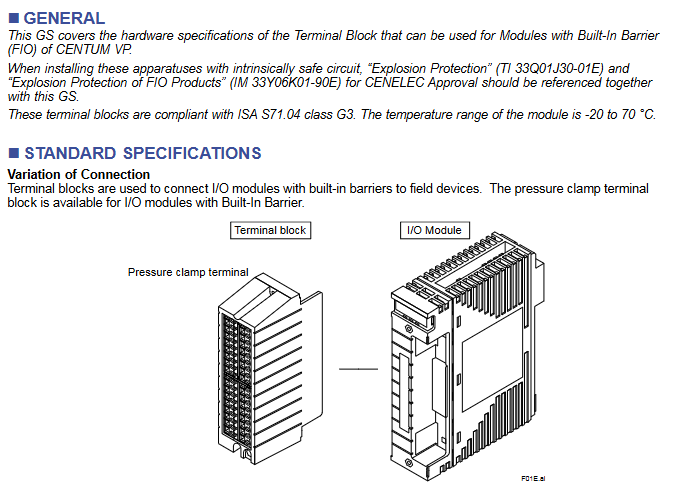
External dimensions and installation compatibility
(1) Size specification classification
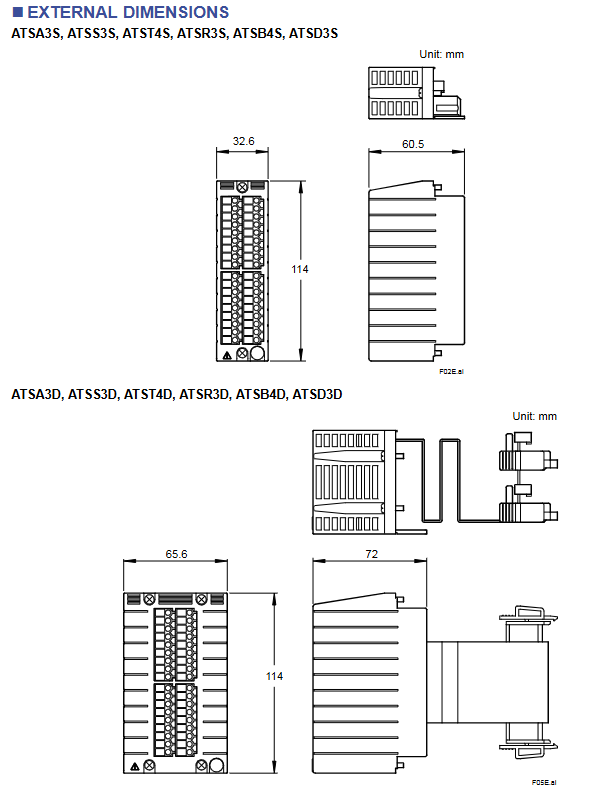
The size of the terminal block is directly related to the redundancy design, and all models within the same series have identical dimensions for standardized installation layout. The specific specifications are as follows:
Series types include model size parameters (unit: mm), reference drawings, installation and adaptation scenarios
Single channel series ATSA3S, ATSS3S, ATST4S, ATSR3S, ATSB4S, ATSD3S length x width x height: 32.6 x 60.5 x 114 F02E.ai is suitable for control cabinet layouts with limited installation space and no need for redundant design, and can be densely arranged
The dual redundant series ATSA3D, ATSS3D, ATST4D, ATSR3D, ATSB4D, ATSD3D length x width x height: 65.6 x 72 x 114 F05E.ai is suitable for the layout of control cabinets in critical control areas and requires a certain amount of installation space to ensure the heat dissipation and maintenance convenience of redundant components
(2) Dimensional design features
Height uniformity: All models have a height of 114mm, which facilitates the planning of installation positions according to the floor height inside the standard control cabinet and improves the cleanliness of the installation layout
Width differentiation: The width of the dual redundant series (72mm) is greater than that of the single channel series (60.5mm), and the length (65.6mm) is greater than that of the single channel series (32.6mm), adapting to the spatial requirements of its internal redundant structure
Standardized design: The dimensions comply with industrial equipment installation specifications and can seamlessly adapt to other supporting equipment of the Yokogawa CENTUM VP system (such as I/O modules, control cabinet rails, etc.), reducing installation difficulty
Model coding rules and ordering requirements
(1) Detailed explanation of coding rules
Explanation of optional/fixed values for the meaning of coding components
The prefix (such as ATSA, ATSS, etc.) application type identification ATSA (analog input), ATSS (analog output), ATST (thermocouple/mV), ATSR (RTD/PAT), ATSB (digital input), ATSD (digital output) prefix directly corresponds to the core application functions of the terminal block, making it easy to quickly identify
Intermediate numbers (such as 3S, 3D, 4S, 4D, etc.) indicate the number of channels and redundancy types. 3S (8 channels+single channel), 3D (8 channels+double redundancy), 4S (16 channels+single channel), 4D (16 channels+double redundancy) numbers "3" correspond to 8 channels, and "4" corresponds to 16 channels; The letters "S" and "D" distinguish redundant types
Suffix code configuration identifier -0 (fixed value) All models use a unified suffix code, with no additional optional configurations, simplifying the selection and ordering process
(2) Ordering requirements
Users need to specify the complete model (including suffix code) when placing an order, for example:
Conventional simulation input scenario: Order "ATSA3S-0"
Key scenario digital output: Order "ATSD3D-0"
Due to the fixed suffix code of -0, the core needs to confirm the model body composed of the prefix and the middle digit to ensure a complete match with the actual application type, channel number, and redundancy requirements.
- YOKOGAWA
- Reliance
- ADVANCED
- SEW
- ProSoft
- WATLOW
- Kongsberg
- FANUC
- VSD
- DCS
- PLC
- man-machine
- Covid-19
- Energy and Gender
- Energy Access
- Renewable Integration
- Energy Subsidies
- Energy and Water
- Net zero emission
- Energy Security
- Critical Minerals
- A-B
- petroleum
- Mine scale
- Sewage treatment
- cement
- architecture
- Industrial information
- New energy
- Automobile market
- electricity
- Construction site
- HIMA
- ABB
- Rockwell
- Schneider Modicon
- Siemens
- xYCOM
- Yaskawa
- Woodward
- BOSCH Rexroth
- MOOG
- General Electric
- American NI
- Rolls-Royce
- CTI
- Honeywell
- EMERSON
- MAN
- GE
- TRICONEX
- Control Wave
- ALSTOM
- AMAT
- STUDER
- KONGSBERG
- MOTOROLA
- DANAHER MOTION
- Bentley
- Galil
- EATON
- MOLEX
- Triconex
- DEIF
- B&W
- ZYGO
- Aerotech
- DANFOSS
- KOLLMORGEN
- Beijer
- Endress+Hauser
- schneider
- Foxboro
- KB
- REXROTH
- YAMAHA
- Johnson
- Westinghouse
- WAGO
- TOSHIBA
- TEKTRONIX
- BENDER
- BMCM
- SMC
- HITACHI
- HIRSCHMANN
- XP POWER
- Baldor
- Meggitt
- SHINKAWA
- Other Brands
- UniOP
- KUKA
- IBA
- Beckhoff
- ADLINK
-
Siemens 6SL3244-0SA01-1AA0 - SINAMICS G120 Control Unit
-
DANFOSS 175Z2688 - COATEDE CONTROLUNIT VLT5000
-
SIEMENS 6FM1721-3AA20 - Positioning Module
-
REXORTH VTS0605 PVAR S21 - Drive Module
-
BECKHOFF 2915-0000 - Control Module
-
COOPER EATON CGLine 400 40071347901 - CEAG CG Controller
-
SIEMENS 3UF5031-3AN00-1 - SIMOCODE DP Basic Unit
-
SIGMATEK DNC305 05-011-305 - Drive Controller
-
Multivac MV1 10249768 - Control Module
-
SCHNEIDER ELECTRIC MES114 59646 & 59645 - Circuit Breaker Accessory
-
CAMILLE BAUER CAPAX 44-580-0012 - Transmitter
-
HENGSTLER VT360P LS1/TOK - Encoder
-
BURKERT 8792 - 24V DC IP65 / IP67 Positioner
-
SENSOPART V10-OB-A1-W6 - Vision Sensor
-
ALLEN-BRADLEY 1762-L40BXB SER.C REV.J - MicroLogix 1200 Controller
-
HITACHI CPU22-02HC 33025801-2 - CPU Module
-
HITACHI AGH-0 33034810-2 - Control Board
-
PHILIPS AIH110 VER 1.0 - Control Module
-
BAUMULLER DO8000 - Drive Controller
-
B&R PS477 3PS477.9 Rev.C0 - Power Supply
-
ABB ALFA LAVAL 200-CISB - Communication Interface 2 x SatBus
-
Moeller MI4-570-TA1 - HMI Operator Panel
-
ABB ACH550-01-06A9-4+B055 - Variable Frequency Drive
-
ABB TPU2 3HNE00313-1 REV 12 - Teach Pendant Unit
-
Schneider Electric BRS368H130ABA - Stepper Motor
-
Foxboro FCM100E P0972ZA - I/A Series Communication Module
-
Siemens 6ES7 450-1AP00-0AE0 6ES7450-1AP00-0AE0 - Simatic S7 Version:04 Counter Module
-
Schneider Electric ATV320U07N4W - Altivar Machine Drive
-
Priva TouchPoint Flush V06:02 5060002 - Control Panel
-
Lenze ESMD402L4TXA - 4kW SMD Inverter Drive
-
Lenze ESMD402L4TXA - 4kW SMD Inverter Drive
-
Schneider Electric PM210 PM210MG - Powerlogic Power Meter
-
ASCOM U982-DB/1C U982 - Power Supply / Communication Module
-
DYADIC SYSTEMS SCN5-010-050-S03-NA - Servo Cylinder
-
Reliance Electric GMI-S04 - AC/AC CONVERTER 380/400V 50/60Hz 3.9/5.2A
-
Pro-Face GLC150-BG41-XY32KF-24V 3080060 PFXGLC150BDBP - Touch Screen HMI
-
ROFIN RSL TERMINAL V2 0185.01/03 - TERMINAL
-
HONEYWELL R7241E1077 - Burner Control / Amplifier
-
SEW MM22C-503-00 8241201 - 2.2kW Movimot Drive
-
Brand Digital III 50mL - Burette
-
Danfoss 195N0039 VLT2811PS2B20STR1DBF00A00C0 - 2.4kVA VLT Drive
-
SONY LG10-2 EK1 - Digital Gauge Indicator
-
EMERSON SKD3400750 - 7.5kW AC Drive
-
SIEMENS 6AV6 542-0AG10-0AX0 - MULTIPANEL HMI
-
TELEMECANIQUE ATV21HU55N4 - ALTIVAR21 5.5KW Variable Speed Drive
-
MITSUBISHI A985GOT-TBA-EU - GOT900 Touch Screen HMI
-
SCHNEIDER LXM32AD30N4 - Lexium 32 Servo Drive
-
SICK PSR01-1501 M20Z-02550A122 - Safety Laser Scanner
-
GECMA CHALLENGER 15-2-FMO - LITE TOUCH Monitor
-
Uniop EK02 6ZA982 - HMI Operator Panel
-
TELEMECANIQUE ATV18U54M2 - SQUARE D ALTIVAR 18 3kW Drive
-
Schneider Electric ATV312HU75S6 - 7.5kW Altivar 312 Drive
-
Siemens 6GK7243-5DX30-0XE0 6GK7 243-5DX30-0XE0 - Communications Processor
-
Schneider Electric LV432455 VIGI630 - 3POLE Earth Leakage Module
-
Rexroth PSI 6100.750 L1 R911170694-107 - frequency inverter / inverter
-
SWEDISH MICROWAVE AB Ku-Band BDC 138010-45-D0 - Block Downconverter
-
METTLER TOLEDO IND429 IND429-BB30 - Weighing Terminal
-
Siemens 6SL3210-5HE10-4UF0 - Sinamics V90 Servo Drive
-
B&R X20CP0482 Rev.D0 - X20 CPU Module
-
Mitsubishi FR-E720S-110SC-EC FRE720S110SCEC - 31A~11A Drive With Filter
-
ABB ACH580-01-026A-4 - Variable Frequency Drive
-
Siemens 6SL3210-1KE13-2AP1 - SINAMIC G120CDP 1.1kw Drive
-
Schneider Electric TM250D 4P3D LV431440 - Compact NSX250 Circuit Breaker
-
RELIANCE ELECTRIC GD.722.81.00-A 802288-74C - MAXITRON Servo Control Card
-
Uniop EK02 6ZA982 - HMI Operator Panel
-
Siemens 6SE9113-7JA13 - MICRO MASTER Junior 1.5kW Inverter
-
Mitsubishi FR-E720S-110SC-EC FRE720S110SCEC - 31A~11A Drive with Filter
-
Johnson Controls FEC2621 MS-FEC2621-0 - Field Equipment Controller
-
BENDER IR475LYT-429 - A-ISOMETER Insulation Monitor
-
Berger lahr D550 RS15 22.550-00-30b - Stepper Drive
-
Rexroth PSI 6100.750 L1 R911170694-107 - Frequency Inverter / INVERTER
-
KOYO 205 D2-06B-1 D2-240 H2-ECOM D2-08ND3 F2-08TRS - DIRECT LOGIC PLC WITH MODULE
-
TELEMECANIQUE ATV18U54M2 ATV18U54M - SQUARE D ALTIVAR 18 3kW Drive
-
Lenze 471-E1.D - Board / Controller Speed
-
Mitsubishi FR-A740-00038-EC - Frequency Inverter
-
Johnson Controls IOM3723 MS-IOM3723-0 - Input/Output Module
-
CURTIS 1238-5602 - AC Motor Controller
-
FOXBORO P0912XX REV.A - 220VAC Power Supply
-
Siemens 6SE9113-7JA13 - MICRO MASTER Junior 1.5kW Inverter
-
Mitsubishi FR-A740-00038-EC - Frequency Inverter
-
KOYO 205 D2-06B-1 D2-240 H2-ECOM D2-08ND3 F2-08TRS - DIRECT LOGIC PLC WITH MODULE
-
AUTZ M406D-00101 - Servo Motor
-
Lauer PCS095 PG095.508.BB - Operator Panel
-
ABB SCOP45SB/DX232 - SattCon OP45 SB Operator Panel
-
SEW Eurodrive MCH42A0030-5A3-4-00 MDX60A0030-5A3-4-00 - 4.8kVA Movidrive Inverter
-
BENDER IR475LYT-429 - A-ISOMETER Insulation Monitor
-
Johnson Controls FEC2621 MS-FEC2621-0 - Field Equipment Controller
-
Johnson Controls IOM3723 MS-IOM3723-0 - Input/Output Module
-
Berger lahr D550 RS15 22550-00-30b - Stepper Drive
-
SIEMENS 6FX1120-4BD03 6FX11204BD03 5702049304.00 E-Stand: A - Sinumerik Module
-
Allen-Bradley 1771-NIV B - HIGH RESOLUTION ISOLATED ANALOG SERIES Module
-
HONEYWELL XFC2D06001 - Flow Computer / Controller
-
Contraves Varidyn Compact ADB 380.90M - DC Drive 380v - 400v 90A 50kVA
-
Red Lion Control GEM52000 - Control Module
-
Siemens 6ES5 955-3NC13 - modular power supply TYPE:DIN41752
-
Danfoss ICV50 G20Mn50T / 027H5200 - Valve zaw
-
Eberle PLS508 P-814 / 2X EA-88 / A-812 / MT-81 / S-11 - PLC with Modules
-
Siemens 6ES7 314-6CF01-0AB0 6ES7314-6CF01-0AB0 - SIMATIC CPU314C-2 DP
-
EBERLE EM-525-87 EM52487 - ICE DETECTOR BASE UNIT
-
Telemecanique / Schneider TSXRKZ02 - TSX Micro automation plus 7module
-
B&R 5DLSDL.1001-00 - Display Link Receiver
-
Siemens 6FX1120-4BD03 6FX11204BD03 5702049304.00 E-Stand: A - Sinumerik Module
-
ALLEN-BRADLEY 1771-NIV A - HIGH RESOLUTION ISOLATED ANALOG SERIES Module
-
ALLEN-BRADLEY 1771-NIV B - HIGH RESOLUTION ISOLATED ANALOG SERIES Module
-
Contraves Varidyn Compact ADB 380.90M - DC Drive 380V - 400V 90A 50kVA
-
Contraves Varidyn Compact ADB 380.90M - DC Drive 380V - 400V 90A 50kVA
-
Ropex RES-202 - Resistron Temperature Controller
-
HONEYWELL XFC2D06001 - Flow Computer / Controller
-
Telemechanics ATV452U40 - DIMMER ALTIVAR5 SERIES 452 4kW 5HP Frequency Inverter
-
VEGA VEGAPLUS61 PS61.XXAGPHAMAX - Radar Level Sensor
-
BRANSON ULTRASONIC TRANSDUCER - Ultrasonic Transducer
-
Danfoss ICV50 G20Mn50T / 027H5200 - Valve Valvola Zaw
-
Schneider Electric 2001549/1 GALAXY PW 5102851200 NT07 - panler card
-
REXROTH VT3006-36 A - Proportional Valve Amplifier
-
Allen-Bradley 1746-OBP16 SERIES:C - SLC 500 OUTPUT MODULE
-
SCHNEIDER LXM32MD12N4 - Lexium 32 Servo Drive
-
Schneider Electric ATV630U22N4 - 2.2KW Altivar Process Drive
-
Allen-Bradley 1746-OBP16 SERIES:C - SLC 500 OUTPUT MODULE
-
Vanderlande 0E2550-00002... - Bagtrax Integrated Power Module 400V 32A
-
B&R X20CP0410 Rev.D0 - X20 CPU Module
-
VANDERLANDE 0E2550-00002 02EDD2B0100 - BAGTRAX Integrated Power Module 400V 32A
-
Rexroth R061205010 - Linear Bushing / Bearing
-
INDRAMAT TVM1.2-50-220/300-W0-220/380 - Power Supply Module
-
Vanderlande 0E2550-00002... - Bagtrax Integrated Power Module 400V 32A
-
HOMAG KEB 07F5S1A-YA00 09E5T60-1001 - Combivert Inverter WITH KEYPAID AND FILTER
-
Siemens 3RW3047-1BB14 - Soft Starter
-
Sumitomo AF-500 AF502-A40 - 0.4kW Transistor Inverter
-
Sumitomo AF-500 AF502-A40 - 0.4kW Transistor Inverter

K-JIANG

Add: Jimei North Road, Jimei District, Xiamen, Fujian, China
Tell:+86-15305925923