

K-WANG


YOKOGAWA CENTUM VP Distributed Control System
System: Yokogawa Oprex Control and Safety System
Manufacturer: Yokogawa Electric Corporation
Core positioning: Yokogawa's most advanced integrated production control platform, which has undergone more than 40 years of technological evolution, aims to create value with customers through "process collaborative innovation" and meet the needs of digital transformation and integration of new technologies (such as IoT) in multiple industries
YOKOGAWA CENTUM VP Distributed Control System
Product core positioning
CENTUM VP is a distributed control system with over 40 years of technological accumulation. As a core component of the Yokogawa OpreX ecosystem, it features "integration, high reliability, scalability, and ease of operation" as its core characteristics, achieving integrated collaboration in production control, safety management, and asset operation and maintenance. It supports the integration of new technologies such as IoT and provides enterprises with automation solutions throughout the entire lifecycle.
System historical evolution and compatibility
(1) Development History
The Yokogawa CENTUM series always adheres to independent research and development, and each generation of products reserves an upgrade path. The key milestones are as follows:
Year Product Version Core Progress
The first product of the CENTUM V series in 1983 laid the foundation for the control architecture
1988 CENTUM-XL technology iteration to enhance system scalability
1993 CENTUM CS new generation control system, optimized control performance
In 1998, the CENTUM CS 3000 improved integration and adapted to more complex industrial scenarios
2001 CENTUM CS 3000 R3 version optimized to enhance compatibility and stability
In 2008, CENTUM VP R5 launched the first VP series, equipped with Vnet/IP control network
In 2011, CENTUM VP officially released its core version
In 2015, CENTUM VP R6 continued to upgrade, improving its functional modules and adapting to the ecosystem
(2) Compatibility advantage
Backward compatibility: CENTUM VP can directly control and monitor all Yokogawa legacy systems (including CENTUM V、CENTUM-XL、CENTUM CS、CENTUM CS 3000 By controlling the network, cross version collaboration can be achieved without the need for large-scale replacement of existing hardware
Third party migration: 350+non Yokogawa system migration projects have been successfully completed, covering mainstream brands such as Bailey INFI90、Foxboro I/A、Emerson RS3/PROVOX/DeltaV、Honeywell TDC2000/3000/PKS、Siemens SIMATIC Wait, the migration process is simple and efficient, ensuring business continuity
Detailed explanation of the core functional modules of the system
(1) Operation module: Focus on efficient collaborative operation
1. Integrated management architecture
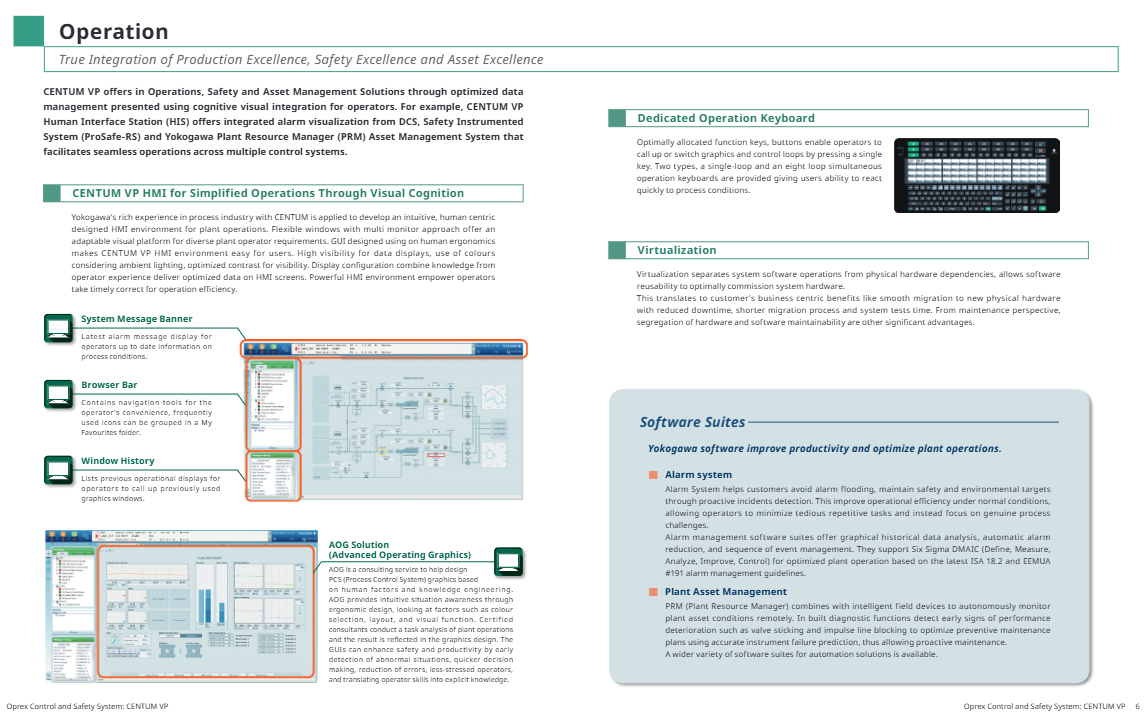
The deep integration of the three major goals of "production excellence, safety excellence, and asset excellence" is achieved through cognitive visual integration technology to optimize data presentation. For example, HIS (Human Machine Interface Station) can unify the visualization of alarm information from DCS, Safety Instrumented System (ProSafe RS), and Factory Resource Manager (PRM), breaking down barriers to multi system operation and achieving seamless collaboration.
2. Humanized Human Machine Interface (HMI)
Design concept: Based on ergonomics and experience in Yokogawa Industries, create an intuitive and easy-to-use operating environment that adapts to the usage habits of different operators
Core features:
Flexible configuration: supports multi screen display and custom window layout to meet the visualization needs of complex production scenarios
High visibility: sufficient data display brightness, color matching suitable for industrial lighting environment, contrast optimization to improve readability
Convenient navigation: including system message bar (displaying the latest alarm information in real time), browser bar (supporting common function collection and grouping), window history (quickly calling past operation interfaces)
AOG solution: Advanced Operating Graphics consulting service, where certified consultants design PCS graphics based on human factors and knowledge engineering. By optimizing color, layout, and visual functions, it achieves early anomaly detection, rapid decision-making, and reduces operational errors, while transforming operator experience into explicit knowledge
3. Specialized operation keyboard
Provide two types of dedicated keyboards, with optimized function key layout that supports one click calling of graphics or control circuits, helping operators quickly respond to process changes:
Single loop operation keyboard: suitable for precise operation of a single control loop
Simultaneous operation keyboard with eight circuits: meeting the efficient requirements of multi circuit collaborative control
4. Virtualization technology
Decoupling system software and physical hardware, improving software reusability, brings multiple advantages:
Convenient Migration: Supports smooth migration to new physical hardware, reducing downtime
Efficient testing: Shorten the system testing cycle and reduce the limitations caused by hardware dependencies
Maintenance optimization: independent maintenance of software and hardware to enhance operational flexibility
5. Core software suite
Alarm Management System: Compliant with ISA 18.2 and EEMUA # 191 standards, supporting Six Sigma DMAIC (Definition Measurement Analysis Improvement Control) method, with graphical historical data analysis, automatic alarm filtering, and event sequence management functions, effectively avoiding alarm proliferation and allowing operators to focus on core process issues
Factory Resource Manager (PRM): Linked with intelligent on-site devices, it enables remote autonomous monitoring of asset status, identifies signs of equipment performance degradation (such as valve jamming and pulse line blockage) in advance through built-in diagnostic functions, accurately predicts instrument failures, optimizes preventive maintenance plans, and achieves proactive operation and maintenance
(2) Control module: ensuring high reliability and stable operation
1. High availability design
Dual redundancy architecture: The processor module, power supply, I/O module, and I/O network of FCS (Field Control Station) all adopt a dual redundancy design, with the main and backup modules running synchronously, seamlessly switching to the backup module in case of failure, ensuring control continuity and no downtime losses
Online maintenance capability: supports online modification of FCS application logic and parameters, allows for online replacement of faulty modules without interrupting process control, and adapts to scenarios such as factory expansion and process adjustment
2. Core Control Unit (FCS)
100% independently developed and manufactured by Yokogawa, continuing the high reliability genes of the CENTUM series
Equipped with powerful processing capabilities and large capacity application storage, fully adapted to advanced on-site digital technology, ensuring efficient, safe, and stable control of the production process
3. Security Control Network (Vnet/IP)
Technical specifications: Compliant with IEEE802.3 Ethernet standard, with a transmission rate of 1Gbps, supporting both star and ring topologies
Core advantages: It combines openness and security, does not affect the efficiency of process control data transmission, and has built-in security mechanisms such as anti fraud, anti tampering, and anti DoS attacks to ensure the stability and reliability of the control network; Regardless of project size and complexity, it can ensure HIS data updates every second
4. Multi factor I/O module solution
I/O module type, core characteristics, applicable scenarios
N-IO (Network I/O) next-generation software can configure intelligent I/O, with a single module supporting AI/AO/DI/DO signals; The signal type of each I/O point is configured through adapter software to adapt to design changes; No need for traditional wiring grouping, saving installation space and cost; Can be deployed as a remote I/O module in on-site remote junction boxes that require flexible adaptation of signal types, pursuit of installation efficiency and cost optimization scenarios
FIO (Field Network I/O) divides various modules according to process signal types, and can be connected to field equipment through pressure clamp terminal blocks, dedicated terminal boards, or MIL cables in traditional industrial scenarios that require configuration through terminal blocks
RIO system upgrade I/O includes Remote I/O module and RIO system upgrade dedicated I/O module, maximizing the utilization of existing assets and achieving rapid system upgrade. Based on the expansion and upgrade scenarios of the existing RIO system
5. Function blocks and control capabilities
Provide rich functional blocks, covering monitoring, control, operation, calculation, logic functions, and sequence control, supporting continuous control, advanced control, complex sequence control, and batch control. The control system can be flexibly designed through the combination of functional blocks to maintain modularity and scalability
(3) Engineering module: Accelerating project delivery and quality improvement
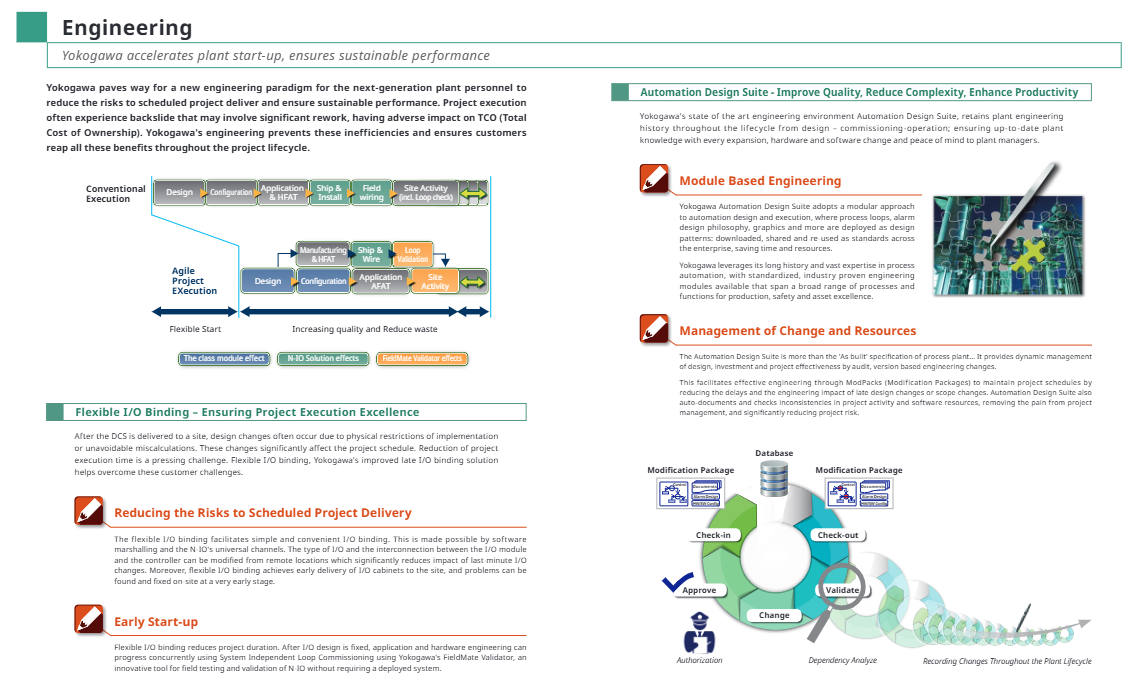
1. Core engineering environment: Automation Design Suite
Full lifecycle data management: Record the complete engineering history from design, debugging to operation, ensuring data integrity and consistency during system expansion, software and hardware changes, and providing reliable engineering archives for factory managers
Modular engineering: Encapsulate process loops, alarm design, graphics, etc. into standardized design modules that can be downloaded, shared, and reused across enterprises, reducing repetitive work and saving time and resources
Change and Resource Management: Implement version based engineering change management through ModPacks, automatically document project activities and detect data inconsistencies, reducing project delays and risks caused by later changes
2. Flexible I/O binding technology
Core advantage: Based on software grouping and N-IO universal channels, it supports remote modification of I/O types and module controller connection relationships, greatly reducing the impact of later design changes on project progress
Project Value:
Early delivery of I/O cabinets to the site, early detection and resolution of installation issues
Combined with FieldMate Validator debugging tool, it supports independent loop debugging of the system, eliminating the need to deploy a complete system and shortening project duration
Engineering design and hardware installation can be carried out in parallel to improve project execution efficiency
3. Agile project execution
Compared to traditional project processes (design configuration manufacturing and factory acceptance testing shipping installation on-site activities), CENTUM VP reduces rework and waste, improves project quality and delivery efficiency, and lowers total cost of ownership (TCO) through modular design, flexible I/O binding, and other technologies
(4) Sustainable Plant: Ensuring Long Term Value
1. Full lifecycle services
Yokogawa provides service support covering the entire lifecycle of the system, including online upgrades, patch updates, migration services, security solutions, etc. Through deep collaboration with customers, it ensures the sustainable return on investment of control system assets
2. Long term stable operation guarantee
Component updates and upgrades: By updating outdated components, replacing outdated supported peripherals, upgrading FCS (improving processing speed and adding new features), etc., seamless system transition can be achieved. Maintenance activities can be synchronized with factory downtime without taking up additional production time
Lifecycle performance assurance services: covering planning and execution, maintenance, protection, analysis, modernization upgrades, and other aspects, providing services such as engineer dispatch, workbench maintenance, equipment status monitoring, seamless upgrades, etc., to prevent unexpected failures
3. Network security protection system
Security certification: CENTUM VP on-site control unit obtained ISASecure certification ® EDSA (Embedded Device Security Assurance) certification, rigorously tested by CSSC (Control System Security Center) certified laboratory, meets the security requirements of industries such as petroleum, petrochemical, and power
Endpoint Security Services: Provides USB port locking, security information services, antivirus software, whitelist software, etc., verifies the compatibility of Yokogawa products with antivirus software, Microsoft security updates, and ensures system endpoint security
Security network design: Vnet/IP control network has multiple built-in security mechanisms to resist various network attacks, and Windows PC/Server provides security configuration options
System architecture and core components
(1) Hardware components
Component Name Abbreviation Core Function Hardware Configuration
The core interface for HIS operator control and monitoring in the human-machine interface station is based on the Windows operating system, using commercially available PC hardware, and can be optionally equipped with a dedicated operation keyboard
The ENG system configuration, programming, debugging, and maintenance of the engineering station are consistent with the HIS hardware configuration, and are equipped with the complete CENTUM VP engineering suite
The core control unit of the FCS system in the on-site control station is independently developed and manufactured by Yokogawa, with dual redundancy design, high reliability and processing capability
Unified gateway station/general subsystem gateway UGS/GSGW system interface and subsystem control UGS to achieve docking with STARDOM or third-party subsystems; GSGW is used to operate and monitor the subsystems connected to CENTUM VP
Bus converter BCV network domain connection and system compatibility connect multiple control network domains, achieving compatible docking between the previous generation CENTUM system and CENTUM VP
(2) Network and Communication Architecture
Control network: Vnet/IP (1Gbps, redundant design), responsible for real-time transmission of core control data, safe and reliable
Digital fieldbus: supports FOUNDATION ™ fieldbus、HART、PROFINET、PROFIBUS-DP、DeviceNet、Modbus、Modbus/TCP、EtherNet/IP Multiple industrial bus protocols are available to adapt to different brands and types of field devices
(3) Key software components
UACS (Unified Alarm and Status Server): Complies with IEC 62682 (Ed1, 2014)/ISA18.2-2016 standards, standardizes alarm management, and improves alarm response efficiency
Operational Excellence Software Suite: Based on the Windows platform, it covers functions such as factory security, asset operation and maintenance, production management and optimization, providing comprehensive support for efficient plant operations
Safety Control Station (SCS) - ProSafe RS: A T Ü V SIL3 certified safety instrumented system that integrates Yokogawa Pair&Spare and Vnet/IP technologies, with strong synergy with CENTUM VP
STARDOM Network Control System: Intelligent Hybrid Remote Communication Controller, suitable for the upstream oil and gas market, can be seamlessly integrated with CENTUM VP through UGS
Applicable industries and scenarios
Core industries: Process industries such as petroleum, petrochemical, power, chemical, metallurgical, pharmaceutical, water treatment, etc
Key scenarios:
Real time control and monitoring of continuous production processes
Safety protection and emergency response in high-risk industrial scenarios
Remote operation and preventive maintenance of industrial assets
Collaborative operation and data management of multi system integration
Upgrading, expanding, and migrating existing systems to third-party systems
- YOKOGAWA
- Reliance
- ADVANCED
- SEW
- ProSoft
- WATLOW
- Kongsberg
- FANUC
- VSD
- DCS
- PLC
- man-machine
- Covid-19
- Energy and Gender
- Energy Access
- Renewable Integration
- Energy Subsidies
- Energy and Water
- Net zero emission
- Energy Security
- Critical Minerals
- A-B
- petroleum
- Mine scale
- Sewage treatment
- cement
- architecture
- Industrial information
- New energy
- Automobile market
- electricity
- Construction site
- HIMA
- ABB
- Rockwell
- Schneider Modicon
- Siemens
- xYCOM
- Yaskawa
- Woodward
- BOSCH Rexroth
- MOOG
- General Electric
- American NI
- Rolls-Royce
- CTI
- Honeywell
- EMERSON
- MAN
- GE
- TRICONEX
- Control Wave
- ALSTOM
- AMAT
- STUDER
- KONGSBERG
- MOTOROLA
- DANAHER MOTION
- Bentley
- Galil
- EATON
- MOLEX
- Triconex
- DEIF
- B&W
- ZYGO
- Aerotech
- DANFOSS
- KOLLMORGEN
- Beijer
- Endress+Hauser
- schneider
- Foxboro
- KB
- REXROTH
- YAMAHA
- Johnson
- Westinghouse
- WAGO
- TOSHIBA
- TEKTRONIX
- BENDER
- BMCM
- SMC
- HITACHI
- HIRSCHMANN
- XP POWER
- Baldor
- Meggitt
- SHINKAWA
- Other Brands
- UniOP
- KUKA
- IBA
- Beckhoff
- ADLINK
-
Siemens 6SL3244-0SA01-1AA0 - SINAMICS G120 Control Unit
-
DANFOSS 175Z2688 - COATEDE CONTROLUNIT VLT5000
-
SIEMENS 6FM1721-3AA20 - Positioning Module
-
REXORTH VTS0605 PVAR S21 - Drive Module
-
BECKHOFF 2915-0000 - Control Module
-
COOPER EATON CGLine 400 40071347901 - CEAG CG Controller
-
SIEMENS 3UF5031-3AN00-1 - SIMOCODE DP Basic Unit
-
SIGMATEK DNC305 05-011-305 - Drive Controller
-
Multivac MV1 10249768 - Control Module
-
SCHNEIDER ELECTRIC MES114 59646 & 59645 - Circuit Breaker Accessory
-
CAMILLE BAUER CAPAX 44-580-0012 - Transmitter
-
HENGSTLER VT360P LS1/TOK - Encoder
-
BURKERT 8792 - 24V DC IP65 / IP67 Positioner
-
SENSOPART V10-OB-A1-W6 - Vision Sensor
-
ALLEN-BRADLEY 1762-L40BXB SER.C REV.J - MicroLogix 1200 Controller
-
HITACHI CPU22-02HC 33025801-2 - CPU Module
-
HITACHI AGH-0 33034810-2 - Control Board
-
PHILIPS AIH110 VER 1.0 - Control Module
-
BAUMULLER DO8000 - Drive Controller
-
B&R PS477 3PS477.9 Rev.C0 - Power Supply
-
ABB ALFA LAVAL 200-CISB - Communication Interface 2 x SatBus
-
Moeller MI4-570-TA1 - HMI Operator Panel
-
ABB ACH550-01-06A9-4+B055 - Variable Frequency Drive
-
ABB TPU2 3HNE00313-1 REV 12 - Teach Pendant Unit
-
Schneider Electric BRS368H130ABA - Stepper Motor
-
Foxboro FCM100E P0972ZA - I/A Series Communication Module
-
Siemens 6ES7 450-1AP00-0AE0 6ES7450-1AP00-0AE0 - Simatic S7 Version:04 Counter Module
-
Schneider Electric ATV320U07N4W - Altivar Machine Drive
-
Priva TouchPoint Flush V06:02 5060002 - Control Panel
-
Lenze ESMD402L4TXA - 4kW SMD Inverter Drive
-
Lenze ESMD402L4TXA - 4kW SMD Inverter Drive
-
Schneider Electric PM210 PM210MG - Powerlogic Power Meter
-
ASCOM U982-DB/1C U982 - Power Supply / Communication Module
-
DYADIC SYSTEMS SCN5-010-050-S03-NA - Servo Cylinder
-
Reliance Electric GMI-S04 - AC/AC CONVERTER 380/400V 50/60Hz 3.9/5.2A
-
Pro-Face GLC150-BG41-XY32KF-24V 3080060 PFXGLC150BDBP - Touch Screen HMI
-
ROFIN RSL TERMINAL V2 0185.01/03 - TERMINAL
-
HONEYWELL R7241E1077 - Burner Control / Amplifier
-
SEW MM22C-503-00 8241201 - 2.2kW Movimot Drive
-
Brand Digital III 50mL - Burette
-
Danfoss 195N0039 VLT2811PS2B20STR1DBF00A00C0 - 2.4kVA VLT Drive
-
SONY LG10-2 EK1 - Digital Gauge Indicator
-
EMERSON SKD3400750 - 7.5kW AC Drive
-
SIEMENS 6AV6 542-0AG10-0AX0 - MULTIPANEL HMI
-
TELEMECANIQUE ATV21HU55N4 - ALTIVAR21 5.5KW Variable Speed Drive
-
MITSUBISHI A985GOT-TBA-EU - GOT900 Touch Screen HMI
-
SCHNEIDER LXM32AD30N4 - Lexium 32 Servo Drive
-
SICK PSR01-1501 M20Z-02550A122 - Safety Laser Scanner
-
GECMA CHALLENGER 15-2-FMO - LITE TOUCH Monitor
-
Uniop EK02 6ZA982 - HMI Operator Panel
-
TELEMECANIQUE ATV18U54M2 - SQUARE D ALTIVAR 18 3kW Drive
-
Schneider Electric ATV312HU75S6 - 7.5kW Altivar 312 Drive
-
Siemens 6GK7243-5DX30-0XE0 6GK7 243-5DX30-0XE0 - Communications Processor
-
Schneider Electric LV432455 VIGI630 - 3POLE Earth Leakage Module
-
Rexroth PSI 6100.750 L1 R911170694-107 - frequency inverter / inverter
-
SWEDISH MICROWAVE AB Ku-Band BDC 138010-45-D0 - Block Downconverter
-
METTLER TOLEDO IND429 IND429-BB30 - Weighing Terminal
-
Siemens 6SL3210-5HE10-4UF0 - Sinamics V90 Servo Drive
-
B&R X20CP0482 Rev.D0 - X20 CPU Module
-
Mitsubishi FR-E720S-110SC-EC FRE720S110SCEC - 31A~11A Drive With Filter
-
ABB ACH580-01-026A-4 - Variable Frequency Drive
-
Siemens 6SL3210-1KE13-2AP1 - SINAMIC G120CDP 1.1kw Drive
-
Schneider Electric TM250D 4P3D LV431440 - Compact NSX250 Circuit Breaker
-
RELIANCE ELECTRIC GD.722.81.00-A 802288-74C - MAXITRON Servo Control Card
-
Uniop EK02 6ZA982 - HMI Operator Panel
-
Siemens 6SE9113-7JA13 - MICRO MASTER Junior 1.5kW Inverter
-
Mitsubishi FR-E720S-110SC-EC FRE720S110SCEC - 31A~11A Drive with Filter
-
Johnson Controls FEC2621 MS-FEC2621-0 - Field Equipment Controller
-
BENDER IR475LYT-429 - A-ISOMETER Insulation Monitor
-
Berger lahr D550 RS15 22.550-00-30b - Stepper Drive
-
Rexroth PSI 6100.750 L1 R911170694-107 - Frequency Inverter / INVERTER
-
KOYO 205 D2-06B-1 D2-240 H2-ECOM D2-08ND3 F2-08TRS - DIRECT LOGIC PLC WITH MODULE
-
TELEMECANIQUE ATV18U54M2 ATV18U54M - SQUARE D ALTIVAR 18 3kW Drive
-
Lenze 471-E1.D - Board / Controller Speed
-
Mitsubishi FR-A740-00038-EC - Frequency Inverter
-
Johnson Controls IOM3723 MS-IOM3723-0 - Input/Output Module
-
CURTIS 1238-5602 - AC Motor Controller
-
FOXBORO P0912XX REV.A - 220VAC Power Supply
-
Siemens 6SE9113-7JA13 - MICRO MASTER Junior 1.5kW Inverter
-
Mitsubishi FR-A740-00038-EC - Frequency Inverter
-
KOYO 205 D2-06B-1 D2-240 H2-ECOM D2-08ND3 F2-08TRS - DIRECT LOGIC PLC WITH MODULE
-
AUTZ M406D-00101 - Servo Motor
-
Lauer PCS095 PG095.508.BB - Operator Panel
-
ABB SCOP45SB/DX232 - SattCon OP45 SB Operator Panel
-
SEW Eurodrive MCH42A0030-5A3-4-00 MDX60A0030-5A3-4-00 - 4.8kVA Movidrive Inverter
-
BENDER IR475LYT-429 - A-ISOMETER Insulation Monitor
-
Johnson Controls FEC2621 MS-FEC2621-0 - Field Equipment Controller
-
Johnson Controls IOM3723 MS-IOM3723-0 - Input/Output Module
-
Berger lahr D550 RS15 22550-00-30b - Stepper Drive
-
SIEMENS 6FX1120-4BD03 6FX11204BD03 5702049304.00 E-Stand: A - Sinumerik Module
-
Allen-Bradley 1771-NIV B - HIGH RESOLUTION ISOLATED ANALOG SERIES Module
-
HONEYWELL XFC2D06001 - Flow Computer / Controller
-
Contraves Varidyn Compact ADB 380.90M - DC Drive 380v - 400v 90A 50kVA
-
Red Lion Control GEM52000 - Control Module
-
Siemens 6ES5 955-3NC13 - modular power supply TYPE:DIN41752
-
Danfoss ICV50 G20Mn50T / 027H5200 - Valve zaw
-
Eberle PLS508 P-814 / 2X EA-88 / A-812 / MT-81 / S-11 - PLC with Modules
-
Siemens 6ES7 314-6CF01-0AB0 6ES7314-6CF01-0AB0 - SIMATIC CPU314C-2 DP
-
EBERLE EM-525-87 EM52487 - ICE DETECTOR BASE UNIT
-
Telemecanique / Schneider TSXRKZ02 - TSX Micro automation plus 7module
-
B&R 5DLSDL.1001-00 - Display Link Receiver
-
Siemens 6FX1120-4BD03 6FX11204BD03 5702049304.00 E-Stand: A - Sinumerik Module
-
ALLEN-BRADLEY 1771-NIV A - HIGH RESOLUTION ISOLATED ANALOG SERIES Module
-
ALLEN-BRADLEY 1771-NIV B - HIGH RESOLUTION ISOLATED ANALOG SERIES Module
-
Contraves Varidyn Compact ADB 380.90M - DC Drive 380V - 400V 90A 50kVA
-
Contraves Varidyn Compact ADB 380.90M - DC Drive 380V - 400V 90A 50kVA
-
Ropex RES-202 - Resistron Temperature Controller
-
HONEYWELL XFC2D06001 - Flow Computer / Controller
-
Telemechanics ATV452U40 - DIMMER ALTIVAR5 SERIES 452 4kW 5HP Frequency Inverter
-
VEGA VEGAPLUS61 PS61.XXAGPHAMAX - Radar Level Sensor
-
BRANSON ULTRASONIC TRANSDUCER - Ultrasonic Transducer
-
Danfoss ICV50 G20Mn50T / 027H5200 - Valve Valvola Zaw
-
Schneider Electric 2001549/1 GALAXY PW 5102851200 NT07 - panler card
-
REXROTH VT3006-36 A - Proportional Valve Amplifier
-
Allen-Bradley 1746-OBP16 SERIES:C - SLC 500 OUTPUT MODULE
-
SCHNEIDER LXM32MD12N4 - Lexium 32 Servo Drive
-
Schneider Electric ATV630U22N4 - 2.2KW Altivar Process Drive
-
Allen-Bradley 1746-OBP16 SERIES:C - SLC 500 OUTPUT MODULE
-
Vanderlande 0E2550-00002... - Bagtrax Integrated Power Module 400V 32A
-
B&R X20CP0410 Rev.D0 - X20 CPU Module
-
VANDERLANDE 0E2550-00002 02EDD2B0100 - BAGTRAX Integrated Power Module 400V 32A
-
Rexroth R061205010 - Linear Bushing / Bearing
-
INDRAMAT TVM1.2-50-220/300-W0-220/380 - Power Supply Module
-
Vanderlande 0E2550-00002... - Bagtrax Integrated Power Module 400V 32A
-
HOMAG KEB 07F5S1A-YA00 09E5T60-1001 - Combivert Inverter WITH KEYPAID AND FILTER
-
Siemens 3RW3047-1BB14 - Soft Starter
-
Sumitomo AF-500 AF502-A40 - 0.4kW Transistor Inverter
-
Sumitomo AF-500 AF502-A40 - 0.4kW Transistor Inverter

K-JIANG

Add: Jimei North Road, Jimei District, Xiamen, Fujian, China
Tell:+86-15305925923