

K-WANG


BENDER ISOMETER ® IRDH375 series Insulation Monitoring Equipment
BENDER ISOMETER ® IRDH375 series Insulation Monitoring Equipment
Product Overview
BENDER ISOMETER ® The IRDH375 series is an insulation monitoring device developed by Bender, a German company, specifically for ungrounded alternating current (AC), mixed AC/DC, and direct current (DC) systems (i.e. IT systems). Its core mission is to monitor the insulation resistance status between the system conductor and the ground in real time, warn of insulation faults in a timely manner, and ensure the safe and stable operation of electrical systems. This series of products, with patented measurement technology, flexible adaptability, and comprehensive functional configuration, are widely used in various scenarios with strict electrical safety requirements, and fully comply with multiple international universal standards, possessing high reliability and compatibility.
Core adaptation range
(1) System type adaptation
Basic adaptation systems: AC system, DC system, AC/DC hybrid main circuit
Special adaptation system: AC/DC main circuit with direct connection to DC components (such as rectifiers, converters, thyristor controlled DC drivers); UPS system, battery system; Phase controlled heater; Installation scenarios for equipment with switch mode power supply; High leakage capacitance IT system; Coupling IT systems
(2) Voltage parameter specifications
Rated monitoring voltage: AC/AC-DC 0... 793V, DC 0... 650V
Extended monitoring voltage: By combining with a dedicated coupling device, it can be extended to higher voltage levels such as DC 0... 1760V, 3/(N)/AC 0... 7200V (50... 400Hz), etc
Power supply voltage requirements:
AC power supply: 88... 264V (frequency 42... 460Hz)
DC power supply: 77... 286V or 19.2... 72V (please refer to the equipment nameplate for details)
Power protection: requires power supply through a 6A fuse; Mandatory requirement to use 5A fuses for UL and CSA application scenarios
Core technology and functional characteristics
(1) Measurement technology
Adopting the patented AMPPlus measurement method, designed specifically for modern power supply systems, it can accurately respond to complex scenarios containing a large number of directly connected DC components and high system leakage capacitors, effectively solving the problem of inaccurate monitoring by traditional measurement methods in such scenarios, and ensuring the stability and reliability of insulation resistance monitoring.
(2) Basic functions
Insulation monitoring core: Real time monitoring system insulation resistance, supporting two independent adjustable response values (1k Ω... 10M Ω), can set warning threshold and alarm threshold separately, achieving graded warning
Automatic adaptation capability: Without manual intervention, the device can automatically adapt to system leakage capacitance (maximum allowable value ≤ 500 μ F) and adapt to changes in system parameters under different operating conditions
Self monitoring and self testing:
Continuous self-monitoring: Real time inspection of the device's own working status, automatic triggering of system fault alarm in case of malfunction
Optional automatic self testing: supports manual self testing through the TEST button to verify device functionality and the connection status between the system and the earth
Display and operation:
Display configuration: Dual row backlit LCD display screen, supports switching between standard mode and menu mode, clearly displays insulation resistance value, device settings, fault information, etc
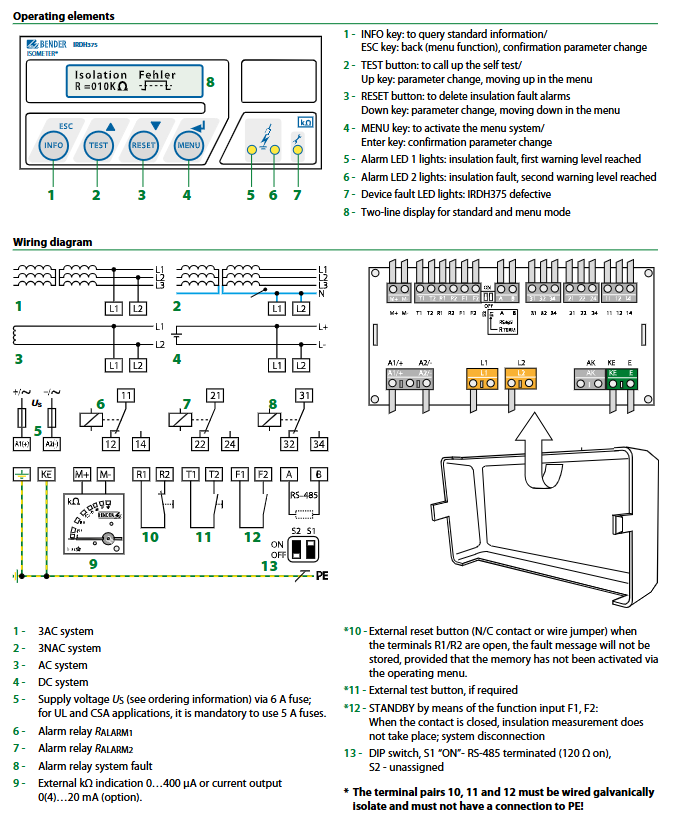
Operation buttons: equipped with four core buttons: INFO (query standard information), TEST (self-test), RESET (clear fault alarm), MENU (activate menu system), and support direction keys (up/down) and confirm key operation. Parameter configuration can be completed through panel buttons; Support external testing and reset buttons (cable length ≤ 10m)
Alarm function:
Alarm output: 2 independent alarm relays, both with passive conversion contacts, supporting N/O (normally open) or N/C (normally closed) operation modes; Additional configuration of system fault alarm relay (default N/C operation mode)
Alarm indication: 3 dedicated alarm LED lights, corresponding to "Level 1 Insulation Fault Warning", "Level 2 Insulation Fault Alarm", and "Equipment Self Fault", providing intuitive feedback on the alarm level
Fault storage: It can store fault information and clear it through the RESET button or external reset button (when terminals R1/R2 are disconnected and the storage function is not activated through the operation menu, the fault information is not stored)
Extension interface:
Communication interface: RS-485 interface (supports ASCII protocol), transmission distance ≤ 1200m (recommended to use J-Y (St) Y 2 × 0.8mm ² twisted pair, with one end of the shielding layer connected to PE), supports communication with external systems
External indicator interface: Reserve an external k Ω indicator interface (output 0... 400 μ A signal), which can be connected to external measuring instruments to display insulation resistance values
Terminal design: adopting plug-in terminals, convenient wiring, and terminal protection level up to IP30
Other auxiliary functions:
INFO button: Press to query additional information such as system leakage capacitance, current device settings, etc
Standby function: Controlled through function input ports F1 and F2, the device enters standby mode when the contacts are closed, pausing insulation measurement and achieving system disconnection control
DIP switch configuration: When the S1 switch is in the "ON" state, the RS-485 interface enables a 120 Ω terminal resistor; S2 switch has not yet been assigned a function
(3) Advanced features of IRDH375B (added compared to the base model)
Historical record storage: Built in historical memory with real-time clock, which can record all alarm information and attach date and time stamps for easy fault tracing and analysis
Enhanced Communication Capability: Equipped with an electrically isolated RS-485 interface, supporting BMS protocol, capable of stable communication with other Bender devices, and adaptable to centralized control scenarios such as building management systems
Coupling system adaptation: Built in insulation monitoring device disconnect relay, supports multiple IRDH375B devices to work together in the coupling IT system, and ensures that only one device is active at any time by controlling input ports F1/F2 to avoid monitoring conflicts
Analog output: Added 0 (4)... 20mA current output, which can be used for external data acquisition devices to achieve remote transmission and recording of insulation resistance data
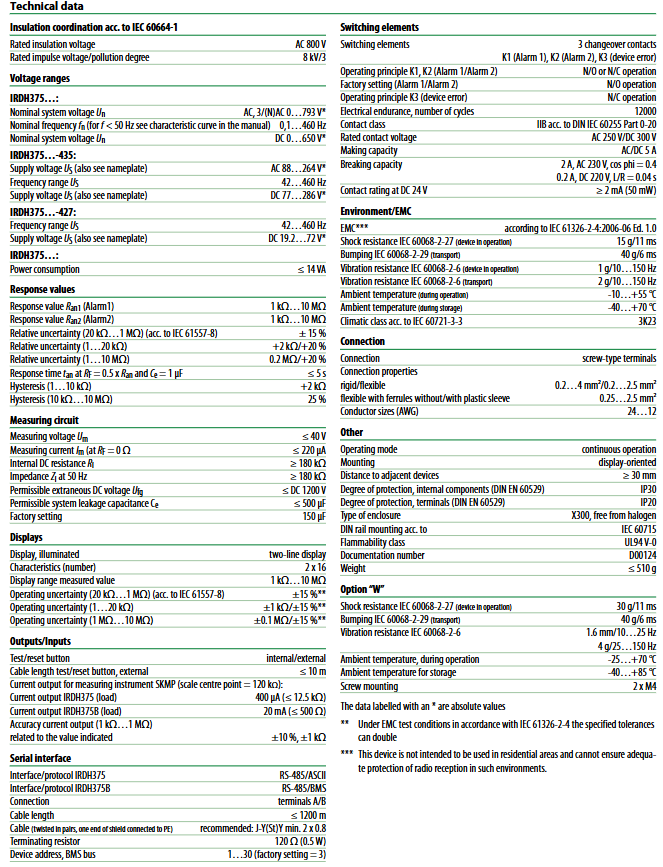
Key performance parameters
Specific parameter specifications for performance categories
When the insulation resistance R_F=0.5 x the set response value R_an and the system leakage capacitance C_e=1 μ F, the response time is ≤ 5s
Measurement accuracy 1k Ω... 1M Ω Range: ± 15% ± 1k Ω; 1k Ω... 10M Ω Range: ± 15% ± 0.1M Ω (compliant with IEC 61557-8 standard)
Electrical durability contact category 12000 IIB (compliant with DIN IEC 60255 Part 0-20); Rated contact voltage AC 250V/DC 300V
Contact capacity AC/DC 5A; 2A at AC 230V, cos φ=0.4; 0.2A at DC 220V, L/R=0.04s; minimum control current ≥ 2mA (50mW)
Environmental adaptability working temperature: -10...+55 ℃ (regular model), -25...+70 ℃ (Option-W model); Storage temperature: -40...+70 ℃ (regular version), -40...+85 ℃ (Option-W version); Climate grade: IEC 60721-3-3 3K23
Anti interference and mechanical performance electromagnetic compatibility (EMC): compliant with IEC 61326-2-4:2006-06 Ed.1.0 standard; Impact resistance: IEC 60068-2-27 (15g/11ms); Anti collision (transportation): IEC 60068-2-29 (40g/6ms); Vibration resistance: IEC 60068-2-6 (1g/10... 150Hz, transportation scenario 2g/10... 150Hz); Option-W enhances impact resistance (30g/11ms) and vibration resistance (1.6mm/10-25Hz, 4g/25... 150Hz) performance
Mechanical specification panel opening size: 138 × 68mm; installation method: DIN rail installation (in accordance with IEC 60715 standard) or screw installation (2 × M4); Shell type: X300 type, halogen-free material; Protection level: IP20 for equipment casing; Weight ≤ 510g; distance between adjacent equipment installations ≥ 30mm
Wiring specification terminal type: spiral terminal; Conductor adaptation: rigid conductor 0.2... 4mm ², flexible conductor (with/without plastic sleeve) 0.2... 2.5mm ²; Suitable for AWG wire gauge: 24... 12; Terminal pairs 10, 11, and 12 must be electrically isolated and must not be connected to PE
Operation and Display Instructions
(1) Operation button function
Core functions of buttons/operating components
INFO key to query standard information; Cooperate with menu operations to achieve function switching
Return to the previous level in ESC menu mode; Confirm parameter changes
Test button to start device self-test; As an up arrow key in menu mode, it is used for parameter changes and menu navigation
The RESET button clears the insulation fault alarm record; As the down arrow key in menu mode, it is used for parameter changes and menu navigation
MENU key activates the menu system; As a confirmation key in menu mode, confirm parameter changes
Alarm LED 1 lights up to indicate insulation fault, reaching the first level warning threshold
Alarm LED 2 lights up to indicate insulation fault, reaching the second level alarm threshold
Device fault LED lights up to indicate a device malfunction (IRDH375 malfunction)
Dual row display screen standard mode displays insulation resistance value and fault information; Menu mode displays parameter configuration interface
(2) Parameter configuration method
Support two parameter configuration methods: one is to operate through the dual row LCD display screen on the device panel in conjunction with functional buttons; The second is to connect to the external control system through the RS-485 interface for remote configuration (in accordance with the corresponding communication protocol). During the configuration process, changes can be confirmed through the ESC key or Enter key, and the operation logic is clear and easy to understand.
- YOKOGAWA
- Reliance
- ADVANCED
- SEW
- ProSoft
- WATLOW
- Kongsberg
- FANUC
- VSD
- DCS
- PLC
- man-machine
- Covid-19
- Energy and Gender
- Energy Access
- Renewable Integration
- Energy Subsidies
- Energy and Water
- Net zero emission
- Energy Security
- Critical Minerals
- A-B
- petroleum
- Mine scale
- Sewage treatment
- cement
- architecture
- Industrial information
- New energy
- Automobile market
- electricity
- Construction site
- HIMA
- ABB
- Rockwell
- Schneider Modicon
- Siemens
- xYCOM
- Yaskawa
- Woodward
- BOSCH Rexroth
- MOOG
- General Electric
- American NI
- Rolls-Royce
- CTI
- Honeywell
- EMERSON
- MAN
- GE
- TRICONEX
- Control Wave
- ALSTOM
- AMAT
- STUDER
- KONGSBERG
- MOTOROLA
- DANAHER MOTION
- Bentley
- Galil
- EATON
- MOLEX
- Triconex
- DEIF
- B&W
- ZYGO
- Aerotech
- DANFOSS
- KOLLMORGEN
- Beijer
- Endress+Hauser
- schneider
- Foxboro
- KB
- REXROTH
- YAMAHA
- Johnson
- Westinghouse
- WAGO
- TOSHIBA
- TEKTRONIX
- BENDER
- BMCM
- SMC
- HITACHI
- HIRSCHMANN
- XP POWER
- Baldor
- Meggitt
- SHINKAWA
- Other Brands
- UniOP
- KUKA
- IBA
- Beckhoff
- ADLINK
-
ABB 3BHE039724R2643 PPD513 AC 800PEC High-Speed Controller for Power Electronic and Excitation Control Systems
-
SHINKAWA FRP 360A - BOARD
-
SHINKAWA IBP-43AM - PCB Board
-
SHINKAWA IBP-42-M - PCB Board
-
SHINKAWA DSP-11C - PCB Board
-
SHINKAWA FRP-341E - BOARD
-
SHINKAWA CPP-111 - PCB Board
-
SHINKAWA FRP-342A - BOARD
-
SHINKAWA FRP-341D - BOARD
-
SHINKAWA MDP-X MDP-135 - PCB Board
-
SHINKAWA MGP-57 - BOARD
-
SHINKAWA FRP-226A - PCB Board
-
SHINKAWA MDP-141 - PCB Board
-
SHINKAWA IOP-188 - BOARD
-
SHINKAWA FRP-341C - BOARD
-
SHINKAWA MDP-90 - PCB Board
-
SHINKAWA CPP-107A - PCB Board
-
SHINKAWA FRP-227A - PCB Board
-
SHINKAWA FRP-249A - PCB Board
-
SHINKAWA MDP-74 - PCB Board
-
SHINKAWA FRP-270 FRP-268 - PCB Board
-
SHINKAWA FRP-386 - PCB Board
-
SHINKAWA ZUP-02C - BOARD
-
SHINKAWA MDP-136A - PCB Board
-
SHINKAWA FRP-259 - PCB Board
-
SHINKAWA JBP-470 - BOARD
-
SHINKAWA MDP-82 - BOARD
-
SHINKAWA FCP-07A - PCB Board
-
SHINKAWA DSP-09A - PCB Board
-
SHINKAWA IOP-178 - PCB Board
-
Nemic-Lambda / Shinkawa VS15C-15 CCB010A UTC-1000 - Power Supply Board
-
SHINKAWA IOP-176A - PCB Board
-
SHINKAWA VM-5C SST-2194-001-P001G - ECCENTRICITY MONITOR
-
SHINKAWA VM-5K SST-2194-001-P001G - VIBRATION MONITOR
-
THK / Shinkawa SRS9M UTC-1000 - Linear Block w/ Rail 26cm
-
Shinkawa JBP-316 P-26-73B-1 P-26-73A-1 UTC-1000 - Board
-
SHINKAWA IOP-215 - BOARD
-
SHINKAWA JBP-268 - PCB Board
-
SHINKAWA ZUP-08 - PCB Board
-
SHINKAWA BCP-05A - BOARD
-
SHINKAWA DSP-15 - PCB Board
-
SHINKAWA FRP-289 - PCB Board
-
SHINKAWA FCP-01 - BOARD
-
SHINKAWA MDP-84 - BOARD
-
SHINKAWA CMU-13A - CAMERA MOTION CONTROLLER
-
SHINKAWA BCP-05D - PCB Board
-
SHINKAWA MDP-FF MDP-87 - Stage Control Board
-
SHINKAWA FRP-342 - BOARD
-
SHINKAWA BCP-05C - BOARD
-
Shinkawa CMU-26A - Camera Control unit
-
SHINKAWA PSP-30 - Welding Machine Control Board
-
SHINKAWA EFU-24 - Spark Generator
-
Shinkawa CMU-27A - Camera Control unit
-
SHINKAWA CMU-44 - Camera Control Unit
-
THK / Shinkawa SRS9M UTC-1000 - Linear Block w/ Rail 21cm
-
TDK-Lambda / Shinkawa VS100B-24 VS100B24 UTC-1000 - Power Supply Board
-
SHINKAWA CMU-34 - Camera Control Unit
-
SHINKAWA FDP-06A - PCB Board
-
SHINKAWA BCP-06A - BOARD
-
SHINKAWA CMU-13A - Camera Control Unit
-
SHINKAWA CMU-31A - Camera Control Unit
-
SHINKAWA VM-5Y1-02/GEM 1594-005-P001G - ECCENTRICITY MONITOR
-
Shinkawa JBP-331 P-26-101B P-26-101A P26101A UTC-1000 - Board
-
SHINKAWA CMU-26 - Camera Control Unit
-
Shinkawa ACB-3000 ACB3000 - Industrial-Grade Automated Friction Bonder
-
Shinkawa SBB-1100 SBB1100 - Stud Bump Bonder Machine
-
Shinkawa ACB-1000 ACB1000 - Super Automated Wire Bonder Machine
-
CKD / Shinkawa FCS500-H6H6 FCS500H6H6 UTC-1000 - Precision Air Source Filter
-
SHINKAWA VM-5H3 1596-001-P002B VM-5Z1 3595-001-P003C - Power Supply Monitor Rack
-
SHINKAWA VM-5H3 2194-001-F004B - Dual Vibration Dual Thrust Monitor Rack
-
Shinkawa EFU-10 - Wire Bonder Spark Generator EFO Box
-
SHINKAWA MP-2S - Overspeed Unit Instruction
-
Shinkawa PK-167B-3 PK-167A-3 10P-10 - PCB Board
-
SHINKAWA VM-3D VM-3E VL VM-3D2 - Vibration Sensor Mit Verlangerungskabel
-
shinkawa FKP-452F2-3 - Sensor
-
shinkawa UTC-1000 ZUP-02B - PCB BOARD
-
SHINKAWA VM-3D VM-3E VL VM-3D2 - VIBRATION SENSOR WITH EXTENSION CABLE
-
Shinkawa E194236-0003 AWM 2464 UTC-1000 - Cable 6&4 Pins Female-Female
-
TDK-Lambda / Shinkawa VS100B-15 VS100B15 UTC-1000 - Power Supply Board
-
Shinkawa FK-202F2-2-1 - Electric Vortex Sensor
-
Marubeni Shinkawa S038493 - Rotary Encoder
-
Shinkawa E194236-0003 AWM 2586 UTC-1000 - Cable 10 & 8 Pins Male-Female
-
National / Shinkawa CAT5E NR3160 UTC-1000 - Ethernet Receptacle Connector Cable
-
Shinkawa LLS2902 E69157 UTC-1000 - Cable 3 Pins Male-Female
-
Shinkawa AWG16 600V UTC-1000 - 5 Pins Cable Female-Female
-
SHINKAWA WK-142K2-2 - Vibration sensors
-
Shinkawa DA-C8-J10 DAC8J10 UTC-1000 - Connector Cable
-
Shinkawa P-27-67B P2767B P-27-67A P2767A UTC-1000 - Circuit Board
-
Taiyo / Shinkawa E67647-WH E67647WH UTC-1000 - Computer Power Cable
-
Shinkawa E66085-H 20276 UTC-1000 - Connector Cable 15 Pins Male-Male
-
Shinkawa P-28-49B JBP-380C P-28-49A BEJ240619A UTC-1000 - Board w/
-
Shinkawa WKN-142K2-2 - 2-Wire vibration transmitter
-
SHINKAWA VM-741 VM-741B - MONITORING SYSTEM
-
Shinkawa FL-202F08R-U2-02-12-10 - Extension probe
-
Shinkawa FK-202F-1-3 FK-202F-2-3 - module
-
Shinkawa CMU-13A CMU13A - Camera Motion Control Unit Cut Cable
-
SHINKAWA VM-5J - DUAL DIFFERENTIAL EXPANSION MONITOR
-
Ebrain / Shinkawa 650-VME08IS-S N6071085 UTC-1000 - Backplane Panel Board
-
Yaskawa Electric / SHINKAWA UGQMEM-06-SW12 MD-11 - Minertia Motor w/ 30 day warranty
-
Shinkawa FL-202F08R-U2-02-12-10 - Extension probe
-
Shinkawa WT-650-16 SP-256A UTC-1000 - Power Source Power Supply AC100V 50/60Hz
-
Yaskawa / Shinkawa UGRMEM-01SSW11 UGRMEM01SSW11 MD-06 - Minertia Motor
-
SHINKAWA FK-452F1 - sensor
-
Shinkawa MS-313 - RPS positioning system
-
Shinkawa Sec M / Rn-ac109-2a - Beschleunigungsmesser
-
Shinkawa PFD80SX UTC-1000 - Power Source Power Supply 80V 1.6A AC100-230V
-
SHINKAWA VL-202A08L-1A72 - Probe extension cable
-
Shinkawa SDP-FA-4.1 - Instruction Manual
-
SHINKAWA VM-5L G0-2 GC6D1377 - Module
-
Shinkawa FRP-184A FRP-111 P-22-17A - Circuit Board
-
Shinkawa CRP-06 PK-189A-3 PK-189B-3 - PCB Board
-
Shinkawa WK-142K2-1 - Vibration Transmitter
-
SHINKAWA VM-5 SST-2194-001-P001G - MAIN BOARD DUAL VIBRATION MONITOR MAIN BOARD
-
Shinkawa SDP-FA-TAPE - Full Automatic Die Bonder Instruction Manual
-
Sanritz Automation / Shinkawa SC2125-0 C12ABP3 SC2125-0-P1 UTC-1000 - Board
-
Shinkawa SDP-FA-4.1 - Die Pickup Unit Instruction Manual
-
Shinkawa E194236-0003 AWM 2464 UTC-1000 - Cable 20 Pins Female-Female
-
IHI / SHINKAWA CQ71SEN004 WK-142K3-3 - 2-wire Transmitter
-
SHINKAWA FK-452F1 - sensor
-
Shinkawa D461256 - Pin Vertical Motion Cam
-
SHINKAWA SE02111-05 STB-FA-IL-7 - Full Automatic Inner Lead Bonder Specifications
-
Shinkawa PSP-25A P-26-58A-3 P2658A3 UTC-1000 - Circuit Controller Board
-
Shinkawa WKN-142K5-2 - Vibration Transmitter
-
Euresys / Shinkawa DAC-422S-A3 DAC422SA3 UTC-1000 - Alpha cPCI Board
-
Shinkawa IL-188-5373-23 IL188537323 - Spare Part
-
Shinkawa FK-202F1-3-1 - Vibration sensor
-
Shinkawa VL-202A08L-1018/BEN - Capteur De Proximite Avec Cable De 9 Metres
-
Shinkawa FK-202F-2-3 - Vibration Transmitter

K-JIANG

Add: Jimei North Road, Jimei District, Xiamen, Fujian, China
Tell:+86-15305925923