

K-WANG


Rexroth EcoDrive 03 Series Drive Controller
Rexroth EcoDrive 03 Drive Controller DKC Series: Technical Analysis and Application Practical Guide
In the field of precision control in modern industrial automation, the performance and reliability of the drive controller, as the core hub connecting the power supply and the actuator, directly determine the efficiency and safety of the entire production system. The Rexroth EcoDrive 03 series drive controller launched by Bosch Rexroth has become the preferred choice for many high-end manufacturing equipment due to its excellent control performance and high flexibility. This article will comprehensively analyze the drive controllers of DKC.3-040, DKC.3-100, and DKC * *. 3-200 models based on detailed technical documents, covering various key links from product identification, technical specifications, safety compliance to installation, wiring, and maintenance. The aim is to provide engineers and technicians with a unique professional operation guide.
Introduction: The industrial benchmark for high-performance drive controllers
The Rexroth EcoDrive 03 series drive controller (DKC series) is an intelligent device designed specifically for complex motion control tasks. This series covers multiple models such as DKC03.3-040 (16A), DKC03.3-100 (40A), and DKC03.3-200 (200A), which can meet a wide range of needs from light load precision positioning to heavy-duty spindle drive. These devices not only comply with strict UL 508 C and CSA C22.2 No. 14-05 standards, but also have strong electromagnetic compatibility (EMC) design, suitable for various industrial environments. This article will delve into how to correctly identify, install, wire, and maintain these high-precision devices to ensure their maximum effectiveness in a safe and compliant environment.
Product Identification and Core Technical Specifications
1. Interpretation of Model Code
Correctly identifying the device model is the first step in selection and maintenance. The model code of EcoDrive 03 follows a specific logic. Taking "DKC 03.3-040-7-FW" as an example:
DKC stands for Drive Controller.
03.3: Represents the series version, where 03 refers to the EcoDrive 03 series.
040: Represents the type of current. The code corresponds to the specific rated current, such as 040 corresponding to 16A, 100 corresponding to 40A, and 200 corresponding to 200A.
7: Represents voltage category.
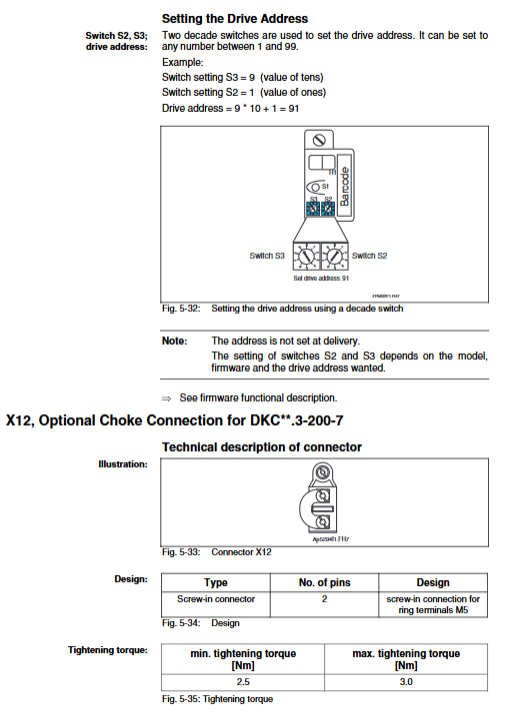
FW stands for Firmware. It should be noted that firmware modules with specified driver functions usually need to be ordered separately, and the driver address is not pre-set at the time of delivery, so it needs to be set through physical switches.
2. Nameplate information
Each device comes with a detailed type nameplate, including barcode, serial number, hardware index, production cycle, part number, and device type. For DKC models, the nameplate will also specifically indicate specific parameter information, which is a key basis for equipment traceability and after-sales support.
3. Core technical parameters and UL/CSA ratings
Understanding technical specifications is the foundation of system integration. The design of this series of drive controllers fully considers North American and international standards:
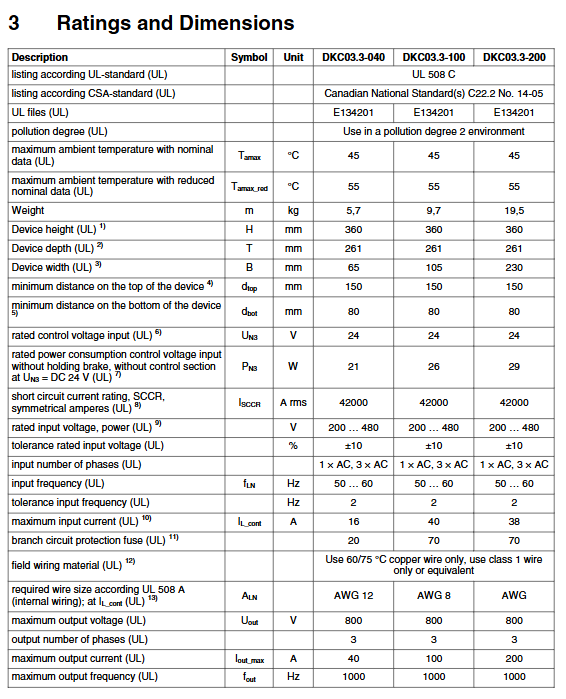
Power and Environment: The equipment is suitable for environments with pollution level 2. Under nominal data, the maximum ambient temperature is 45 ° C; if the rated data is reduced, the maximum tolerance is 55 ° C.
Electrical parameters:
Input voltage: 200... 480 V AC, tolerance ± 10%, supports single-phase or three-phase input (1 × AC, 3 × AC).
Input frequency: 50... 60 Hz.
Maximum output voltage: up to 800 V.
Maximum output current: Depending on the model, they are 40A (040 type), 100A (100 type), and 200A (200 type).
Control voltage: rated 24 V DC.
Short circuit current rating (SCCR): The symmetrical ampere rating (SCCR) of all models is 42000 A rms, indicating their strong short-circuit resistance and suitability for circuits capable of delivering 600V AC or lower voltages up to this value.
Physical dimensions and heat dissipation:
Weight: ranging from 5.7 kg (040 type) to 19.5 kg (200 type).
Installation spacing: In order to ensure heat dissipation, a minimum distance of 150mm must be reserved at the top of the device, and at least 80mm of space must be reserved at the bottom.
Power consumption: Under continuous output current, the power consumption is 180W (040 type), 420W (100 type), and 960W (200 type) respectively, which provides important basis for the heat dissipation design of the control cabinet.
Safety Compliance and Operating Standards
Safety is the lifeline of industrial automation systems. The operation of EcoDrive 03 must strictly follow the safety instructions in the document.
1. Electrical safety and contact protection
There are high-voltage components inside the drive controller, which pose a serious threat to life safety. The operator must:
Grounding requirement: Due to leakage current greater than 3.5 mA, the grounding conductor of the equipment must be non removable and permanently connected. The cross-sectional area of the copper core of the grounding wire shall not be less than 10 mm ², and it must be connected from the main power connection to all motors.
Power off operation: Before touching any components above 50V, the main power must be cut off and measures must be taken to prevent re closing. It is crucial to wait for at least 30 minutes after a power outage to fully discharge the capacitor and measure the voltage to confirm it is below 50V before operation.
Prohibited use of RCCB: Residual current operated circuit breakers (RCDs) cannot be used in this electrical drive system and must be prevented from indirect contact through overcurrent protection devices or other means.
2. Mechanical safety and hazardous movements
Incorrect wiring, parameter input, or sensor malfunction may cause the motor to produce uncontrollable and dangerous movements. To prevent such risks:
External monitoring: Cannot rely solely on the internal monitoring function of the drive. Users must conduct hazard and fault analysis based on specific installation conditions and integrate validated advanced monitoring equipment.
Protective measures: Dangerous areas must be isolated by physical means such as safety fences, protective covers, and light curtains. The emergency stop switch must be installed within reach of the operator and its function must be verified before starting.
Vertical axis safety: The vertical motion axis must have additional mechanical locking, external braking, or balancing devices after power failure, as standard motor braking is not sufficient to ensure personnel safety.
3. Thermal safety and magnetic field protection
High temperature components: The surface temperature of the motor casing, driver, or choke may exceed 60 ° C (140 ° F), and the cooling time after power failure may last up to 140 minutes. Protective gloves should be worn during operation.
Electromagnetic field: Personnel wearing pacemakers, metal implants, or hearing aids are strictly prohibited from entering the equipment operation or storage area to avoid health hazards.
Installation environment and control cabinet design
The correct installation environment is the guarantee for the long-term stable operation of equipment.
1. Electrostatic discharge (ESD) protection
Electronic components are extremely sensitive to static electricity. During installation and operation, all exposed conductive parts (such as human bodies and tools) must discharge static electricity through grounding. It is recommended to use anti-static packaging for storing and transporting sensitive components.
2. Layout and heat dissipation of control cabinet
Multi layer layout: When using multi-layer installation inside the control cabinet, special attention must be paid to the maximum allowable inlet air temperature of the components. When necessary, a dedicated fan should be installed to guide the cooling air and prevent hot air from flowing back to the air inlet of the lower level equipment.
Installation of cooling unit: When using the cooling unit, it is necessary to prevent condensed water droplets from falling onto electronic devices. The fan of the cooling unit must not splash accumulated condensed water onto the equipment. The setting temperature of the cooling unit should not be lower than the maximum ambient temperature to avoid condensation inside the cabinet.
3. Touch protection and shielding
Touch protection: After wiring is completed, appropriate touch protection covers must be installed for each device. The opening on the protective cover should be as small as possible, and damaged protective covers should not be used.
Shielded connection: In order to meet EMC requirements, the shielding layer of all cables (especially motor cables) must be grounded extensively through shielding terminals such as XS1, XS2, XS3, etc. The allowable outer diameter range of the shielding layer varies from 6mm to 35mm, depending on the driver model.
Deep analysis of electrical connections
Electrical connection is a critical link in system debugging, and any negligence can lead to equipment damage or safety accidents.
1. X1 terminal: Control voltage and signal
X1 is the core interface for controlling voltage, using spring contact terminals.
24V power supply: X1.1 (+24V) and X1.2 (0V) are the main power inputs. The loss of control voltage can cause the motor to stop freely without torque, which is an extremely dangerous situation, so it is necessary to ensure reliable power supply. The input terminal allows a maximum current of 10A and can be used to cycle power to other DKC devices.
Prohibit signal (AH) and drive enable (RF):
AH (Drive Halt) is used to stop the shaft with a set acceleration and jerk.
RF (Drive Enable) activates the drive through the 0-1 edge.
Note: These inputs are effective in non bus communication mode and may not be valid in bus communication modes such as SERCOS or Profibus.
Operation preparation contact: This contact provides feedback to the PLC that the driver is ready and can be connected to the main power supply. Its response time shall not exceed 10ms and must be correctly integrated in the control circuit.
2. X5 terminal: DC bus, motor and main power supply
The X5 terminal bears the responsibility of power transmission and adopts threaded connection terminals (M5) with a tightening torque of 2.5-3.0 Nm.
DC bus connection (L+, L -): used to connect multiple controllers or auxiliary capacitor modules. Polarity must be strictly distinguished, reverse connection will cause serious damage. The cross-sectional area of the wiring wire shall not be less than 10 mm ² and shall be equipped with fuse protection.
Motor connections (A1, A2, A3): Rexroth original motor cables must be used. The cable length is limited by the switching frequency and EMC, typically up to 75m at 4kHz. If a longer distance is required, the switching frequency needs to be reduced.
Main power connection (L1, L2, L3): Choose single-phase or three-phase connection according to the power grid situation. The main power connection should not be connected in series between units.
3. X6 terminal: motor temperature monitoring and brake control
The X6 terminal is responsible for the auxiliary functions of the motor and also uses spring contact terminals.
Temperature monitoring (TM+, TM -): used to connect PTC or NTC thermistors inside the motor and evaluate the motor temperature in real time.
Brake control (BR+, BR -): controls the motor to hold the brake. For the DKC03.3-200-7 model, its braking output current can reach 4A, while other models have 2A. The braking voltage needs to be provided externally, usually sharing the power supply with the control voltage, but attention should be paid to the current carrying capacity during line cycling.
4. Protective grounding (XE1, XE2)
XE1 is used for motor grounding, XE2 is used for main power grounding. It is necessary to use wires with a cross-sectional area greater than 10 mm ² and ensure grounding continuity from the main power source to the motor. This is the last line of defense against electric shock accidents.
Maintenance and capacitor discharge safety
1. Discharge of DC bus capacitor
EcoDrive 03 integrates large capacity capacitors as energy storage components internally. Even if the power is cut off, these capacitors may still hold high voltage charges that can be fatal.
Natural discharge: After a power outage, the discharge resistor inside the device will reduce the voltage to below 50V within 30 minutes.
Forced discharge: To shorten the waiting time, an external discharge device can be used. The device connects a 1000 Ω, 1000W resistor to the L+and L - terminals through a contactor.
Operation process:
Install the discharge device before the first power on.
Disconnect the main power supply.
Activate the discharge device.
Be sure to confirm that the voltage is below 50V before any contact operation.
2. Overcurrent protection and fuses
External branch circuit protection must be provided, usually configured with corresponding fuses or circuit breakers based on the maximum input current. For example, for the DKC03.3-200 model, a 70A Class J fuse is required.
- YOKOGAWA
- Reliance
- ADVANCED
- SEW
- ProSoft
- WATLOW
- Kongsberg
- FANUC
- VSD
- DCS
- PLC
- man-machine
- Covid-19
- Energy and Gender
- Energy Access
- Renewable Integration
- Energy Subsidies
- Energy and Water
- Net zero emission
- Energy Security
- Critical Minerals
- A-B
- petroleum
- Mine scale
- Sewage treatment
- cement
- architecture
- Industrial information
- New energy
- Automobile market
- electricity
- Construction site
- HIMA
- ABB
- Rockwell
- Schneider Modicon
- Siemens
- xYCOM
- Yaskawa
- Woodward
- BOSCH Rexroth
- MOOG
- General Electric
- American NI
- Rolls-Royce
- CTI
- Honeywell
- EMERSON
- MAN
- GE
- TRICONEX
- Control Wave
- ALSTOM
- AMAT
- STUDER
- KONGSBERG
- MOTOROLA
- DANAHER MOTION
- Bentley
- Galil
- EATON
- MOLEX
- Triconex
- DEIF
- B&W
- ZYGO
- Aerotech
- DANFOSS
- KOLLMORGEN
- Beijer
- Endress+Hauser
- schneider
- Foxboro
- KB
- REXROTH
- YAMAHA
- Johnson
- Westinghouse
- WAGO
- TOSHIBA
- TEKTRONIX
- BENDER
- BMCM
- SMC
- HITACHI
- HIRSCHMANN
- XP POWER
- Baldor
- Meggitt
- SHINKAWA
- Other Brands
- UniOP
- KUKA
- IBA
- Beckhoff
- ADLINK
-
FANUC A06B-0169-B088 - AC Servo Motor Alpha M40 3000 3 KW
-
ALPHA WIRE 1299C-SLATE-1000 - Multi-Conductor Cable Wire
-
alpha / Wittenstein SK+180S-MF1-10-1M1-1K - Hypoid Gearbox i=10
-
ALPHA WIRE 1181/40C SL005 - Multi-Conductor Cable Wire
-
Generic / DSI Straight Anatomic Plastic Adapter Head + Screw Hex - Dental Implant Fixture
-
Alpha II-650 MV6500526A - Power Supply Unit
-
ALPHA WIRE 7036 WH001 - Hook-Up Wire
-
FANUC RDCGM00000004O / TP 050-MF1-7-061-000 - Gear Reducer / Alpha Gearbox
-
Alpha II-650 MV6500436A - TDK-Lambda Power Supply Unit
-
Alpha S-Alpha600 J60033 - 600W Switching Power Supply Unit
-
Alpha 1500W J00032 - Power Supply Unit
-
Alpha 600W H60638 - Switching Power Supply Unit
-
Alpha 650 MV6500314A - Power Supply Unit
-
Aloka UST-5413 - Linear Probe for Prosound Alpha 6
-
ALPHA WIRE TFT25015 NA002 - High Temperature Heat Shrink Tubing Wire Sleeving
-
JAVAD ALPHA2 / GrAnt-G3 - GPS Receiver
-
Alpha 400W H47318 - Switching Power Supply Unit
-
Alpha SG-ALPHA-202-001 / Q1001-010-001 - Circuit Board Module
-
Antlia Dual ERF H-Alpha & Cak/CaH - Density Astronomical Accessory
-
ALPHA WIRE 5100C SL033 - Multi-Conductor Cable Wire
-
ALPHA WIRE 5098C-SL033 - Multi-Conductor Cable Wire
-
Fanuc A06B-6290-H105 - Alpha Sv 80hv-B Module Servo Amplifier
-
FANUC A06B-6240-H105 - Aux Axis Alpha aiSV 80 Servo Amplifier
-
Endress+Hauser Alpha-Log RSA10-61B1S / 42974737/0130 - Data Logger Measurement Instrument
-
ALPHA WIRE 6363-SL002 - Multi-Conductor Cable Wire
-
Alpha SP100S-MF1-7-1K1-2S - Gear Reducer
-
Alpha SP 100G-MF1-4-0H1-2S-PGG - Planetary Gear Reducer
-
FANUC A06B-0143-B175 #0275 - Alpha 12/3000 AC Servo Motor
-
James Burn Alpha Doc P33 / GBC PDI - Automatic Punch DocuPunch
-
Titus HVAC 105383-01 - ALPHA BAC Controller and Actuator
-
Wittenstein Alpha SP 100S-MF2-20-0E0-2S - Planetary Gearbox i=20
-
Kashiyama Alpha-85-ZV / SP-8026G - Pump Controller
-
Christ Alpha 2-4 LDplus - Freeze Drier Part N/ 101542
-
Lambda / Alpha H40896 - 400W Power Supply Unit
-
Wittenstein Alpha LP-070S-MF1-3-1E1-38 - Planetary Gearbox
-
Matrox / EXO-2480 133-D06-3 / 398-17962-1 - Alpha Numeric PCB Board
-
Fanuc A06B-6096-H204 - Dual Axis Alpha Servo Amplifier Module
-
Alpha Wire 5002C-SL001 - Multi-Conductor Cable 2 Conductors 22AWG 300VAC
-
Alpha 600W H60638 - Switching Power Supply Unit
-
Alpha Scientific Spin Precession Dual Electro Magnet Beam Line Chamber - Electro Magnet Beam Line Chamber
-
ALPHA WIRE 6017C SL005 - Multi-Conductor Cable Wire
-
ALPHA WIRE 65804 SL002 - Multi-Conductor Cable Wire
-
Fanuc A06B-0152-B010 - AC Servo Motor Alpha A30/2000 with Brake
-
ALPHA WIRE 5856-VI001 - Hook-Up Wire
-
ALPHA WIRE M13142-SL001 - Multi-Conductor Cable Wire
-
Alpha & Omega AOZ1017 - 8-Pin SOIC SMD Buck Switching Regulator IC
-
Alpha 600W H67027 CA600 - 600W Switching Power Supply Unit
-
ALPHA WIRE 2845/7-RD001 - Hook-Up Wire
-
Wittenstein Alpha VH+063S-MF1-10-6H1-1K-0C2 - Worm Gear Reducer i=10
-
ALPHA WIRE 2414C SL022 - Multi-Conductor Cable Wire
-
ALPHA WIRE 5672-SL005 - Multi-Conductor Cable Wire
-
BECKHOFF / Alpha AM8021-0B10-0000 + CP 040-MO1-10 - Servo Motor with Planetary Gearbox
-
ALPHA Systems Lab Inc MBA-WV1-F / PCB-WV1-F - PCB Board
-
FANUC A06B-0826-B201 - Alpha P12 AC Spindle Motor
-
WF & HC / Alpha-E 10045 - Tiller Bar Flat Flange Inlet 3150LB 3X 2.5 Inch
-
Seiler Alpha Air 3 - Dental Microscope
-
Alpha 400W H47223 - Switching Power Supply Unit
-
Wittenstein Alpha SP 180S-MC1-5-1M0-2K - Planetary Gearbox
-
FANUC A06B-6117-H211 - Servo Amplifier Module Alpha iSV 160/160 Amp
-
Alpha S-Alpha600 J60033 - 600W Switching Power Supply Unit
-
Adaptive Alpha Eclipse StreetSmart Model 17X - Master Slave LED Sign 44 x 44 Inch
-
ALPHA WIRE 391697-WH005 / 391697WH005 - Hook-Up Wire
-
Generic 22W Laser Engraver Cutter - Smart Air Pump APP Control CNC Dual-core CPU DIY Tools
-
FANUC A06B-6102-H226 / A06B6102H226 - Spindle Amplifier Module
-
FANUC A06B-6090-H006 / A06B6090H006 - Servo Power Supply Module
-
Alpha Wire Apr-19 - High Low Temperature Cable 75 FT
-
Wittenstein Alpha HG+ 075S-MF2-28-6E1-1S10 - Hypoid Gearbox Reducer i=28
-
Alpha J00032 - 1500W Power Supply Unit
-
Alpha H47038 - 400W Power Supply Unit
-
FANUC A06B-6096-H204 - Dual Axis Alpha Servo Amplifier Module
-
Wittenstein Alpha LPB090-MO1-10-111-00 - Alpha Planetary Gearbox
-
ALPHA WIRE 2842/19-YL001 - Hook-Up Wire
-
WITTENSTEIN ALPHA HG+060S-MF1-56C1-1K00 - Planetary Gearbox
-
Basler A102K Alpha VIS - Black and White CCD Industrial Camera
-
Alpha H40935 - 400W Power Supply Unit
-
FANUC A06B-6114-H207 - 2-Axis Servo Amplifier Module SVM20/40i Alpha i Series
-
TDK-Lambda / Alpha H47318 - 400W Switching Power Supply Unit
-
HITACHI Aloka Prosound Alpha 7 Premier - Diagnostic Ultrasound System
-
Alpha SP100S-MF1-4-1E1-2S - Precision Gear Reducer
-
FANUC A20B-2001-0950 - Control Circuit Board PCB
-
ALPHA WIRE 2855/1-GR001 - Hook-Up Wire
-
FANUC A06B-6096-H204 - Dual Axis Alpha Servo Amplifier Module
-
Wittenstein Alpha LPB090-MO1-10-111-00 - Alpha Planetary Gearbox
-
ALPHA WIRE 2842/19-YL001 - Hook-Up Wire
-
Basler A102K Alpha VIS - Black and White CCD Industrial Camera
-
Wittenstein Alpha LP 090-M01-7-111-000 / Schneider - Gear Box i:7 Schneider Electric Servo Motor
-
LAMBDA ALPHA 600W H60554 - Switching Power Supply Unit
-
Fanuc A06B-0238-B100 / A860-2000-T301 - AC Servo Motor with Encoder
-
FANUC A06B-6290-H322 - ALPHA iSV 10/10/10HV-B 3-Axis Servo Drive
-
Polymotor Italiana 9919 121 90332 / Alpha SP75-M1-3 - D.C. Permanent Magnet Motor with Gearbox
-
MJ Research PTC-200 - PCR DNA Engine Thermal Cycler with Dual 48-Well Alpha Block
-
ALPHA WIRE 5002C-SL002 - Multi-Conductor Cable Wire
-
Fluke / Victoreen ASM 990 / 489-110D - Biomedical Radiation Detector Probe with Pelican Case
-
ALPHA WIRE 5855-BK001 - Hook-Up Wire 22AWG Silver Plated Copper
-
Tetra / Alpha 600W H60552 - Switching Power Supply Unit
-
Bruker Alpha FTIR Spectrometer / Alpha-P ATR - Infrared Spectrometer FTIR Instrument
-
Simagic AlphaM-FX-C 290mm FX-C - Formula Steering Wheel with Alpha Mini Wheel Base
-
Alpha Wire 5152C 20/2C - XtraGuard High Performance Instrumentation/Control Cable
-
ALPHA WIRE 1219/40C SL005 - Multi-Conductor Cable Wire
-
ALPHA WIRE 3131441 TN005 - Multi-Conductor Cable Wire
-
ALPHA WIRE 2172-SV005 - Multi-Conductor Cable Wire
-
FANUC A20B-2100-0742 - ALPHA ia Servo Control Board
-
Olympus Endo Alpha Cart TI-A1 - Medical Equipment Cart with Accessories
-
ALPHA WIRE 74010-BK002 - Multi-Conductor Cable Wire
-
Fanuc A06B-6110-H026#N - ALPHA i Power Supply Module PSM-26i
-
Alpha Laval SX2/013 - Rotary Lobe Pump
-
Alpha II-450P MV4500007B - Switching Power Supply Unit
-
TDK-Lambda / Alpha 400W - Switching Power Supply Unit
-
ALPHA ALPHA6000E-3015GB/3018PB - Frequency Inverter Drive Power Converter
-
ALPHA WIRE 391245-WH005 - Hook-Up Wire
-
Alpha H60562 CA600 - 600W Switching Power Supply Unit
-
Fanuc A06B-0147-B675 - Alpha 22/2000 3.8kW 2000rpm AC Servo Motor
-
ALPHA WIRE 9821 - Twinaxial Cable 1PR 25AWG Poly Insulation
-
Fanuc / Alpha A16B-2203-0820 - ALPHA i Spindle Wiring PCB
-
FANUC A20B-2100-0742 - ALPHA ia Servo Control Board
-
Fanuc A06B-6096-H104 - Alpha Servo Module
-
Fuji Electric RYT202D5-VV2 / Faldic Alpha5 - Servo Amplifier
-
ALPHA WIRE 2817/6 20 AWG - PTFE High Temperature Cable
-
Aloka Prosound Alpha 10 / EU-6031C / JB-274D - High Voltage Power Supply for Ultrasound
-
Wittenstein Alpha SP 140S-MF1-5-01F-2S - Planetary Gearbox
-
FANUC A06B-6124-H205 - Alpha iSV Servo Amplifier Module
-
TDK-Lambda / Alpha MV6500314A - 650W Power Supply Unit
-
TDK-Lambda / Alpha H47318 - 400W Switching Power Supply Unit
-
Alpha H47318 - 400W Switching Power Supply Unit
-
CNC Bearing / Alpha AR090-S1-300-20-N - Robotics Bearing Component
-
Alpha CA400 5A,3.3Q,5B,12/12E / DXH47037 - 400W Power Supply Unit
-
FANUC A20B-2100-0742 - ALPHA ia Servo Control Board
-
Fanuc / Amada A04B-0810-C403 / LC1212 alpha II - Pressure Regulator

K-JIANG

Add: Jimei North Road, Jimei District, Xiamen, Fujian, China
Tell:+86-15305925923