

K-WANG


Westinghouse iGen5000 Digital Inverter Generator
Engine parameters: displacement 224cc, spark plug model 97109-F7RTC, electrode clearance 0.024-0.032 inches (0.60-0.80mm), intake valve clearance 0.0031-0.0047 inches (0.08-0.12mm), exhaust valve clearance 0.0051-0.0067 inches (0.13-0.17mm).
Westinghouse iGen5000 Digital Inverter Generator
Core parameters and configuration of the product
1. Core performance parameters
Power specifications: Operating power of 3900 watts, peak power of 5000 watts, rated voltage of 120V, rated frequency of 60Hz, total harmonic distortion ≤ 3%, single-phase output.
Engine parameters: displacement 224cc, spark plug model 97109-F7RTC, electrode clearance 0.024-0.032 inches (0.60-0.80mm), intake valve clearance 0.0031-0.0047 inches (0.08-0.12mm), exhaust valve clearance 0.0051-0.0067 inches (0.13-0.17mm).
Fuel and engine oil: Tank capacity 3.4 gallons (12.8 liters), recommended 87-93 octane gasoline, ethanol content ≤ 10% (E15/E85 prohibited); The oil capacity is 0.63 US quarts (0.60 liters), and the recommended model for regular use is 10W-30. For extreme temperatures, 5W-30, 10W-40, or 5W-30 synthetic oil can be selected.
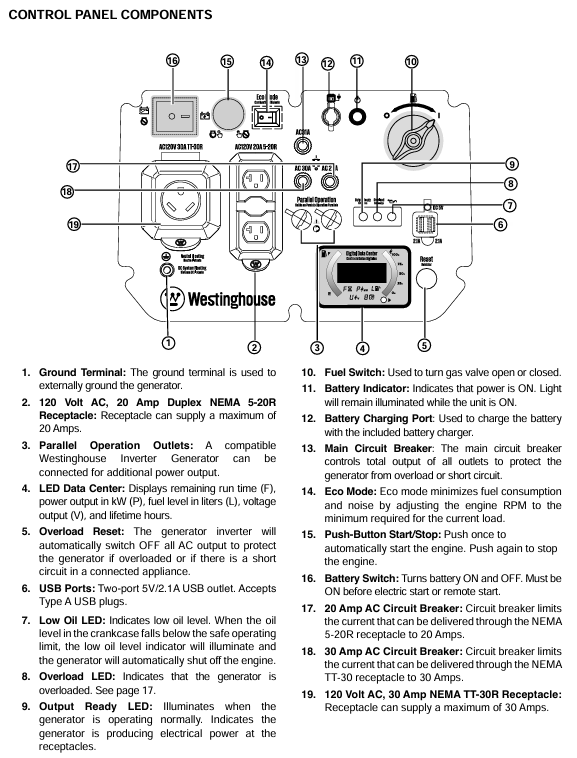
Start and Control: Supports recoil start, electric start, remote start (up to 99 feet/30 meters), equipped with a digital data center that can display remaining operating time, power output, fuel level, voltage, and cumulative operating hours.
2. Key configurations
Control panel: including 120V 20A dual socket (NEMA 5-20R), 120V 30A socket (NEMA TT-30R), USB dual port (5V/2.1A), parallel operation interface, overload reset button, ECO mode switch, etc.
Safety configuration: low oil level indicator light, overload indicator light, output ready indicator light, main circuit breaker and branch circuit breaker, floating neutral grounding system, spark plug lightning arrester.
Portable design: equipped with a retractable handle, transport wheels, and a two person carrying handle, making it easy to move and transport.
Safety operation standards (top priority)
1. Environment and scene security
Only operate in well ventilated outdoor areas, away from closed or semi closed spaces such as doors, windows, ventilation openings, garages, basements, etc., to prevent carbon monoxide poisoning.
Maintain a ventilation gap of at least 5 feet (1.5 meters) around the generator, avoid flammable and combustible materials, and cool for at least 30 minutes after operation before storage or transportation.
Do not use in damp environments (rainy, snowy, or waterlogged), avoid skin contact with engine oil and gasoline, and wear protective equipment during operation.
2. Fuel safety operation
Before refueling, the engine must be turned off and cooled for at least 5 minutes. Smoking or being close to sources of ignition is prohibited to avoid fuel spillage.
Fuel should be stored in approved containers, in a well ventilated area, away from heat and ignition sources, and gasoline should not be used as a cleaning agent.
If there is a fuel leak, it should be wiped clean immediately, and the generator should be started only after the leak area is completely dry. Burning the leaked fuel is prohibited.
3. Electrical safety
It is prohibited to directly connect to the building's power grid unless the conversion switch is installed by a qualified electrician and complies with local electrical regulations.
Only use grounded three core extension cords, tools, and appliances, or double insulated equipment to avoid using worn or damaged wires.
When starting and shutting down the generator, it is necessary to disconnect all load connections and gradually add loads to avoid instantaneous overload.
4. Operation taboos
Not suitable for driving medical support equipment, operation is prohibited when fatigued, under the influence of alcohol, or under the influence of drugs.
During transportation or maintenance, it is necessary to disconnect the spark plug wire and battery connection to prevent accidental starting.
Avoid tilting or flipping the generator to prevent fuel or oil leakage.
Complete operational process
1. Preparation before startup
Check that the generator is placed in a horizontal, dry, and ventilated outdoor area, away from doors, windows, and flammable materials.
Confirm that the oil level is between the L (low) and H (high) marks on the dipstick. If it is insufficient, add the recommended model of oil (new engines do not have oil and need to be refilled for the first time).
Check that the fuel is sufficient, the fuel switch is in the off position, all loads have been disconnected, and the battery switch is in the off state.
Connect battery: Open the battery access cover, ensure the battery is securely fixed, connect the quick connector, and reset the battery cover.
2. Startup steps
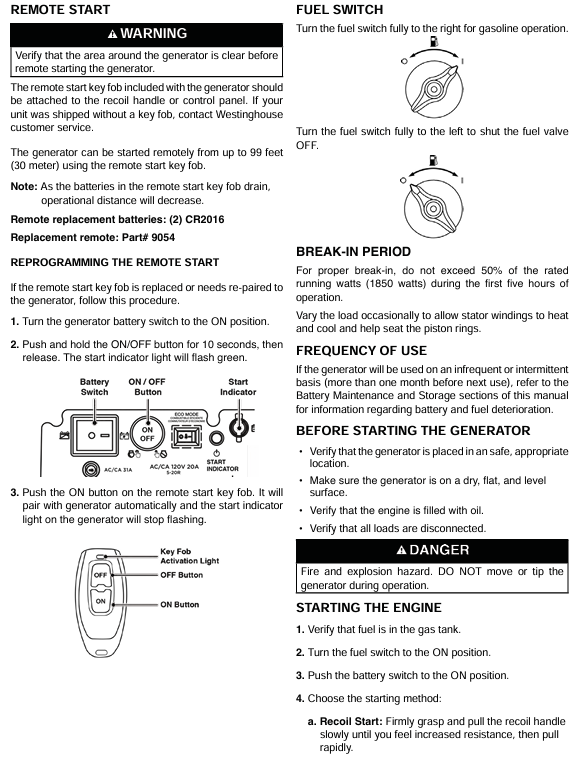
Turn on the fuel switch (clockwise to the ON position).
Turn on the battery switch (press to the ON position).
Choose the startup method:
Backlash start: Slowly pull the recoil handle until resistance is felt, then quickly pull it.
Electric start: Long press the start/stop button on the control panel for 2 seconds.
Remote start: Long press the ON button on the remote control for 1 second (distance not exceeding 99 feet).
Maintenance Plan and Operation
1. Battery maintenance
After running for 30-60 minutes, the generator will automatically charge the battery. If not in use for a long time, the accompanying charger should be used to charge for 8 hours per month (no more than 8 hours to avoid overcharging).
Battery replacement: Disconnect the battery and connect the new battery (part number 511019) to the positive and negative poles (red+, white -). Secure the battery strap and reset the battery cover. Dispose of used batteries according to local regulations.
2. Storage maintenance
(1) Short term storage (<1 month)
Clean the surface of the generator, remove the protective cover of the control panel, store in a dry, ventilated place, away from fire and heat sources.
Keep the battery charged once a month to ensure sufficient power for the next use.
(2) Mid term storage (2-6 months)
Add fresh fuel and fuel stabilizer, run the generator for 5 minutes, and allow the stabilizer to circulate throughout the entire fuel system.
Drain the fuel from the carburetor float chamber to avoid the formation of gum and carbon deposits.
Turn off the battery switch, charge once a month, and cover with a dust cover (plastic cover is prohibited to prevent moisture accumulation).
(3) Long term storage (>6 months)
Drain the fuel from the fuel tank (using a manual fuel pump for extraction, electric fuel pumps are prohibited), and clean the fuel filter.
Drain the fuel from the carburetor float chamber, remove the spark plug, inject 1 teaspoon of engine oil into the cylinder, pull the recoil lever to the piston compression stroke (valve closed), and then install the spark plug (without wiring).
Disconnect the battery, store it separately and charge it regularly. Place the generator in a dry, ventilated, and cool place.
Common troubleshooting
Possible causes and solutions for the fault phenomenon
The engine cannot start due to battery switch OFF, insufficient fuel, or fuel deterioration. Open the battery switch and add fresh fuel. If the fuel deteriorates, empty the fuel tank and clean the fuel system
The air filter is dirty and the low oil level triggers a shutdown for cleaning or replacing the air filter. Add engine oil to the standard level
Wait for 5 minutes until the spark plug is wet (flooded), faulty, or has improper clearance, and then pull the recoil handle to exhaust; Disassemble the spark plug, dry or replace it, and adjust the gap to the specified value
Start the battery with recoil when it runs out of power, or charge it for 8 hours with the included charger
Immediately stop the engine after starting, if there is insufficient fuel, abnormal oil level, or clogged air filter, add fuel, check and adjust the oil level, and clean the air filter
Fuel pollution, low fuel level switch malfunction. Drain the fuel tank and add fresh fuel. If the problem is not resolved, contact customer service
The generator lacks power, the air filter is clogged, the fuel has deteriorated or contaminated. Clean or replace the air filter, empty the old fuel and add fresh fuel
Fuel filter blockage, ignition system malfunction, contact authorized service provider for maintenance
Unstable engine operation/engine shutdown, dirty air filter, generator overload, clean air filter, disconnect partial load, ensure total load does not exceed rated power
Replace or repair faulty equipment due to tool or electrical malfunction, and restart the generator
The overload indicator light of the AC socket without output is on, and the circuit breaker trips to disconnect all loads. Press the overload reset button to reset the circuit breaker and check if the load power exceeds the standard
Output ready light not on, equipment failure. Restart the generator and check if the equipment is normal. If there is still no output, contact customer service
Product registration and after-sales support
After starting, wait for the engine speed to stabilize and the output ready indicator light (green) to light up before connecting the load.
ECO mode on: Only used when there is no heavy load. Press the ECO mode switch, and the engine will adjust its speed according to the load, reducing fuel consumption and noise; When driving large start-up loads such as air conditioning and water pumps, the ECO mode needs to be turned off.
3. Operation and load management
The total power of the load shall not exceed 3900 watts (operating power), and the total starting load shall not exceed 5000 watts (peak power).
Load connection sequence: Start the generator first, connect the maximum load after it stabilizes, and then add other loads in sequence. Connect each load and wait for the generator to stabilize.
Extension cable selection: An outdoor dedicated three core grounding extension cable should be used, and the cable diameter should be selected according to the load current (such as using a 10 gauge cable with a length not exceeding 100 feet for a 20A load).
4. Shutdown steps
Disconnect all connected loads, turn off the electrical switch, and unplug the plug.
Run the generator without load for 3-5 minutes to stabilize the internal temperature.
Press the start/stop button on the control panel for 1 second, or the OFF button on the remote control for 1 second.
Turn off the battery switch (press to OFF position) and turn off the fuel switch (turn counterclockwise to OFF position).
If not used for a long time, the fuel and battery should be disposed of according to storage requirements.
5. Special operation: Parallel operation
Only compatible Westinghouse inverter generators can be connected in parallel, requiring the use of dedicated parallel cables (such as 507PC model).
Operation steps:
Both generators have turned off the fuel switch and ECO mode.
Connect the parallel interface of two generators using parallel cables.
Start one generator first, wait for the output ready light to turn on, and then start another one.
Gradually connect the load, with the total load not exceeding the sum of the power of the two generators.
Attention: Do not enable ECO mode during parallel operation to avoid voltage instability during high load startup.
6. High altitude operations (>2000 feet/762 meters)
High altitude carburetor kit (part number 518913-01) needs to be installed, otherwise it will result in decreased performance and increased fuel consumption.
For every 1000 feet increase in altitude, the power decreases by about 3.5%, and the load needs to be adjusted according to the actual altitude.
Do not use high-altitude kits at low altitudes (<2000 feet) to avoid damaging the engine.

- YOKOGAWA
- Reliance
- ADVANCED
- SEW
- ProSoft
- WATLOW
- Kongsberg
- FANUC
- VSD
- DCS
- PLC
- man-machine
- Covid-19
- Energy and Gender
- Energy Access
- Renewable Integration
- Energy Subsidies
- Energy and Water
- Net zero emission
- Energy Security
- Critical Minerals
- A-B
- petroleum
- Mine scale
- Sewage treatment
- cement
- architecture
- Industrial information
- New energy
- Automobile market
- electricity
- Construction site
- HIMA
- ABB
- Rockwell
- Schneider Modicon
- Siemens
- xYCOM
- Yaskawa
- Woodward
- BOSCH Rexroth
- MOOG
- General Electric
- American NI
- Rolls-Royce
- CTI
- Honeywell
- EMERSON
- MAN
- GE
- TRICONEX
- Control Wave
- ALSTOM
- AMAT
- STUDER
- KONGSBERG
- MOTOROLA
- DANAHER MOTION
- Bentley
- Galil
- EATON
- MOLEX
- Triconex
- DEIF
- B&W
- ZYGO
- Aerotech
- DANFOSS
- KOLLMORGEN
- Beijer
- Endress+Hauser
- schneider
- Foxboro
- KB
- REXROTH
- YAMAHA
- Johnson
- Westinghouse
- WAGO
- TOSHIBA
- TEKTRONIX
- BENDER
- BMCM
- SMC
- HITACHI
- HIRSCHMANN
- XP POWER
- Baldor
- Meggitt
- SHINKAWA
- Other Brands
- UniOP
- KUKA
- IBA
- Beckhoff
- ADLINK
-
Siemens 6SL3244-0SA01-1AA0 - SINAMICS G120 Control Unit
-
DANFOSS 175Z2688 - COATEDE CONTROLUNIT VLT5000
-
SIEMENS 6FM1721-3AA20 - Positioning Module
-
REXORTH VTS0605 PVAR S21 - Drive Module
-
BECKHOFF 2915-0000 - Control Module
-
COOPER EATON CGLine 400 40071347901 - CEAG CG Controller
-
SIEMENS 3UF5031-3AN00-1 - SIMOCODE DP Basic Unit
-
SIGMATEK DNC305 05-011-305 - Drive Controller
-
Multivac MV1 10249768 - Control Module
-
SCHNEIDER ELECTRIC MES114 59646 & 59645 - Circuit Breaker Accessory
-
CAMILLE BAUER CAPAX 44-580-0012 - Transmitter
-
HENGSTLER VT360P LS1/TOK - Encoder
-
BURKERT 8792 - 24V DC IP65 / IP67 Positioner
-
SENSOPART V10-OB-A1-W6 - Vision Sensor
-
ALLEN-BRADLEY 1762-L40BXB SER.C REV.J - MicroLogix 1200 Controller
-
HITACHI CPU22-02HC 33025801-2 - CPU Module
-
HITACHI AGH-0 33034810-2 - Control Board
-
PHILIPS AIH110 VER 1.0 - Control Module
-
BAUMULLER DO8000 - Drive Controller
-
B&R PS477 3PS477.9 Rev.C0 - Power Supply
-
ABB ALFA LAVAL 200-CISB - Communication Interface 2 x SatBus
-
Moeller MI4-570-TA1 - HMI Operator Panel
-
ABB ACH550-01-06A9-4+B055 - Variable Frequency Drive
-
ABB TPU2 3HNE00313-1 REV 12 - Teach Pendant Unit
-
Schneider Electric BRS368H130ABA - Stepper Motor
-
Foxboro FCM100E P0972ZA - I/A Series Communication Module
-
Siemens 6ES7 450-1AP00-0AE0 6ES7450-1AP00-0AE0 - Simatic S7 Version:04 Counter Module
-
Schneider Electric ATV320U07N4W - Altivar Machine Drive
-
Priva TouchPoint Flush V06:02 5060002 - Control Panel
-
Lenze ESMD402L4TXA - 4kW SMD Inverter Drive
-
Lenze ESMD402L4TXA - 4kW SMD Inverter Drive
-
Schneider Electric PM210 PM210MG - Powerlogic Power Meter
-
ASCOM U982-DB/1C U982 - Power Supply / Communication Module
-
DYADIC SYSTEMS SCN5-010-050-S03-NA - Servo Cylinder
-
Reliance Electric GMI-S04 - AC/AC CONVERTER 380/400V 50/60Hz 3.9/5.2A
-
Pro-Face GLC150-BG41-XY32KF-24V 3080060 PFXGLC150BDBP - Touch Screen HMI
-
ROFIN RSL TERMINAL V2 0185.01/03 - TERMINAL
-
HONEYWELL R7241E1077 - Burner Control / Amplifier
-
SEW MM22C-503-00 8241201 - 2.2kW Movimot Drive
-
Brand Digital III 50mL - Burette
-
Danfoss 195N0039 VLT2811PS2B20STR1DBF00A00C0 - 2.4kVA VLT Drive
-
SONY LG10-2 EK1 - Digital Gauge Indicator
-
EMERSON SKD3400750 - 7.5kW AC Drive
-
SIEMENS 6AV6 542-0AG10-0AX0 - MULTIPANEL HMI
-
TELEMECANIQUE ATV21HU55N4 - ALTIVAR21 5.5KW Variable Speed Drive
-
MITSUBISHI A985GOT-TBA-EU - GOT900 Touch Screen HMI
-
SCHNEIDER LXM32AD30N4 - Lexium 32 Servo Drive
-
SICK PSR01-1501 M20Z-02550A122 - Safety Laser Scanner
-
GECMA CHALLENGER 15-2-FMO - LITE TOUCH Monitor
-
Uniop EK02 6ZA982 - HMI Operator Panel
-
TELEMECANIQUE ATV18U54M2 - SQUARE D ALTIVAR 18 3kW Drive
-
Schneider Electric ATV312HU75S6 - 7.5kW Altivar 312 Drive
-
Siemens 6GK7243-5DX30-0XE0 6GK7 243-5DX30-0XE0 - Communications Processor
-
Schneider Electric LV432455 VIGI630 - 3POLE Earth Leakage Module
-
Rexroth PSI 6100.750 L1 R911170694-107 - frequency inverter / inverter
-
SWEDISH MICROWAVE AB Ku-Band BDC 138010-45-D0 - Block Downconverter
-
METTLER TOLEDO IND429 IND429-BB30 - Weighing Terminal
-
Siemens 6SL3210-5HE10-4UF0 - Sinamics V90 Servo Drive
-
B&R X20CP0482 Rev.D0 - X20 CPU Module
-
Mitsubishi FR-E720S-110SC-EC FRE720S110SCEC - 31A~11A Drive With Filter
-
ABB ACH580-01-026A-4 - Variable Frequency Drive
-
Siemens 6SL3210-1KE13-2AP1 - SINAMIC G120CDP 1.1kw Drive
-
Schneider Electric TM250D 4P3D LV431440 - Compact NSX250 Circuit Breaker
-
RELIANCE ELECTRIC GD.722.81.00-A 802288-74C - MAXITRON Servo Control Card
-
Uniop EK02 6ZA982 - HMI Operator Panel
-
Siemens 6SE9113-7JA13 - MICRO MASTER Junior 1.5kW Inverter
-
Mitsubishi FR-E720S-110SC-EC FRE720S110SCEC - 31A~11A Drive with Filter
-
Johnson Controls FEC2621 MS-FEC2621-0 - Field Equipment Controller
-
BENDER IR475LYT-429 - A-ISOMETER Insulation Monitor
-
Berger lahr D550 RS15 22.550-00-30b - Stepper Drive
-
Rexroth PSI 6100.750 L1 R911170694-107 - Frequency Inverter / INVERTER
-
KOYO 205 D2-06B-1 D2-240 H2-ECOM D2-08ND3 F2-08TRS - DIRECT LOGIC PLC WITH MODULE
-
TELEMECANIQUE ATV18U54M2 ATV18U54M - SQUARE D ALTIVAR 18 3kW Drive
-
Lenze 471-E1.D - Board / Controller Speed
-
Mitsubishi FR-A740-00038-EC - Frequency Inverter
-
Johnson Controls IOM3723 MS-IOM3723-0 - Input/Output Module
-
CURTIS 1238-5602 - AC Motor Controller
-
FOXBORO P0912XX REV.A - 220VAC Power Supply
-
Siemens 6SE9113-7JA13 - MICRO MASTER Junior 1.5kW Inverter
-
Mitsubishi FR-A740-00038-EC - Frequency Inverter
-
KOYO 205 D2-06B-1 D2-240 H2-ECOM D2-08ND3 F2-08TRS - DIRECT LOGIC PLC WITH MODULE
-
AUTZ M406D-00101 - Servo Motor
-
Lauer PCS095 PG095.508.BB - Operator Panel
-
ABB SCOP45SB/DX232 - SattCon OP45 SB Operator Panel
-
SEW Eurodrive MCH42A0030-5A3-4-00 MDX60A0030-5A3-4-00 - 4.8kVA Movidrive Inverter
-
BENDER IR475LYT-429 - A-ISOMETER Insulation Monitor
-
Johnson Controls FEC2621 MS-FEC2621-0 - Field Equipment Controller
-
Johnson Controls IOM3723 MS-IOM3723-0 - Input/Output Module
-
Berger lahr D550 RS15 22550-00-30b - Stepper Drive
-
SIEMENS 6FX1120-4BD03 6FX11204BD03 5702049304.00 E-Stand: A - Sinumerik Module
-
Allen-Bradley 1771-NIV B - HIGH RESOLUTION ISOLATED ANALOG SERIES Module
-
HONEYWELL XFC2D06001 - Flow Computer / Controller
-
Contraves Varidyn Compact ADB 380.90M - DC Drive 380v - 400v 90A 50kVA
-
Red Lion Control GEM52000 - Control Module
-
Siemens 6ES5 955-3NC13 - modular power supply TYPE:DIN41752
-
Danfoss ICV50 G20Mn50T / 027H5200 - Valve zaw
-
Eberle PLS508 P-814 / 2X EA-88 / A-812 / MT-81 / S-11 - PLC with Modules
-
Siemens 6ES7 314-6CF01-0AB0 6ES7314-6CF01-0AB0 - SIMATIC CPU314C-2 DP
-
EBERLE EM-525-87 EM52487 - ICE DETECTOR BASE UNIT
-
Telemecanique / Schneider TSXRKZ02 - TSX Micro automation plus 7module
-
B&R 5DLSDL.1001-00 - Display Link Receiver
-
Siemens 6FX1120-4BD03 6FX11204BD03 5702049304.00 E-Stand: A - Sinumerik Module
-
ALLEN-BRADLEY 1771-NIV A - HIGH RESOLUTION ISOLATED ANALOG SERIES Module
-
ALLEN-BRADLEY 1771-NIV B - HIGH RESOLUTION ISOLATED ANALOG SERIES Module
-
Contraves Varidyn Compact ADB 380.90M - DC Drive 380V - 400V 90A 50kVA
-
Contraves Varidyn Compact ADB 380.90M - DC Drive 380V - 400V 90A 50kVA
-
Ropex RES-202 - Resistron Temperature Controller
-
HONEYWELL XFC2D06001 - Flow Computer / Controller
-
Telemechanics ATV452U40 - DIMMER ALTIVAR5 SERIES 452 4kW 5HP Frequency Inverter
-
VEGA VEGAPLUS61 PS61.XXAGPHAMAX - Radar Level Sensor
-
BRANSON ULTRASONIC TRANSDUCER - Ultrasonic Transducer
-
Danfoss ICV50 G20Mn50T / 027H5200 - Valve Valvola Zaw
-
Schneider Electric 2001549/1 GALAXY PW 5102851200 NT07 - panler card
-
REXROTH VT3006-36 A - Proportional Valve Amplifier
-
Allen-Bradley 1746-OBP16 SERIES:C - SLC 500 OUTPUT MODULE
-
SCHNEIDER LXM32MD12N4 - Lexium 32 Servo Drive
-
Schneider Electric ATV630U22N4 - 2.2KW Altivar Process Drive
-
Allen-Bradley 1746-OBP16 SERIES:C - SLC 500 OUTPUT MODULE
-
Vanderlande 0E2550-00002... - Bagtrax Integrated Power Module 400V 32A
-
B&R X20CP0410 Rev.D0 - X20 CPU Module
-
VANDERLANDE 0E2550-00002 02EDD2B0100 - BAGTRAX Integrated Power Module 400V 32A
-
Rexroth R061205010 - Linear Bushing / Bearing
-
INDRAMAT TVM1.2-50-220/300-W0-220/380 - Power Supply Module
-
Vanderlande 0E2550-00002... - Bagtrax Integrated Power Module 400V 32A
-
HOMAG KEB 07F5S1A-YA00 09E5T60-1001 - Combivert Inverter WITH KEYPAID AND FILTER
-
Siemens 3RW3047-1BB14 - Soft Starter
-
Sumitomo AF-500 AF502-A40 - 0.4kW Transistor Inverter
-
Sumitomo AF-500 AF502-A40 - 0.4kW Transistor Inverter

K-JIANG

Add: Jimei North Road, Jimei District, Xiamen, Fujian, China
Tell:+86-15305925923