

K-WANG
+086-15305925923
Service expert in industrial control field!


Product
Article
NameDescriptionContent
Adequate Inventory, Timely Service
pursuit of excellence


Ship control system
Equipment control system
Power monitoring system
Brand
Product parameters
- Telephone:+86-15305925923
- contacts:Mr.Wang
- Email:wang@kongjiangauto.com
Description
Product package
Contents of the product package:
• UNITROL 1000 series AVR
• Special red USB cable that is used to power and to connect with the AVR.
Keep this USB cable in a safe place.
• Red jumper blocks (3 pcs.)
• Quick installation guide and test certificate
Make sure that all of the listed items are in the product package and that there is
no damage to the items.
Hardware overview
Primary parts of the AVR. Refer to the User Manual for more information
ABB UNITROL1020 EXCITATION SYSTEMS
Safety instructions
Read the safety instructions in the User Manual.
WARNING!
• Obey the safety instructions to prevent physical injury or death, or
damage to the equipment.
• Read and make sure that you understand the operating and safety
instructions before you operate the unit.
• If you are not a qualified electrician, do not do electrical installation or
maintenance work.
• Use personal protective equipment, such as, safety shoes and gloves.
Obey these safety precautions before you do work on the system:
1. Clearly identify the work location and equipment.
2. Disconnect all possible voltage sources. Make sure that reconnection is not
possible. Lock out and tag out.
• Open the main disconnecting device of the AVR.
• Disconnect any external power sources from the control circuits before
you do work on the control cables.
• If you have a permanent magnet generator connected to the AVR,
disconnect it from the AVR with a safety switch or by other means.
• After you disconnect the AVR, always wait for 5 minutes to let the
intermediate circuit capacitors discharge before you continue.
• Do not do work on the AVR when the amber warning LED flashes.
3. Protect any other energized parts in the work location against contact.
4. Take special precautions when you are near bare conductors.
5. Measure that the installation is de-energized.
• Use a multimeter with an impedance of at least 1 Mohm.
• Make sure that the voltage between the AVR input power terminals
(PWR L1, PWR L2 and PWR L3) and the grounding terminal (PE) is near
0 V.
• Make sure that the voltage between the AVR output terminals (IE+, IE and ExCap) and the grounding terminal (PE) is close to 0 V.
6. Install temporary grounding as required by the local regulations.
7. Ask for a permit to work from the person in control of the electrical
installation work.
Residual danger areas
WARNING! Do not do work on the AVR when the amber warning LED
flashes.
When the AVR operates,
• The voltage in the power section can be up to 300 V AC and the short-circuit
current is very high.
• The voltage in the control cabinet is more than 50 V.
When the AVR is disconnected from power supplies, the large capacitors in the
AVR hold a charge for some time. Wait for at least 5 minutes for the capacitors
to discharge before you do work on the AVR. An amber warning LED flashes if
the internal voltage is more than 30 V DC.
Warning labels are attached to all of the cubicle doors to warn personnel against
opening the doors during operation.
If the device is built into a larger system, additional warning labels are attached
to the inside of the cubicle doors and to the covers of the power converter
modules.
Consider the residual danger areas when you do work on the excitation system:
• Danger from live equipment inside the excitation system, if the protective
covers are removed.
• Hazardous voltages from the rotor field winding and the secondary side of
the excitation transformer.
• Danger from charged capacitors if a cabinet door is open immediately after
the system stops.
• Danger from main and auxiliary voltages when cubicle doors are open.
Introduction
This document is a quick installation guide for the UNITROL 1010 and
UNITROL 1020 automatic voltage regulator. Make sure that you read and
understand this document before you install or use the product. This document
is meant only as a brief guide to the product. For detailed information on the
product, refer to the User Manual.
Device description
UNITROL 1010 and UNITROL 1020 are automatic voltage regulators (AVR) for
synchronous machines of up to 80 MVA. The AVRs can be used for the excitation
of indirectly excited synchronous machines and motors. The AVRs can also
operate as a reactive power regulators, power factor regulators or field current
regulators.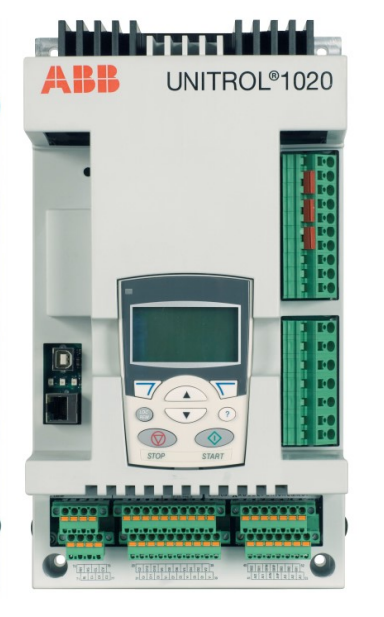
Product package
Contents of the product package:
• UNITROL 1000 series AVR
• Special red USB cable that is used to power and to connect with the AVR.
Keep this USB cable in a safe place.
• Red jumper blocks (3 pcs.)
• Quick installation guide and test certificate
Make sure that all of the listed items are in the product package and that there is
no damage to the items.
Hardware overview
Primary parts of the AVR. Refer to the User Manual for more information.
Warning and status indicators
Mechanical installation
For detailed information on mechanical installation, refer to the User Manual.
Install the AVR in an indoor area that is dry and dust-free, and that does not
contain volatile gases, acid fumes or similar hazards.
Examine the installation area and refer to technical data to make sure that:
• The maximum ambient temperature is in the permitted range.
• The vibration is limited and within the permitted class.
• The ingress protection and pollution degree are suitable.
• The EMC environment is suitable.
Installation requirements:
• Install the AVR vertically to make sure that cooling operates correctly.
• Free space requirements:
• 50 mm above the AVR
• 20 mm below the AVR
• 10 mm on the left and right sides of the AVR
• Make sure that there is sufficient cooling air flow around the AVR.
• Make sure that other devices do not blow hot air on to the AVR.
• The AVR is designed to be installed with suitable hardware to an installation
plate.
• Make sure that the frame of the AVR is electrically grounded (PE) to the
installation plate with a grounding wire (≥4 mm2) through a mounting hole.
Use toothed washers to get a good electrical ground contact.
Installation procedure:
1. Refer to Dimensions for the mounting hole dimensions.
2. Make the appropriate holes in the installation plate.
3. Attach the AVR to the installation plate with suitable hardware, for example,
M6 screws to a torque of 10 Nm. The mounting holes have a diameter of
6.5 mm.
4. Make sure that there is a good electrical ground connection between the
installation plate and the AVR. The installation plate must be electrically
grounded (PE).
Electrical installation
For detailed information on electrical installation, refer to the User Manual.
CAUTION! Separate control (I/O) cables from the excitation (power and
measurement) cables to avoid electromagnetic interference.
Cable dimension requirements:
Grounding
Connect the AVR to the protective earth at terminal 17 with a 4 mm2 grounding
wire.
Make an additional grounding connection through the mounting holes to the
installation plate (if it is connected to the protective earth) or with a 4 mm2
cable to the protective earth.
Make sure that the grounding connections are as short as possible.
Additional signal ground terminals are provided for the control cables.
Inrush current limitation
The large internal DC capacitor of the AVR can cause a high inrush current
especially with a strong voltage source.
WARNING! To prevent damage to the AVR, make sure that the inrush
current is not more than 200 A for 10 ms.
To prevent damage to the AVR from a high inrush current:
To calculate the inrush current, you can use a capacitor voltage of 0 V at startup.
The external resistor for a 200 V AC input is typically 1.5 Ω.
Power and measurement terminals
1) To reduce wiring, you can connect each phase of the excitation power inputs
(PWR) and auxiliary power supply inputs (AUX) with the included jumpers.
Commissioning
For detailed instructions on commissioning, refer to the User Manual.
Commissioning procedure overview:
1. Make sure that all of the connections are correct and safe.
2. Download the configuration file to the AVR. Make sure that the parameters
are correct.
3. Examine the digital and analog I/Os in standstill.
4. Do tests with the machine:
a) Standstill
• Measure resistance of exciter stator winding.
b) No load condition
• Increase the speed of the machine to nominal.
• Start excitation in Manual mode and increase the manual setpoint until
machine voltage is 50%.
• Use CMT 1000 to verify the AVR measurements and compare them with
other equipment used, such as protection devices.
• Increase the setpoint until the machine voltage is 100% and tune the
AVR with the AVR tuning assistant.
• Do step response tests to examine performance in Manual mode and
Auto mode.
c) Machine connected to grid
• Select AUTO (voltage regulator).
• Increase the AUTO setpoint to verify the polarity of the of IM
measurement. Q must increase.
d) Do step response tests to examine performance in Auto mode and direct
VAR regulator modes.
5. Finalizing commissioning
a) Save the parameters on the AVR and verify the status with CMT 1000.
b) Save backup files for project documentation.
Purchase history
| User name | Member Level | Quantity | Specification | Purchase Date |
|---|
Total 0 Record
Related products
Customer Reviews
Satisfaction :
5 Stars
No evaluation information


- LTI Drives
- other
- ADLINK
- Beckhoff
- Shinkawa
- Other Brands
- AMAT
- Iba
- PEPPERL+FUCHS
- Aerotech
- WATLOW
- MAN
- ADVANCED
- Abaco
- YOKOGAWA
- KOLLMORGEN
- MEGGITT
- kong-sberg
- METSO
- Motorola
- NI
- OEMAX
- RELIANCE
- scanlab
- schneider
- uniop
- Vibro-Meter
- Honeywell
- Rolls-Royce
- MOOG
- GE
- B&R
- Woodward
- Yaskawa
- xYCOM
- Siemens
- Emerson
- HIMA
- Bently
- ZYGO
- FOXBORO
- OMACO
- PROSOFT
- ENTERASYS
- TRICONEX
- Parker
- Lenze
- KEBA
- Alstom
- CTI
- ABB
- A-B
172

-
 SIGMATEK TAE 1941 Touch Display Unit
 -
 SIGMATEK TAE 151 Touch Display Unit
 -
 SIGMATEK AKM series servo motor
 -
 SIGMATEK S-DIAS Control System
 -
 SIGMATEK Human Machine Interface (HMI)
 -
 SIGMATEK DIAS Drive 310-23 servo amplifier
 -
 SIGMATEK CCP 521 C-DIAS processor module
 -
 MEGMEET L6 series electric drive
 -
 Sysmex XN-1000/XN-2000 Hematology Analyzer
 -
 Sysmex XN-L series (XN-530/XN-430/XN-330) fully automatic blood cell analyzer
 -
 Sysmex XN-9000 Series Fully Automated Blood Analysis Pipeline
 -
 LTI‑Motion ServoOne Field Bus Systems PROFIBUS and PROFINET
 -
 Micro Innovation MICRO PANEL GF1 Color Touch Human Computer Interface
 -
 Micro Innovation WINbloc Distributed Remote I/O System
 -
 Micro Innovation MICRO PANEL GS-2 Industrial Touch Visualization Operation Panel (HMI)
 -
 LTi LST/LSH series synchronous servo motor
 -
 LTi CDE/CDB3000 positioning controller
 -
 ENOTEC SILOTEC ® Installation and Operation Instructions for 8000 Silo Monitoring O ₂/CO ₑ Analyzer System
 -
 ENOTEC ENSITU ® 7000 Compact Oxygen Transmitter Probe
 -
 ENOTEC COMTEC ® Installation and Operation Instructions for 6000 ATEX GasEx Explosion proof O ₂/COE Analyzer System
 -
 ENOTEC Integrated Products
 -
 ENOTEC OXITEC ® 500E Extraction Oxygen Analyzer
 -
 KUKA KR CS Box-2 Compact Controller for Four Axis SCARA Robot
 -
 KUKA KR C5 slim-2 Robot Controller
 -
 KUKA KR C5 micro With KUKA System Software (KSS/VSS) Assembly Instructions
 -
 KUKA KR C5 micro controller
 -
 KUKA KR C5 Controller Assembly Instructions
 -
 KUKA KR C5 compactcab and KR C5 small-size cab cabinets
 -
 KUKA KR C4 smallsize-2 small robot control cabinet
 -
 KUKA KR C4 Midsize/KR C4 Midsize CK Assembly Manual
 -
 ENOTEC ® Installation and Operation Instructions for 5000/5000+Oxygen Analyzer System
 -
 KUKA KR C4 extended; KR C4 extended CK Assembly Instructions Assembly Manual
 -
 Assembly/Installation Manual for KUKA KR C4 Compact Control Cabinet
 -
 KUKA Sunrise Cabinet Med Medical Collaborative Robot Special Control Cabinet
 -
 KUKA Sunrise Cabinet Next Generation Small Control Cabinet
 -
 KUKA KR C4 Smallsize-2 family's smallest control cabinet
 -
 KUKA KR C4 midsize; KR C4 midsize CK medium-sized control cabinet
 -
 KUKA KR C4 extended is a high-power multi axis control cabinet
 -
 General installation and operation instructions for KUKA KR C4 and KR C4 CK controllers
 -
 KUKA KR C4 compact controller operation instructions
 -
 Installation and Operation Instructions for KUKA Robot Arm
 -
 KUKA TITAN-2 Ultra Ground Overloading Six Axis Robot
 -
 Assembly instructions for KUKA KR SCARA-2 CS series robotic arm body
 -
 KUKA MA KR SCARA X Installation Guide
 -
 KUKA KR FORTEC-2 Ultra Heavy duty Ground Six Axis Robot Mechanical Assembly Manual
 -
 KUKA KR FORTEC-2 new generation heavy-duty ground six axis robot
 -
 KUKA Robots KR 1000 titan; KR 1000 L750 titan With F Variants Assembly Instructions
 -
 KUKA KR 600 FORTEC heavy-duty six axis ground mounted industrial robot
 -
 KUKA KR 500 MT FORTEC Heavy duty Six Axis Industrial Robot
 -
 KUKA KR 360 FORTEC Heavy duty Six Axis Industrial Robot
 -
 KUKA Sunrise Cabinet Med Medical Edition Robot Controller User Manual
 -
 KUKA Robots KR SCARA HO Assembly Instructions
 -
 KUKA Robots KR QUANTEC-2 PA Assembly Instructions
 -
 KUKA Robots KR QUANTEC-2 K and KR QUANTEC-2 P With K-F and P-C Variants Assembly Instructions
 -
 KUKA Robots KR QUANTEC-2 HO Assembly Instructions
 -
 KUKA Robots KR QUANTEC-2 HC Assembly Instructions
 -
 KUKA KR QUANTEC-2 series heavy-duty ground mounted six axis industrial robot
 -
 KUKA KR QUANTEC PA series heavy-duty palletizing robot
 -
 KUKA KR IONTEC-2 series six axis industrial robot
 -
 KUKA KR IONTEC ultra series six axis heavy-duty industrial robot
 -
 KUKA KR IONTEC HO Robot Assembly Manual
 -
 KUKA Robots KR CYBERTECH-3 HW Assembly Instructions
 -
 KUKA Robots KR CYBERTECH-3 Assembly Instructions
 -
 KUKA Robots KR CYBERTECH-2 arc Assembly Instructions
 -
 KUKA Robots KR CYBERTECH nano-2 Assembly Instructions
 -
 KUKA KR CYBERTECH CR HO (KR 20 R1810-HO) assembly instructions
 -
 KUKA Robots KR CYBERTECH With F variant Assembly Instructions
 -
 KUKA KR CYBERTECH CR (KR 20 R1810-CR) Clean Room (CR) Version 6-Axis Industrial Robot
 -
 KUKA KR AGILUS-3 ultra series small six axis serial robot
 -
 KUKA KR 300 R2700-2 C-F Cast Ceiling Mounted 6-Axis Heavy duty Industrial Robot
 -
 KUKA KR 20 R1820-2 E Six Axis Industrial Robot
 -
 Assembly instructions for KUKA KR AGILUS-3 small six axis robot
 -
 KUKA KR AGILUS-2 New Generation Small Six Axis Robot
 -
 KUKA KR 1000 1300 titan PA; KR 1000 L950 titan PA With F Variants Assembly Instructions
 -
 KUKA KR 700 PA/KR 700 PA Arctic Installation Guide
 -
 KUKA KR 18 R1450-3 PP six axis ground mounted industrial robot
 -
 KUKA 12 SCARA Series 4-axis SCARA Horizontal Joint Robot
 -
 KUKA KR 4 R600 Small Six Axis Industrial Robot
 -
 Installation Guide for KUKA KR 3 R540 Small 6-Axis Industrial Robot
 -
 KUKA LBR iiwa CR Clean 7-Axis Lightweight Collaborative Robot
 -
 KUKA KR AGILUS sixx series six axis industrial robot operation instructions
 -
 KUKA 4-axis heavy-duty SCARA horizontal multi joint robot KR 60 R1200 Z400 CS
 -
 KUKA KR 23 SCARA-2 CS SCARA Horizontal Multi Joint Robot
 -
 KUKA KR 20 SCARA CS Robot Assembly Instructions
 -
 KUKA KR 15 DELTA-2 Assembly Manual
 -
 KUKA KR 13 SCARA-2 CS Assembly Manual
 -
 KUKA KR 3 D1200 (Standard Delta Robot) Assembly Instructions
 -
 KUKA KR 3 D1200 HM Assembly Manual
 -
 KUKA LBR Med 7 R800, LBR Med 14 R820 Medical Edition Robot
 -
 KUKA Robots LBR iiwa 7 R800, LBR iiwa 14 R820 Operating instructions
 -
 KUKA LBR iiwa CR (Clean Room Version Robot) Operating Instructions
 -
 Lauer PCStopline series text operation panel
 -
 KUKA LBR iisy (MA_LBR_iisy V5) assembly manual
 -
 KUKA LBR iisy 3 R760 Assembly Manual
 -
 KUKA LBR iico Collaborative Robot Assembly Manual
 -
 Lauer LCAstarline (LCA300/LCA320/LCA325) Text Display Screen
 -
 Lauer PCS950/PCS950c/PCS950e operation console
 -
 Lauer EPC Series Industrial Embedded Human Computer Integrated PC User Guide
 -
 Bonfiglioli Precision Planetary Gearbox TIR-STD ENG R07
 -
 Bonfiglioli ACT/ACU Cold Plate Inverter Installation Instructions
 -
 Bonfiglioli EM-RES-02 Expansion Module
 -
 Bonfiglioli EM-RES-01 Expansion Module
 -
 Bonfiglioli EM-IO-04 Expansion Module
 -
 Bonfiglioli EM-IO-03 Expansion Module
 -
 Bonfiglioli EM-IO-02 Expansion Module
 -
 Bonfiglioli Vectron EM-IO-01 Expansion Module
 -
 Bonfiglioli F series gearbox
 -
 Installation, operation, maintenance, and spare parts of Bonfiglioli HF series reducers
 -
 Installation, Operation, and Maintenance of Bonfiglioli 300-300M Series ATEX Reducer
 -
 Bonfiglioli R3 series planetary gearbox
 -
 Bonfiglioli C series inline helical gear explosion-proof reducer
 -
 Bonfiglioli EM-ENC-05 Expansion Module
 -
 Bonfiglioli EM-ENC-04 Expansion Module
 -
 Bonfiglioli EM-ENC-03 Expansion Module
 -
 Bonfiglioli EM-ENC-02 Expansion Module
 -
 Bonfiglioli CM-CAN CANopen communication module
 -
 Bonfiglioli EM-SYS System Bus Expansion Module
 -
 Bonfiglioli CM-PDP Profibus DP Communication Module
 -
 Bonfiglioli CM-232/CM-485/CM-485T Modbus Communication Manual
 -
 Bonfiglioli BMS series precision planetary servo reduction motor
 -
 Bonfiglioli ACTION series ACT210 (230V), ACT410 (400V) frequency converter operation manual
 -
 Bonfiglioli ACT series frequency converter
 -
 Bonfiglioli HDP/HDO series gear unit IOM installation, operation and maintenance instructions
 -
 Installation, operation, and maintenance of Bonfiglioli 300-300M series reducers
 -
 Bonfiglioli 300M Modular planetary gearboxe
 -
 Bonfiglioli 3/H series heavy-duty modular gearbox
 -
 Bonfiglioli KRG-KCG-KSD hydraulic coupling
 -
 Bonfiglioli Vectron BTD-BCR servo motor

K-JIANG

Add: Jimei North Road, Jimei District, Xiamen, Fujian, China
Tell:+86-15305925923